
How an Aluminium Composite Panel Manufacturer Makes ACP Sheets
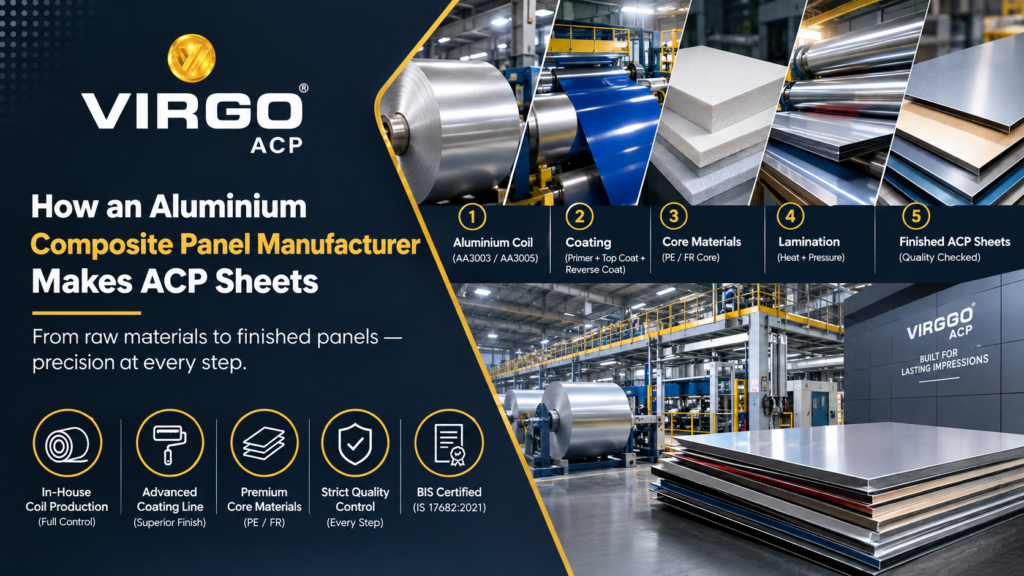
A quality audit comparing two operations reveals something most buyers never ask. Two facilities both describe themselves as an aluminium composite panel manufacturer producing ‘4mm PVDF-coated ACP panels.’ The first controls everything — raw coil, coating line, lamination press. The second buys pre-coated coil from aluminium composite panel suppliers and runs it through a laminator. The first aluminium composite panel manufacturer provides cure temperature data, DFT variance, and batch peel strength distribution. The second ACP sheets manufacturer in India tells you what the coil supplier said. Both hold BIS IS 17682:2021 certification. In three years on a south-facing Indian facade, the two sets of ACP panels will show the difference. Stage 1: Aluminium Coil — Where Every Aluminium Composite Panel Manufacturer Begins ACP panels start as aluminium alloy coil — typically AA3003 or AA3005, rolled to between 0.20mm and 0.50mm gauge. This gauge directly determines skin thickness in the finished ACP panels. An aluminium composite panel manufacturer who controls their own coil production controls this specification. Aluminium composite panel suppliers buying pre-coated coil inherit whatever the coil supplier applied. Before coating, every serious ACP sheets manufacturer in India runs two-stage pre-treatment on coil: alkaline cleaning followed by a conversion coating creating adhesion-active bonding sites. Pre-treatment failure is the invisible defect in ACP panels — undetectable at delivery but visible as coating lifting on installed ACP panels under UV and thermal cycling. An aluminium composite panel manufacturer who controls pre-treatment prevents this upstream. Stage 2: Coating — Where an ACP Sheets Manufacturer in India Adds Surface Performance On the continuous coating line, three layers are applied to ACP panels coil: Primer (5–8 microns DFT) on ACP panels Bonds to the pre-treated aluminium. Chemistry is matched to the top coat — a PVDF ACP panels top coat requires primer formulated to bond to PVDF resin. Every quality aluminium composite panel manufacturer specifies primer chemistry to match their ACP panels top coat system. Top coat (20–25+ microns DFT) on ACP panels The exterior-visible surface. For PVDF ACP panels: fluoropolymer paint at minimum 25 microns DFT. The DFT is the specification governing UV performance of the finished ACP panels — any ACP sheets manufacturer in India should provide this data on their technical datasheet. Reverse coat (8–12 microns) on ACP panels Applied to the interior face — corrosion protection and bondable substrate for the lamination adhesive in ACP panels. Each coating layer is oven-cured immediately, with cure cycle determining the ACP panels coating’s crosslink density. Stage 3: Core Materials in ACP Panels PE-core ACP panels Thermoplastic, lightweight, and combustible. Appropriate for interior ACP panels applications only. Any reputable aluminium composite panel manufacturer clearly marks PE-core ACP panels as interior use only in their product documentation. FR-core ACP panels Mineral fillers — aluminium hydroxide or magnesium hydroxide — that suppress combustion through an endothermic reaction when exposed to fire heat. FR-core ACP panels are required for external facades on multi-storey buildings. Every credible ACP sheets manufacturer in India provides fire test certificates from NABL-accredited laboratories for FR-core ACP panels. Aluminium composite panel suppliers offering FR ACP panels without independent test data are suppliers to question. Stage 4: Lamination — The Bond Quality in ACP Panels In continuous lamination, two coated coil feeds and core material enter the press simultaneously, bonded under controlled temperature and pressure to produce ACP panels. The quality metric is peel strength: force to separate the aluminium skin from the core in ACP panels per unit width, in N/mm. IS 17682:2021 minimum: 60 N/mm for external ACP panels. The most reliable assessment of an aluminium composite panel manufacturer’s lamination quality is peel strength data across multiple production batches. Any serious ACP sheets manufacturer in India tests peel strength on every production run — not just on request from aluminium composite panel suppliers. Stage 5: Quality Control at Every ACP Panels Production Step Incoming coil — alloy, gauge, and surface quality checked before ACP panels coating line Coating application on ACP panels — wet film thickness monitored in real time; cured DFT spot-checked after each oven pass Lamination of ACP panels — peel strength tested from every production run; flatness verified Final ACP panels inspection — visual check for coating defects, dimensional accuracy BIS IS 17682:2021 certification — requires NABL-accredited laboratory testing; licence for ACP panels verifiable at bis.gov.in Frequently Asked Questions Q. What is the difference between an aluminium composite panel manufacturer and aluminium composite panel suppliers? Ans. An aluminium composite panel manufacturer controls ACP panels production from raw material through finished panel — coil, coating, and lamination. Aluminium composite panel suppliers typically purchase finished or semi-finished ACP panels from manufacturers and resell them without production control. Q.What does BIS IS 17682:2021 mean for ACP panels from an ACP sheets manufacturer in India? Ans.The Bureau of Indian Standards specification for ACP panels, covering minimum requirements for peel strength, coating adhesion, dimensional tolerances, weatherometer performance, and fire classification. Any credible ACP sheets manufacturer in India should hold a current BIS licence verifiable at bis.gov.in. Q.What is the difference between PE and FR core in ACP panels? Ans. PE-core ACP panels are combustible — interior use only. FR-core ACP panels use mineral fillers suppressing combustion — required for external facades on multi-storey buildings. Every aluminium composite panel manufacturer should clearly designate which core type appears in each product in their ACP panels range. Why does in-house coil production matter when choosing an aluminium composite panel manufacturer? Ans. An ACP sheets manufacturer in India producing their own coils controls alloy selection, pre-treatment quality, and coating specification upstream for their ACP panels. This enables consistent batch-to-batch quality that aluminium composite panel suppliers assembling from bought-in materials cannot guarantee. Virgo ACP — aluminium composite panel manufacturer with in-house coil production. ACP panels specifications at virgoacp.com/
What ACP Sheet Thickness Should You Choose for Different Applications?
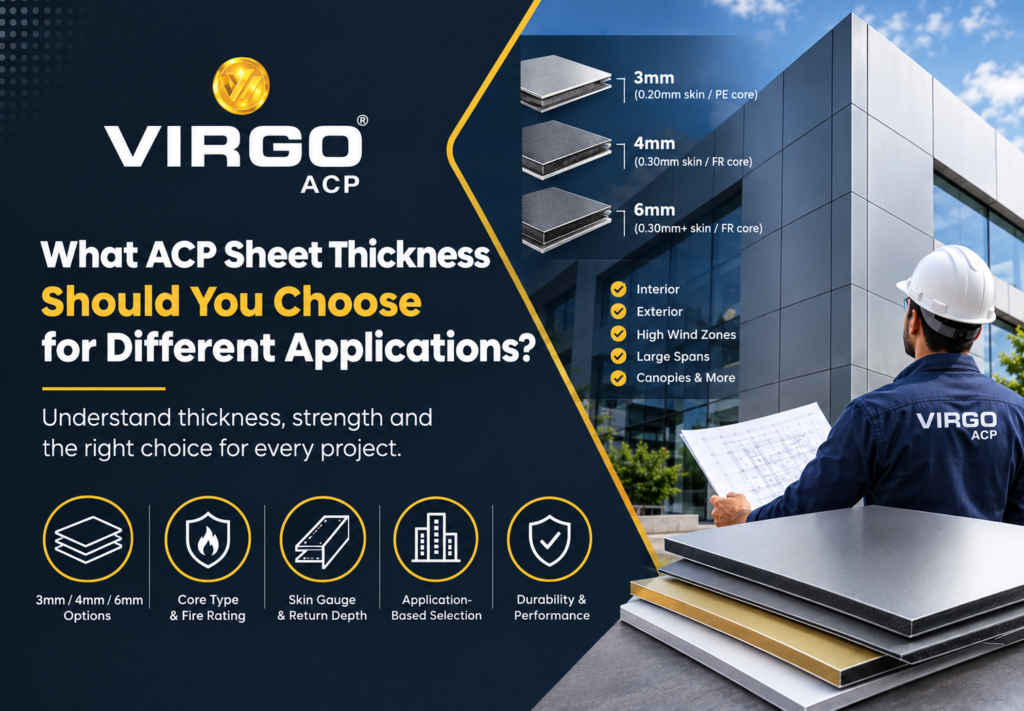
A structural engineer reviewing a coastal building facade inspection report wrote one sentence that should appear on every specification sheet in India: ‘The ACP panels didn’t fail. They did exactly what 3mm ACP sheets do when spanned 1100mm in a coastal wind zone.’ The ACP panels were visibly bowing. Not cracking — bowing. Across a metallic-finish aluminium ACP sheet elevation, that bow reads as a wavy, inconsistent surface across the entire third floor. Remediation required removing forty-six ACP sheets and replacing them with correctly specified 4mm ACP panels. Thickness in ACP sheets governs one thing: rigidity under load. This distinction drives every decision in the table below. Why Thickness Matters in ACP Sheets ACP sheets construction is three bonded layers: two aluminium skins and a core. A standard 4mm aluminium ACP sheet has approximately 0.30mm of aluminium on each face and 3.40mm of core. The bending resistance of ACP sheets scales with the cube of panel depth — a 4mm ACP sheet is approximately 2.4 times more resistant to bending than a 3mm ACP panel of the same width. The jump from 3mm to 4mm ACP cladding sheets for external applications is categorical, not incremental. The second thing thickness controls in ACP sheets is fabrication depth — how deep a return fold can be routed before breaking through the face of the aluminium ACP sheet. More thickness means more material for returns, enabling more ACP panels installation system options. 3mm ACP Sheets — Interior Applications Only Three-millimetre ACP sheets are correctly specified for: interior wall cladding with spans under 600mm, exhibition display systems, retail fixtures, interior feature walls, and signage fascias in covered locations. These are interior ACP panels applications where external durability of the aluminium ACP sheet is irrelevant. The failure mode when 3mm ACP sheets are used externally is predictable: visible deflection on spans above 800mm under moderate wind load. Three-millimetre ACP cladding sheets also produce shallow returns — approximately 12–15mm maximum — which limits compatibility with external ACP panels fixing systems requiring 20mm or deeper returns. 4mm ACP Sheets — The External Standard Four-millimetre ACP sheets are the default for external building facades in India under BIS IS 17682:2021. At approximately 5.5 kg/sqm, 4mm ACP panels handle the wind loads, thermal cycling, and fabrication requirements of standard commercial and residential ACP cladding sheets installations. Within the 4mm specification, aluminium skin thickness per face is the variable that separates ACP sheets products. Both 0.20mm and 0.30mm-skin products are described as ‘4mm ACP panels‘ — with different surface rigidity, dent resistance, and external durability for aluminium ACP sheet applications. Skin Gauge ACP Sheets Application External Compliance 0.20mm Interior ACP panels only Not appropriate for external ACP sheets 0.25mm Protected exterior, low wind ACP cladding sheets Marginal for standard external 0.30mm Standard external ACP panels IS 17682:2021 standard for aluminium ACP Sheet 0.50mm High-wind exterior ACP sheets Compliant — premium specification For external ACP cladding sheets in India, the specification must read: 4mm total thickness, 0.30mm aluminium skin per face, FR-grade core. Without all three numbers, the ACP panels specification is incomplete. 6mm ACP Sheets — Structural Grade Six-millimetre ACP panels enter the specification when ACP sheets spans exceed 2000mm without intermediate subframe support, when the project is in a high wind-load zone (coastal, high-rise above 30m), or when the design requires aluminium ACP sheet return depths above 25mm that 4mm ACP cladding sheets cannot support. The bending resistance of 6mm ACP panels versus 4mm ACP sheets is approximately 3.4 times greater. At 8 kg/sqm (versus 5.5 kg/sqm for 4mm ACP sheets), the additional dead load of 6mm ACP panels affects subframe structural design. ACP Sheets Thickness Selection by Application Application ACP Sheets Thickness Skin Gauge Core Interior wall feature 3mm or 4mm ACP sheets 0.20mm+ PE acceptable Interior signage 3mm ACP panels 0.20mm PE acceptable External residential ACP cladding sheets 4mm ACP sheets 0.30mm FR required External commercial ACP panels 4mm aluminium ACP Sheet 0.30mm FR required High-rise above 30m — ACP sheets 4mm or 6mm ACP panels 0.30mm+ FR required Large-span canopy 6mm ACP cladding sheets 0.30mm FR required Industrial, large bay — ACP panels 6mm ACP sheets 0.30mm+ FR required Frequently Asked Questions Q. What is the standard ACP sheet thickness for external facades in India? Ans. 4mm ACP sheets — the standard for external ACP panels applications under BIS IS 17682:2021. For very large spans or high wind-load zones, 6mm ACP cladding sheets are appropriate. 3mm ACP sheets are interior aluminium ACP sheet specification only. Q. When should I specify 6mm ACP sheets instead of 4mm ACP panels? Ans. When ACP sheets spans exceed 2000mm without intermediate support, when the project is in a high wind-load zone (coastal, high-rise above 30m), or when the installation design requires ACP cladding sheets return depths above 25mm that 4mm ACP panels cannot support. Q.Is 3mm ACP cladding sheets specification appropriate for external facades? Ans.Only in very specific conditions — spans under 600mm, protected locations. For standard external ACP panels, 3mm ACP sheets are under-specified and will show visible deflection above 800mm spans. Q.What is aluminium skin thickness in ACP sheets and why does it matter? Ans. Skin thickness is the gauge of the face sheets in an aluminium ACP sheet. For external ACP panels, 0.30mm minimum per face is the correct ACP cladding sheets specification for dent resistance, surface rigidity, and fabrication depth. Q.Does ACP sheets thickness affect fire performance? Ans. Thickness doesn’t determine fire performance in ACP panels — core type does. FR-grade core is the fire compliance variable in ACP cladding sheets, available in 3mm, 4mm, and 6mm aluminium ACP sheet products. Virgo ACP range of ACP sheets across 300+ shades and 16 series at virgoacp.com/products/
How to Calculate ACP Cladding Sheets Quantity for a Building Project
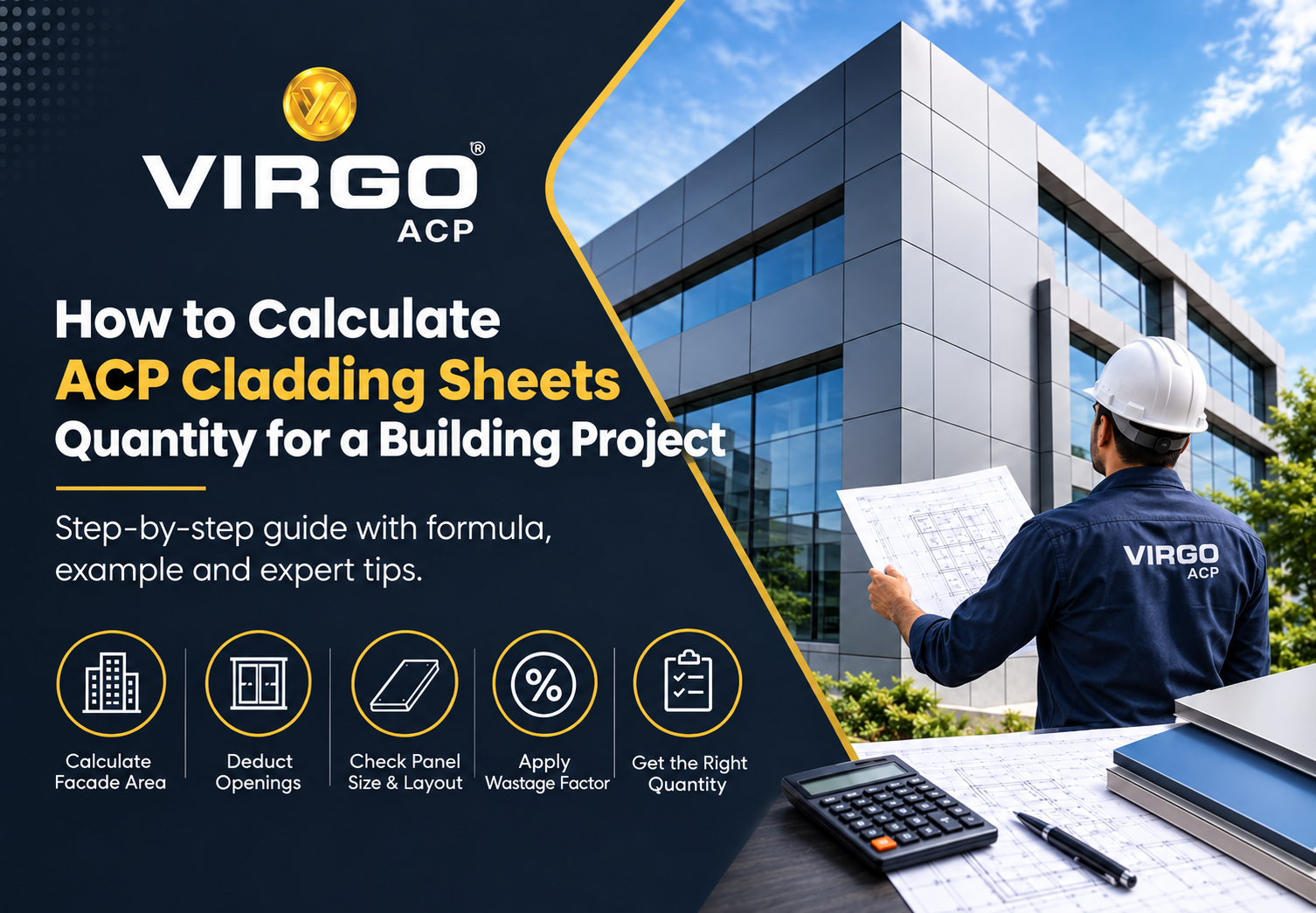
The variation order arrives three weeks into installation. Sixty-two ACP cladding sheets short on the third floor, the fabricator waiting, the crane hired and idle. The project manager pulls the original procurement sheet: net area from the floor plan, 5% wastage as a round number, order placed. Nobody measured the openings individually. Nobody adjusted the wastage for a facade with seventeen window types and four re-entrant corners. The shortfall costs two weeks and a shade-matching exercise that almost works — replacement ACP sheets from a different batch sit three shades lighter than everything below them. Calculating the right quantity of ACP cladding sheets follows a five-step process. Each step handles one variable. Get all five right and the purchase order is correct. What the Calculation Is Made Of A correctly calculated ACP panels quantity is built from five distinct inputs: Gross facade area — every elevation receiving ACP cladding sheets, measured from base of the clad zone to its top and across its full width. Opening deductions — every window, door, ventilation louvre, and glazed element creating a break in the facade where no ACP panels are required. Net cladding area — the actual surface to be covered with ACP cladding sheets after opening deductions. Panel layout efficiency — how a standard 1220mm × 2440mm ACP sheet tiles across the net surface and what cut waste the tiling generates. Wastage factor — the percentage added to account for off-cuts and handling damage on exterior wall cladding panels installations. Every quantity error in ACP cladding sheets procurement traces back to one of these five inputs being wrong, estimated, or omitted. The most common omission is individual opening measurement. Step 1 — Gross Facade Area for ACP Cladding Sheets Work from elevation drawings, not floor plans. A floor plan gives building footprint — not the height of the ACP cladding sheets installation. Gross Area = Width of Cladded Zone × Height of Cladded Zone For each elevation separately. A building with four exposed faces produces four separate gross area figures for ACP panels. Do not average elevations — heights often differ across the same building. Step 2 — Opening Deductions: Every Opening, Measured Individually This is where ACP cladding sheets quantity calculations most consistently go wrong. On a building with mixed window types, a glazed shopfront, service doors, and louvres, a percentage estimate can be 8–12% off the actual opening area — which translates directly into an ACP panels surplus or shortfall. Net Area = Gross Area − Total Opening Deductions Sanity check: openings typically account for 15–30% of gross facade area on commercial exterior wall cladding panels. Use this to verify your individual measurements — not as a calculation shortcut. Step 3 — ACP Sheet Module and Layout Standard ACP sheet in the Indian market: 1220mm × 2440mm — covering 2.98 sqm per ACP panel. Horizontal layout is efficient when storey height aligns with 1220mm modules. Vertical layout is efficient when bay widths align with 1220mm. A well-matched layout generates 8–9% wastage on ACP cladding sheets. A mismatched layout generates 15–16% from the same flat exterior wall cladding panels facade. Step 4 — Wastage Factor for ACP Panels Project Type ACP Cladding Sheets Wastage Factor Simple rectangular, regular grid windows 8–10% Standard commercial, mixed window types 10–12% Residential, varied openings, balcony cutouts 11–14% Complex massing, re-entrant corners 14–18% Curved or angular ACP facade panels elements 17–22% Phased project, 12+ months between ACP sheets deliveries Add 3–5% buffer Ordered ACP Cladding Sheets = Net Area × (1 + Wastage Factor) Number of ACP Panels = Ordered Quantity ÷ 2.98 — Always Round Up Step 5 — Additional ACP Panels Items That Get Missed Parapets — front face and top cap often in the same ACP cladding sheets specification as the main facade Soffits — underside of canopy overhangs and projecting elements in exterior wall cladding panels Returns and reveals — ACP sheets wrapping from the facade face into window reveals Interior elements — reception or lobby ACP panels in the same specification, sometimes in a separate finish schedule Worked Example — Five-Storey Office Building, Ahmedabad Gross Facade Areas Elevation Width Height Gross Area for ACP Cladding Sheets North (Main) 28.0 m 18.5 m 518.0 sqm South 28.0 m 18.5 m 518.0 sqm East 16.0 m 18.5 m 296.0 sqm West 16.0 m 18.5 m 296.0 sqm TOTAL GROSS AREA — — 1,628.0 sqm Total Openings Across All Elevations: 198.4 sqm Net ACP Cladding Sheets Area 1,628.0 − 198.4 = 1,429.6 sqm Wastage — 11% for Mixed-Window Commercial ACP Panels 1,429.6 × 1.11 = 1,586.8 sqm → Order 1,587 sqm ACP cladding sheets ACP Panels Count 1,587 ÷ 2.98 = 532.5 → Order 533 ACP cladding sheets panels Material Schedule Item Quantity Unit ACP cladding sheets (1220×2440mm) 533 Panels Total ACP sheets area ordered incl. wastage 1,587 Sqm Net ACP panels installation area 1,430 Sqm Aluminium subframe for exterior wall cladding panels (at ~4m/sqm) ~6,000 Linear metres Frequently Asked Questions Q. How do I calculate ACP cladding sheets quantity for a building facade? Ans : Five steps: calculate gross facade area (width × height) per elevation; deduct each opening individually to get net ACP