Mumbai has a building problem that most other Indian cities don’t.
It isn’t a shortage of construction activity the city’s skyline is proof enough of that. The problem is durability. A facade material that behaves perfectly in Hyderabad or Delhi for fifteen years can start looking tired in Mumbai in half that time. The culprit is the same one that rusts iron grilles, corrodes air conditioner housings, and turns exposed concrete grey within a monsoon season: the city’s coastal atmosphere. High humidity, salt-laden sea breeze, six months of monsoon rain, and UV levels that don’t let up for the other six.
ACP aluminium composite panels is the cladding material of choice across Mumbai’s construction pipeline right now. Hospitals, commercial towers, retail fascias, residential lobbies, metro stations, school buildings. It’s everywhere. But the ACP that works in this city, and the ACP that doesn’t, are sold by the same dealers using the same catalogue language. That gap between what’s being sold and what should actually be specified is what costs project owners money.
This guide is for anyone sourcing ACP sheets in Mumbai in 2026 who wants to know the difference before signing a purchase order, not after.
The One Thing Mumbai’s Climate Will Not Forgive in an ACP Specification
Salt air is the variable that changes everything about ACP specification in coastal cities, and it’s the variable that gets quietly skipped over in most supplier conversations.
Here’s what happens. The Arabian Sea sits on three sides of Mumbai. The moisture content in the air even on a dry winter day is meaningfully higher than an inland city. Add in monsoon season, which delivers 2,200 mm of rain annually and keeps relative humidity above 90% for weeks at a stretch, and you have conditions that accelerate coating degradation, edge corrosion, and aluminium oxidation at rates that inland specifications simply don’t account for.
Architects and specification consultants who’ve been working in Mumbai long enough have seen what this looks like in practice. A polyester-coated facade that looks crisp at possession starts chalking within four years. Panels with thin aluminium skins show corrosion at cut edges the points where the raw aluminium is exposed after routing within five or six monsoon cycles. And PE-core panels absorb atmospheric moisture over time in ways that compromise the skin-to-core bond.
None of this is industry gossip. It’s physics, and it’s visible on buildings across the city if you know what you’re looking at.
What does correct specification look like for ACP sheets in Mumbai?
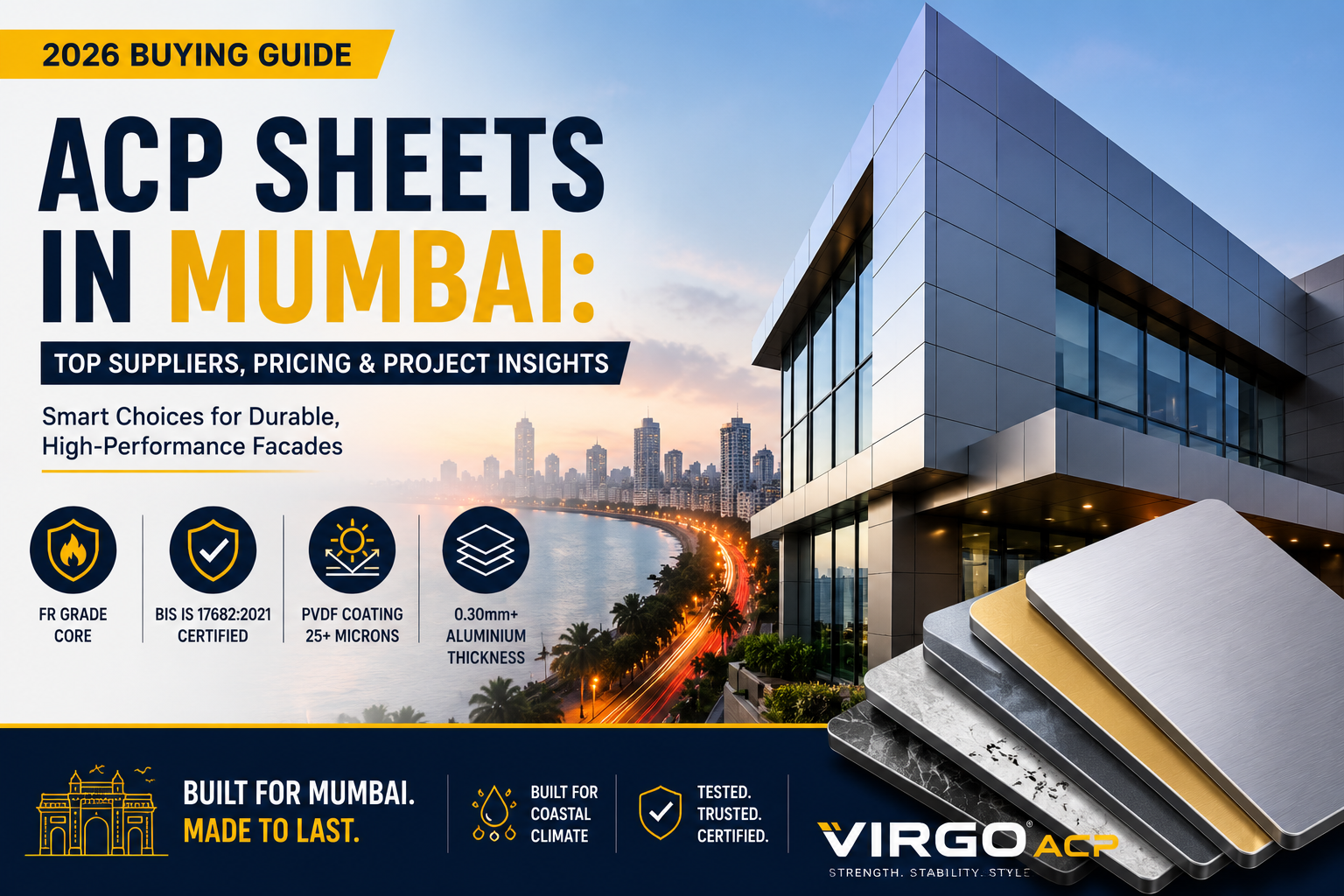
PVDF coating, 25 microns minimum per side – Polyvinylidene fluoride is the only coating chemistry that holds up against the combination of coastal UV and persistent moisture exposure over a 20-year building lifecycle. Not a luxury specification for premium projects the baseline for any external application in Mumbai. Applied over a chromate or equivalent conversion coating on the aluminium surface for adhesion in humid conditions.
FR-grade core, no exceptions for external use – MCGM has been progressively tightening compliance requirements for facade materials on multi-storey and commercial buildings. PE-core ACP on an external Mumbai facade isn’t just a fire safety risk. It’s increasingly a regulatory liability under current MCGM review standards.
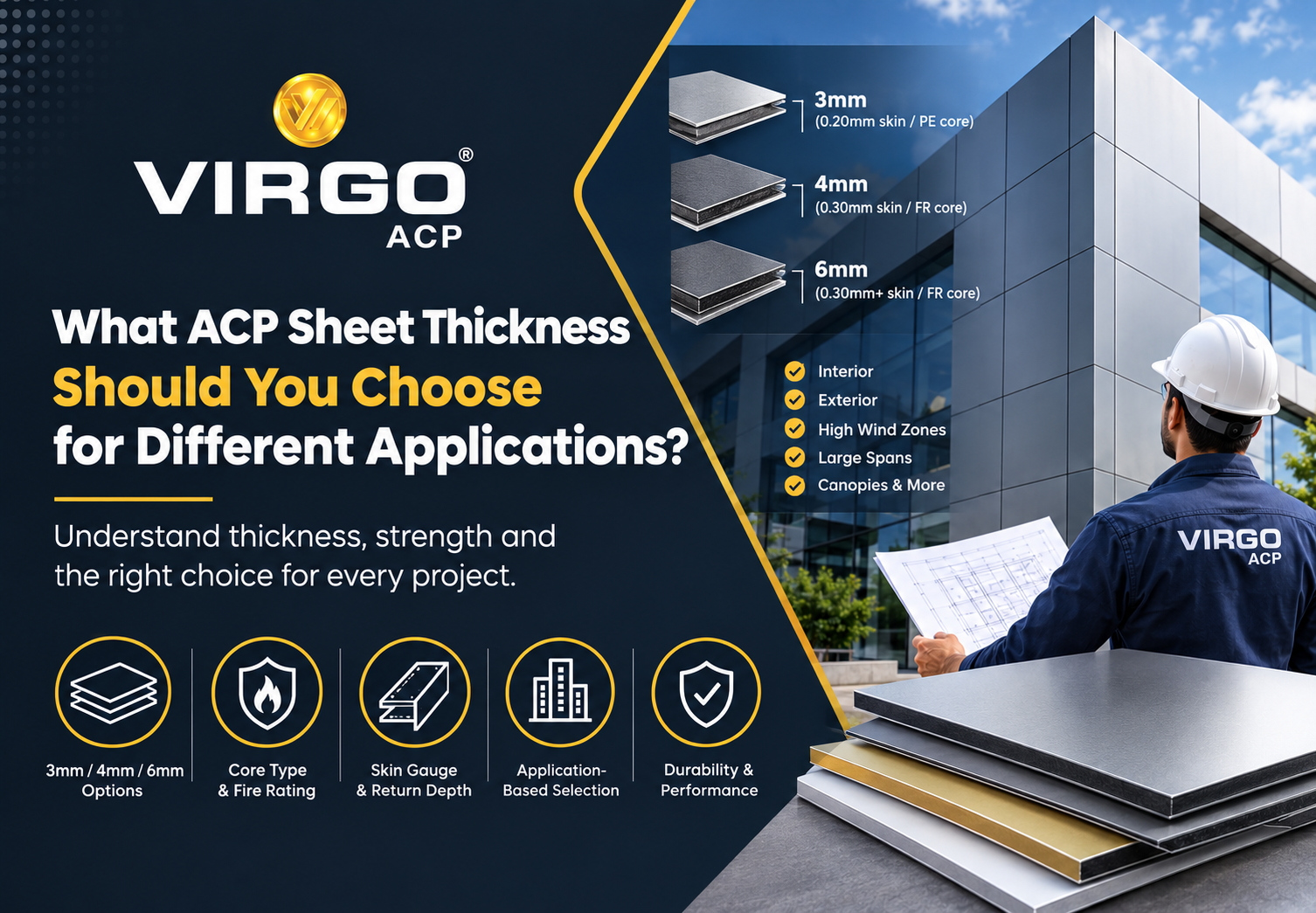
Aluminium skin gauge of 0.30mm or above per face – Thinner skins are more vulnerable to edge corrosion at cut and routed sections. In Mumbai’s environment, this shows up around years four to six oxidation at panel edges that works its way inward over successive monsoon cycles.
These three aren’t upsells. They’re the specification floor for a Mumbai external facade.
How the Mumbai ACP Supply Market Actually Works
Not everyone selling ACP in Mumbai is the same kind of business, and the distinction matters more here than in cities with slower construction pipelines.
Bhiwandi is the dominant logistics hub most serious ACP distributors operating in Mumbai keep stock here and run deliveries across the city and into Navi Mumbai, Thane, and the broader MMR. For standard specifications, 24-to-48-hour delivery from in-stock material is the norm.
Kurla and Chembur carry pockets of building material trade serving Central and South Mumbai. Navi Mumbai particularly Turbhe, Rabale, and Taloja MIDC has its own supplier ecosystem that’s grown significantly through 2025 into 2026.
Within this landscape, you’re dealing with one of three types of supplier:
Authorised distributors – have a formal supply arrangement with a specific manufacturer. They carry verified product, can provide manufacturer-linked test documentation, and have a clear escalation path when something’s wrong.
Multi-brand traders – buy from multiple sources. Not inherently unreliable, but product traceability is weaker and warranty structure is thinner. Their leverage with any specific manufacturer when a batch issue surfaces is limited.
Grey market operators – including some importers of unverified Chinese or Gulf-origin ACP move product on price. Specifications may or may not match the invoice. BIS certification is typically absent.
All three quote using the same language. “Premium PVDF.” “FR grade.” “BIS compliant.” The language isn’t the differentiator. The documentation behind it is.
ACP Sheet Pricing in Mumbai: What the Market Looks Like in 2026
Prices in Mumbai’s ACP market run higher than equivalent specifications in Delhi NCR typically 8 to 12 percent above, driven by logistics costs from North Indian manufacturing hubs, higher distributor overheads in the MMR, and the premium that construction pace places on available stock.
| Specification | Core | Coating | Mumbai Price (per sqft) |
| Economy | PE | Standard Polyester | ₹38–55 |
| Mid-grade | PE | Super Durable Polyester (SDP) | ₹55–70 |
| Commercial grade | FR | SDP / FEVE | ₹70–90 |
| Premium exterior | FR | PVDF (25+ microns) | ₹90–130 |
| Specialty finishes | FR | PVDF — Stone / Metallic / Mirror | ₹110–165+ |
Volume moves price significantly. Most distributors in Mumbai have tiered rates they don’t publish. Sourcing 3,000 sqft or more? Ask directly the rate will be different from the walk-in quote.
Delivery cost is typically quoted separately in Mumbai and can add ₹4–9 per sqft depending on site location and floor-level logistics. High-rise delivery in BKC or Worli costs more to execute than a ground-floor retail project in Andheri. Build it into your cost model from the start.
| The economy PE-polyester tier should not be crossing into any external facade specification for a Mumbai building. The per-sqft number looks attractive. The 4-year degradation cost doesn’t. |
Five Supplier Checks That Mumbai Procurement Gets Right
Mumbai’s more experienced contractors and architects have had enough bad procurement experiences to build rigorous supplier evaluation into their process. Here’s what that looks like.
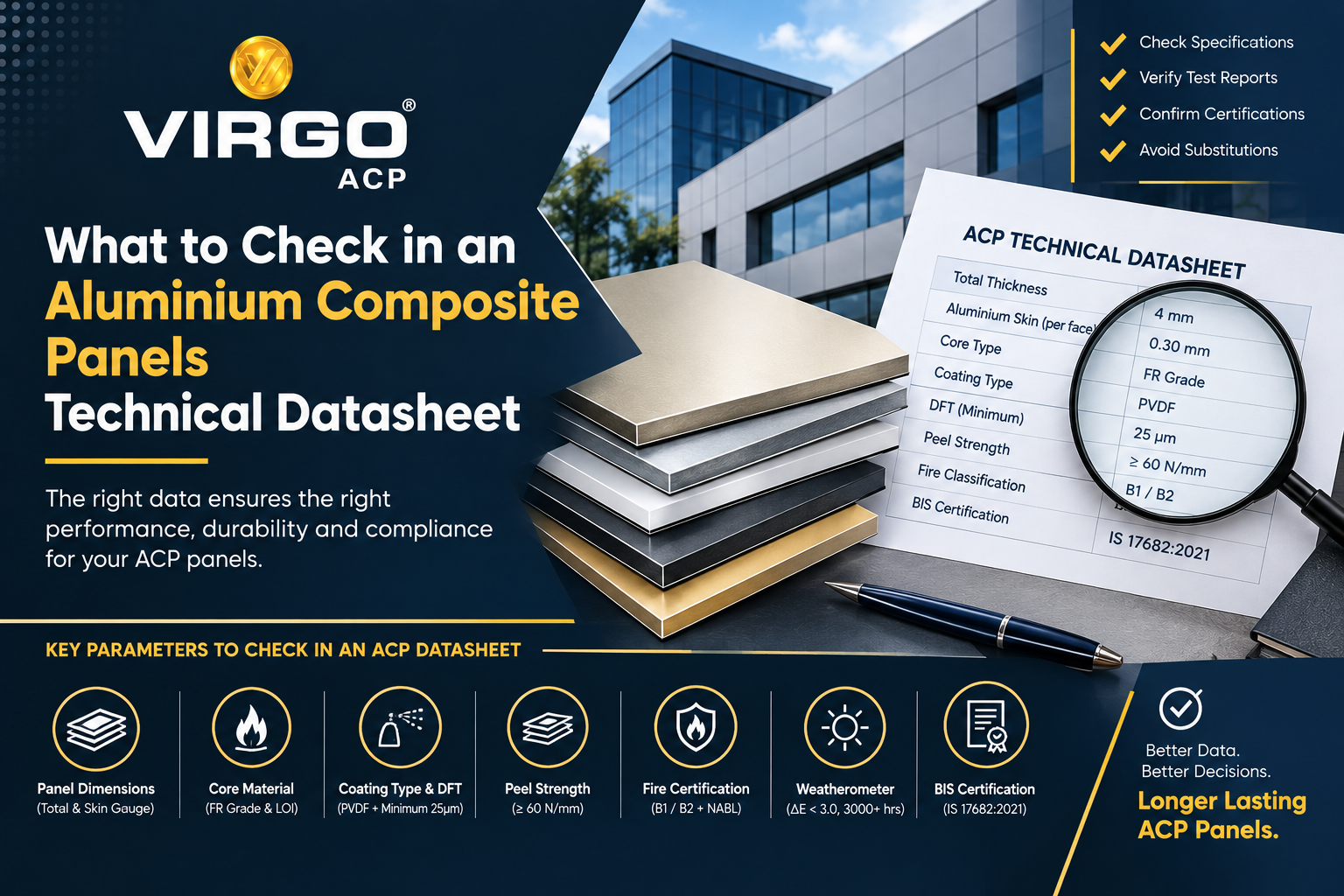
Check the BIS licence number, not the claim – BIS IS 17682:2021 certification is not self-declared. Ask for the licence number and verify at bis.gov.in the licensed products directory takes under five minutes. A supplier who can’t produce a specific number is not BIS certified regardless of what their catalogue says.
Ask for NABL-accredited test certificates – The key word is NABL-accredited the lab itself has been independently verified. Certificates should cover peel strength (minimum 60 N/mm), coating adhesion, fire performance for FR-grade products, and weatherometer results. Dated within the last 18 months.
Ask who actually manufactured the panels – Distributor name and manufacturer name are two different things. Get the manufacturer’s name, verify their BIS certification, and ask whether the distributor is formally authorised by that manufacturer.
Request a physical sample and test it – Scratch the surface with a fingernail. PVDF resists; polyester doesn’t. Look at the cut edge for gaps or delamination. Flex it gently; sound bonding gives consistent rigidity. Pick it up FR cores are noticeably denser than PE, and a panel sold as FR that feels surprisingly light deserves a second look.
Get the warranty in writing – What’s covered, for how long, what the claims process is, who holds the liability. A verbal assurance from a Mumbai trader is not a warranty.
What’s Actually Getting Built in Mumbai Right Now
The city’s 2025–2026 construction pipeline is reshaping supplier demand and specification standards in visible ways.
The Dharavi Redevelopment – among the largest urban redevelopment projects anywhere in the world right now is running active ACP procurement across commercial blocks, housing exteriors, and public amenity buildings. The specification standard is FR-grade PVDF throughout, and certification requirements are strict.
BKC’s commercial and hospitality corridor – continues driving demand for premium ACP finishes stone textures, brushed metallic series, and high-end PVDF solid colours. Architects specifying here are experienced, documentation requirements are firm, and a visible shade variation between panels on a BKC tower is a sign-off refusal, not a conversation.
Healthcare construction across the MMR – is specifying FR-grade ACP as a baseline for both interior and exterior applications. Fire compliance requirements and hygiene finish standards have made this one of the stronger demand sources for certified ACP panel manufacturers.
Metro-adjacent retail and commercial development – along Lines 2, 3, and 7 is generating volume-oriented, fast-turnaround demand. Retail fascia work at metro stations and surrounding commercial development is moving quickly, and suppliers with consistent supply are finding consistent business.
The trend across all of these segments points the same direction: specification standards in Mumbai are rising, and the bar is moving up.
The Direct Manufacturer Conversation Mumbai Buyers Are Starting to Have
For years, local distributors were the default faster access, lower minimum orders, relationships built over time. That still holds for smaller or faster-turnaround projects. But for significant project volumes, a growing number of Mumbai architects, MEP contractors, and developers are bypassing the distribution tier entirely and going direct to ACP panel manufacturers.
The reason isn’t primarily price, though direct supply does remove the distribution margin. The reason is accountability.
When you buy direct from a manufacturer, the test certificates are original production documents. The batch traceability is complete. The warranty is backed by the entity that made the product and controls its quality. And if there’s an issue, you’re having the conversation with the manufacturer directly not with a distributor who then has their own separate conversation with the manufacturer on your behalf.
In a city where project values are high and facade failures are publicly visible, that accountability structure is worth the logistical adjustment to access.
Why Virgo ACP Makes Sense for Mumbai Projects
Virgo ACP is a manufacturer. Not a distributor, not a trader, not an importer. Part of the Virgo Group a manufacturing conglomerate in operation since 1993 Virgo produces the panels it sells and backs what it sells with documentation that holds up under project scrutiny.
The PVDF specification is built in, not bolted on: Virgo’s exterior-grade range uses PVDF coatings applied at 25-micron-plus dry film thickness not as an upgrade option, but as the standard for exterior panels. It’s the specification Mumbai’s coastal environment requires.
FR-grade core across all 16 series: The full range Elite, Valencia, Metauxe, Stone Craft, Wooden, Metallic, Sparkle, and the rest is available in FR-grade core. Architects don’t have to trade design choice for compliance.
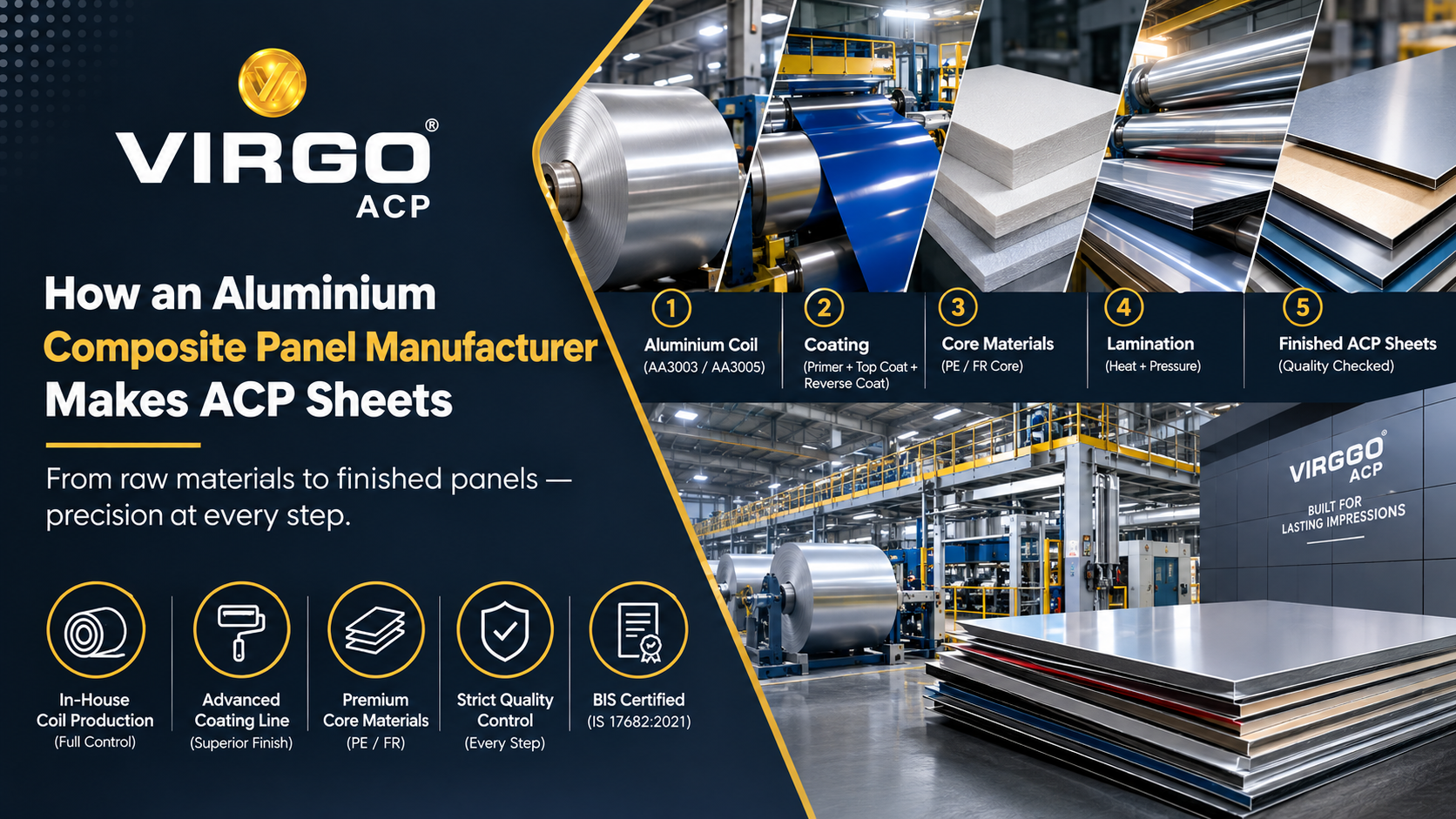
In-house aluminium coil production: Most Aluminium ACP Sheet Manufacturers in India purchase pre-coated coils from third parties. Virgo manufactures its own meaning coating application, alloy specification, and batch-to-batch consistency are controlled within the same production system. For large Mumbai projects where shade matching across 10,000+ sqft matters, this is the manufacturing control that shows up in the final installation.
BIS IS 17682:2021 certified. Triple ISO certified (9001, 45001, 14001): The documentation that Mumbai project specifications, MCGM submissions, and architect sign-offs are asking for with increasing regularity.
Manufacturing in India and Saudi Arabia: The Saudi operation, commissioned in 2025, reflects a brand building for international quality standards which has a direct bearing on the manufacturing rigour applied to the Indian product range.
| Start a Mumbai project enquiry or request samples → virgoacp.com/acp-sheets-in-mumbai/ |
Frequently Asked Questions
Q1. What ACP specification should I use for external facades in Mumbai?
FR-grade core with PVDF coating at a minimum 25 microns dry film thickness per side, from a BIS IS 17682:2021 certified manufacturer. Aluminium skin gauge should be 0.30mm or above per face. This is the specification floor for Mumbai external facades not a premium option. The city’s coastal humidity, salt air, and monsoon UV load degrade lower-grade coatings significantly faster than buyers expect. Don’t compromise on these three parameters regardless of budget pressure.
Q2. What does ACP sheet cost in Mumbai in 2026?
Standard PE-core polyester-coated ACP runs ₹38–55/sqft in Mumbai. FR-grade panels with SDP or FEVE coating run ₹70–90/sqft. Premium FR-grade PVDF-coated panels from certified ACP panel manufacturers range ₹90–130/sqft. Specialty finishes stone-craft, metallic, mirror run ₹110–165+/sqft. Mumbai pricing is typically 8–12% above Delhi NCR equivalents due to logistics. Volume orders above 3,000–5,000 sqft attract lower per-unit pricing that distributors don’t volunteer in standard catalogues.
Q3. Which suppliers in Mumbai stock genuine certified ACP?
Verify BIS IS 17682:2021 certification at bis.gov.in using the supplier’s stated licence number. Authorised distributors of certified ACP panel manufacturers will have verifiable certification, original test documents, and a formal manufacturer appointment. Manufacturers supplying direct to Mumbai projects such as Virgo ACP provide manufacturer-backed documentation and warranty without the intermediary layer.
Q4. How long does ACP last in Mumbai’s environment?
Correctly specified ACP PVDF coating, FR core, 0.30mm-plus aluminium gauge should deliver 20-plus years on a Mumbai facade with minimal maintenance. Underspecified ACP (polyester coating, thin skins) typically shows visible deterioration within 4–7 years in Mumbai’s coastal environment: chalking, uneven fading, edge corrosion, and delamination during heavy monsoon weather. The specification decision at procurement determines service life more than any other factor.
Q5. Is MCGM now requiring FR-grade ACP for building approvals?
MCGM has been progressively tightening facade material compliance requirements for multi-storey and commercial buildings. Specific requirements vary by building type, height, and occupancy classification, but the regulatory direction is clearly toward FR-grade materials for external cladding. Specifying FR-grade ACP with documented BIS certification is the safest approach for any project subject to MCGM review for current approval and for ongoing compliance as standards continue to evolve.
Q6. What ACP finishes are architects specifying for Mumbai projects in 2026?
Premium commercial and hospitality projects in BKC, Worli, and the high-end residential corridors are specifying stone-craft textures and brushed metallic finishes heavily in 2026. Healthcare and institutional projects consistently use neutral PVDF solid colours warm greys, off-whites, champagne tones. Retail and F&B applications use high-gloss solids, sparkle finishes, and bright PVDF colours. The Dharavi redevelopment and metro-adjacent developments are driving substantial volume in standard architectural tones across FR-grade PVDF product lines.
Q7. Can Virgo ACP supply direct to Mumbai and Navi Mumbai project sites?
Yes. Virgo ACP supplies direct to project sites across Mumbai, Navi Mumbai, Thane, and the broader MMR with full manufacturer documentation, BIS certification records, and direct warranty. For project enquiries, specifications, or sample requests, contact the team at virgoacp.com.
Before You Sign That Purchase Order
The pattern with ACP procurement in Mumbai is consistent enough that it’s worth naming directly.
Buyers who haven’t been through a specification failure in this city’s environment tend to treat coating type and core grade as options upgrades available for the right budget. Buyers who have been through it treat them as non-negotiables. The difference between those two groups isn’t knowledge of the specification. It’s experience of the consequence.
Mumbai’s coastal atmosphere is genuinely demanding. The city’s building density means facade failures aren’t hidden behind landscaping they’re visible from the street, from neighbouring buildings, from every floor of the building across the lane. The project values involved make the cost of a wrong material decision significant in ways that smaller-city projects don’t always produce.
The specification questions in this guide aren’t complicated. They just require asking them before the order, verifying the answers against publicly available databases, and choosing suppliers who don’t hesitate when you do.