
PVDF vs FEVE ACP Coating: Which Coating Should You Choose?
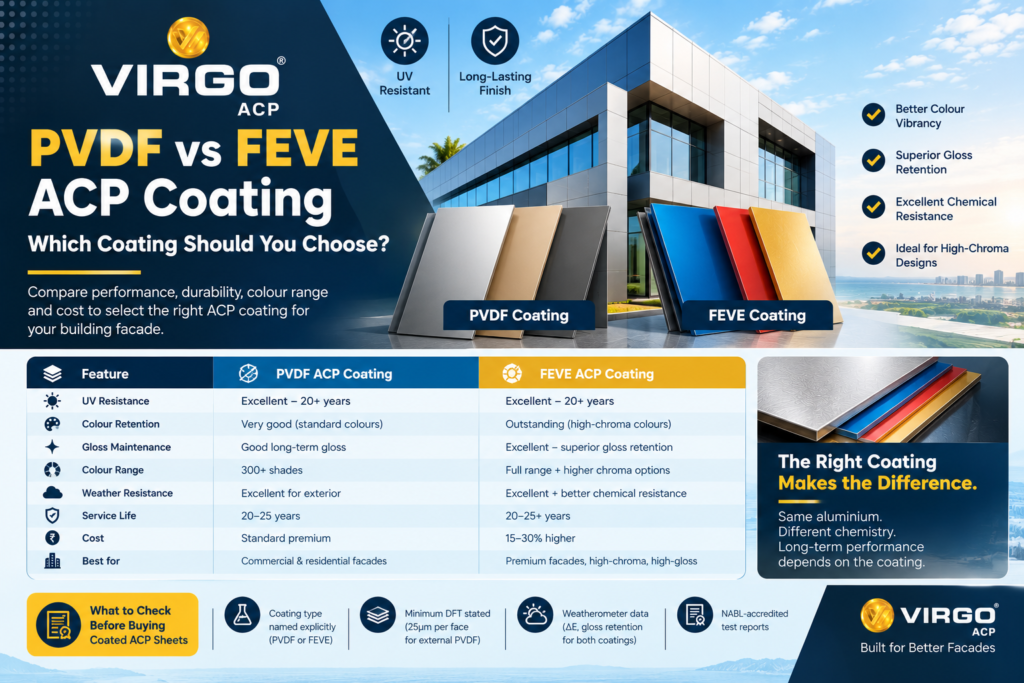
A facade consultant reviewing specifications for a premium commercial complex in Ahmedabad flagged something the original ACP surface coating specification had missed: the west-facing elevation would receive almost nine months of intense UV per year, and the client expected the building to look exactly as rendered for at least fifteen years without repainting. The original specification said ‘PVDF coating.’ The consultant added a specific minimum DFT requirement and a weatherometer performance clause. But the architect then asked: ‘We’ve seen FEVE ACP coating mentioned as a premium option — should we be using that instead?’ The PVDF vs FEVE ACP coating question comes up on premium projects because FEVE is a genuine step up in certain performance parameters. Understanding where the difference matters — and where it doesn’t — is what this guide covers. What Is ACP Coating? ACP coating is the surface layer applied to the aluminium skins of an aluminium composite panel before lamination. The ACP surface coating serves three functions: it protects the aluminium from UV degradation and chemical attack; it provides the visual colour and finish; and it determines how long the panel’s appearance holds under the building’s specific climate conditions. ACP coating for exterior facades is applied in a continuous coil coating process — the aluminium coil passes through coating stations and curing ovens before lamination. The top coat resin system is where the PVDF vs FEVE ACP coating comparison becomes relevant and where the best ACP coating for facade decision is made. What Is PVDF ACP Coating? PVDF ACP coating uses polyvinylidene fluoride as its binder resin — a fluoropolymer developed specifically for exterior architectural finishes where long-term UV resistance was the primary requirement. The fluorine-carbon bond in PVDF ACP coating is among the most stable molecular structures in industrial chemistry, resistant to the UV photons that break lesser coating resins. PVDF ACP coating applied at 25+ microns DFT on the exterior face has a documented service life of 20–25 years under Indian UV conditions. This is the best ACP coating for facade applications in the vast majority of Indian commercial and residential buildings — available across the full colour range, specified under BIS IS 17682:2021, and available in high gloss, satin, and matte ACP surface coating finish levels. What Is FEVE ACP Coating? FEVE ACP coating uses fluoroethylene vinyl ether as its binder resin — a fluoropolymer system with UV resistance comparable to PVDF ACP coating but with specific additional advantages in colour vibrancy, gloss retention, and chemical resistance. FEVE ACP coating enables higher-chroma pigment saturation than standard PVDF ACP coating — making it the coating of choice for vivid, high-saturation ACP facade colours that must maintain their vibrancy over fifteen years. FEVE ACP coating also demonstrates superior long-term gloss retention, making it the best ACP coating for facade applications where gloss level at year ten is as important as at year one. PVDF vs FEVE ACP Coating: Key Differences Factor PVDF ACP Coating FEVE ACP Coating UV Resistance Excellent — 20+ years service life Excellent — 20+ years service life Colour Retention Very good across standard commercial colours Outstanding — superior for high-chroma ACP facade colours Gloss Maintenance Good long-term gloss retention Excellent — superior long-term gloss on ACP surface coating Colour Range Full standard range — 300+ shades Full range + higher chroma options for ACP coating for exterior Weather Resistance Excellent for standard ACP coating for exterior Excellent + better chemical resistance for PVDF vs FEVE coating ACP Surface Coating Durability 20–25 years service life 20–25+ years service life Best ACP Coating for Facade Standard commercial and residential Premium facades, high-chroma, high-gloss statement buildings Cost Standard premium ACP surface coating 15–30% above PVDF ACP coating IS 17682:2021 Compliance Yes — standard ACP coating for exterior Yes — meets external coating requirements Which ACP Coating Is Suitable for Exterior Facades? For most ACP coating for exterior facade applications in India, PVDF ACP coating at 25+ microns DFT is the correct specification. It meets BIS IS 17682:2021 requirements, delivers 20+ years of UV resistance under Indian solar conditions, and is the best ACP coating for facade across the full colour and finish range. FEVE ACP coating is the best ACP coating for facade applications where: the design requires high-chroma colours that must maintain saturation over fifteen years; the building is a statement facade where gloss level at year ten matters; or the location involves specific chemical pollution where FEVE’s superior chemical resistance in the PVDF vs FEVE coating comparison provides meaningful additional protection. How to Choose Between PVDF vs FEVE ACP Coating Building location Coastal or high industrial-pollution environments gain the most from FEVE ACP coating’s chemical resistance advantage in the PVDF vs FEVE coating comparison. Standard urban locations are well-served by PVDF ACP coating as the best ACP coating for facade. Design requirements and colour specification If the brief requires standard commercial tones — warm greys, champagnes, earth tones — PVDF ACP coating delivers the result. If the brief requires vivid, high-saturation colours on ACP coating for exterior, FEVE ACP coating is worth specifying. Expected service life and budget For a 20-year exterior specification, PVDF ACP coating is entirely adequate as the best ACP coating for facade. For a 25-year target on a premium building, FEVE ACP coating provides additional confidence margin in the PVDF vs FEVE ACP coating decision. What to Check Before Buying Coated ACP Sheets Coating type named explicitly — ‘PVDF’ or ‘FEVE ACP coating,’ not ‘premium exterior ACP surface coating’ Minimum DFT stated per face — 25μm minimum for external PVDF ACP coating (not nominal or average) Weatherometer performance data with ΔE values and gloss retention percentage for both PVDF vs FEVE ACP coating options NABL-accredited test reports confirming the ACP coating for exterior performance claims Frequently Asked Questions Q. What is the main difference between PVDF vs FEVE ACP coating? Ans.Both are fluoropolymer ACP surface coating systems with excellent UV resistance. FEVE ACP coating offers superior gloss retention, higher-chroma colour capability, and better chemical resistance than
FR ACP vs Normal ACP: What Is the Difference?
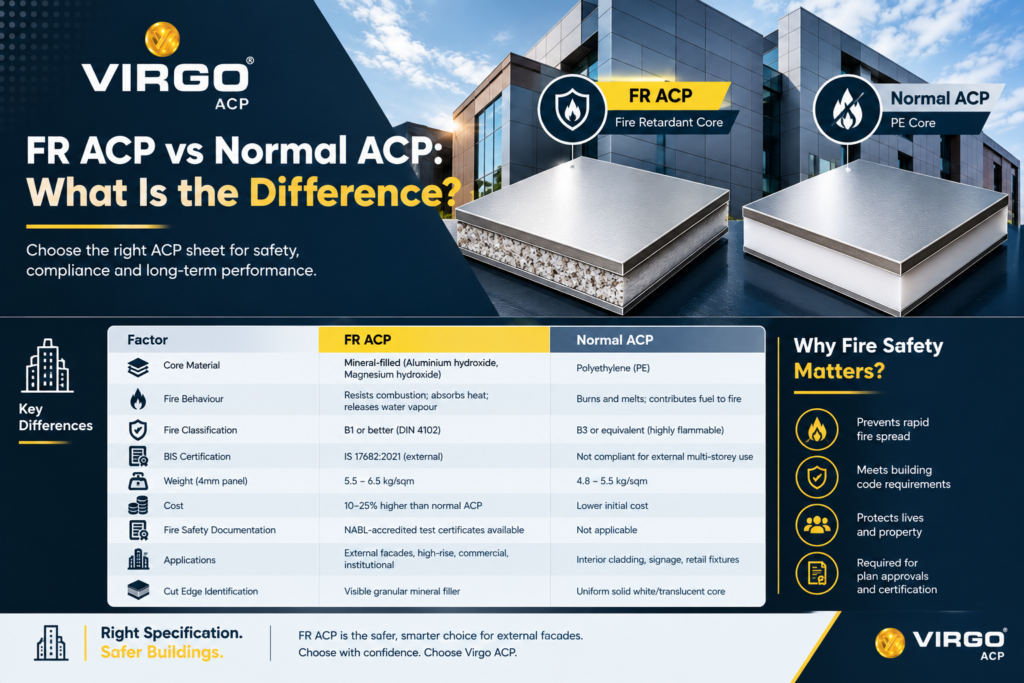
The question comes up in almost every significant facade project specification meeting: do we need FR ACP or will normal ACP sheet work for this application? When a procurement manager asks this question, they’re usually weighing cost. When a fire safety consultant asks it, they already know the answer — and it’s FR ACP. The FR ACP vs normal ACP debate is genuinely important and becomes more so every year as Indian building codes tighten. Getting the FR ACP vs normal ACP decision right before procurement protects the project, the developer, and everyone in the building. What Is FR ACP? FR ACP stands for fire-retardant aluminium composite panel. The ‘FR’ designation refers to the core material — the layer between the two aluminium skins — which contains mineral filler compounds that resist combustion. The mineral fillers in FR ACP cores — typically aluminium hydroxide or magnesium hydroxide — undergo an endothermic decomposition reaction when exposed to fire heat: they absorb heat and release water vapour. This simultaneously removes heat energy from the combustion zone and dilutes oxygen available to sustain burning. FR ACP is classified under DIN 4102 standards as B1 (non-flammable) or better. FR ACP sheet benefits include: fire performance meeting regulatory requirements for external facades on occupied buildings; ability to provide NABL-accredited fire test certificates and BIS IS 17682:2021 certification documentation; and the ACP fire safety compliance necessary for building authority plan approvals. What Is Normal ACP? Normal ACP refers to aluminium composite panels with a PE (polyethylene) core — the original and historically most common ACP construction. Normal ACP sheet is lightweight, extremely easy to route and fold in fabrication, and less expensive than fire retardant ACP sheet. Normal ACP sheet has legitimate applications: interior wall cladding, exhibition displays, retail fixtures, and interior feature walls where ACP fire safety requirements don’t apply in the same way as external facades. The issue is when normal ACP sheet is specified or substituted into applications requiring fire resistant ACP. Normal ACP sheet construction: two aluminium skins bonded to a polyethylene core. Polyethylene burns readily. Several high-profile building fires internationally — including Grenfell Tower in London in 2017 — involved normal ACP or PE-core ACP in external cladding, significantly contributing to fire spread. This is the fundamental reason the FR ACP vs normal ACP decision matters. FR ACP vs Normal ACP: Key Differences Factor FR ACP Normal ACP Sheet Core material Mineral-filled compound (aluminium hydroxide, magnesium hydroxide) Polyethylene (PE) Fire behaviour Resists combustion; absorbs heat; releases water vapour Burns and melts; contributes fuel to fire Fire classification B1 or better (DIN 4102) B3 or equivalent (highly flammable) BIS IS 17682:2021 (external) Compliant — fire retardant ACP sheet standard Non-compliant for external multi-storey use Weight (4mm panel) 5.5–6.5 kg/sqm 4.8–5.5 kg/sqm Cost 10–25% higher than normal ACP sheet Lower initial cost ACP fire safety documentation NABL-accredited fire test certificates available Not applicable for fire performance Applications External facades, high-rise, commercial, institutional Interior cladding, signage, retail fixtures Cut edge identification Visible granular mineral filler in core cross-section Uniform solid white/translucent plastic core Why Is ACP Fire Safety Important for Building Facades? ACP fire safety matters because facades are one of the primary pathways through which fire spreads vertically in multi-storey buildings. External cladding systems with combustible cores allow fire to move from floor to floor far faster than internal fire spread — faster than evacuation systems are designed for. Beyond life safety, ACP fire safety has regulatory implications: BIS IS 17682:2021 classifies products for fire performance for external ACP on multi-storey buildings. Building authority approvals in most major Indian cities now require FR ACP fire documentation. Projects specified with normal ACP sheet instead of fire retardant ACP sheet risk rejection at plan approval or completion certification stage. Where Is FR ACP Commonly Used? Commercial Buildings Any commercial building above ground floor with external ACP cladding should use FR ACP. The documentation requirements, regulatory environment, and RERA disclosure obligations all point to fire retardant ACP sheet for commercial applications. High-Rise Buildings FR ACP vs normal ACP is not a choice for buildings above 15 metres in most Indian states — fire safety codes require fire resistant ACP. FR ACP sheet benefits are mandatory, not optional, for high-rise applications. Hospitals and Institutions Healthcare facilities require FR ACP for all external cladding. ACP fire safety documentation must be available for building licensing and healthcare accreditation inspections. Public Buildings Government procurement guidelines increasingly specify fire retardant ACP sheet by default. FR ACP sheet benefits in terms of BIS certification availability and test documentation make FR ACP the standard for public sector projects. How to Choose Between FR ACP vs Normal ACP Building height — any building above two storeys requires FR ACP for external cladding; normal ACP sheet is not appropriate for multi-storey external facades Application (interior vs exterior) — interior feature walls can use normal ACP sheet where ACP fire safety requirements for the specific space don’t require FR classification; external facades always require fire retardant ACP sheet Fire safety requirements — if a fire safety consultant or building authority requires FR classification, FR ACP is the only answer in the FR ACP vs normal ACP decision Regulatory requirements — RERA-registered residential projects and institutional funding increasingly require FR ACP documentation; normal ACP sheet cannot provide ACP fire safety documentation Does FR ACP Cost More Than Normal ACP? FR ACP costs approximately 10–25% more than normal ACP sheet on a per-sqm basis. The FR ACP vs normal ACP cost comparison is misleading without considering what normal ACP sheet costs on a project: regulatory rejection requiring re-specification to fire retardant ACP sheet mid-project; remediation costs if the building authority requires removal and replacement of non-compliant normal ACP sheet; fire liability exposure in the event of a fire; and insurance implications for buildings with non-compliant facade materials. The FR ACP sheet benefits over the project lifecycle are not proportional to the 10–25% cost premium. FR ACP vs Normal ACP: What to Check Before Buying Core type on
How to Choose the Right ACP Sheet for Building Facades?
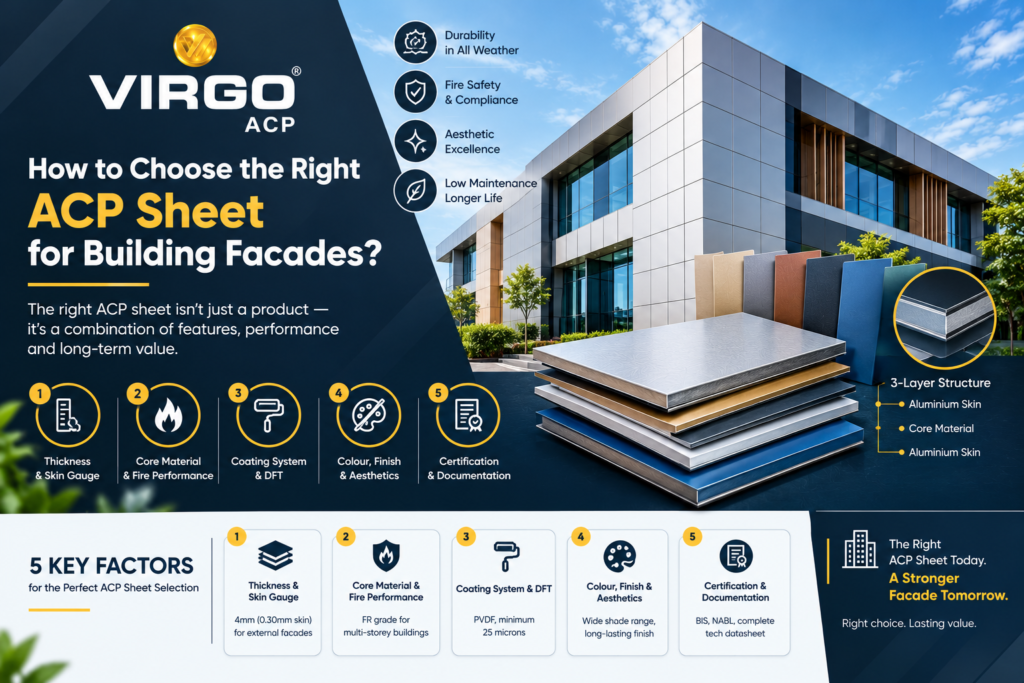
An architect in Pune once said that the most important decision on a commercial facade project isn’t which ACP sheet for building facade you choose — it’s that you understand why you’re choosing it. He had seen three projects on the same street where contractors picked the cheapest available ACP facade sheets. Two had visible surface degradation within four years. The third, where a proper ACP sheet selection guide had been followed, looked exactly as specified eight years later. The difference wasn’t luck. It was methodology. Choosing the right ACP sheet for building facade applications isn’t complicated once you understand the five variables that drive performance. This guide breaks each one down. What Is an ACP Sheet for Building Facades? An ACP sheet for building facade is a three-layer composite panel: two aluminium face sheets permanently bonded to a core material. The aluminium skins give the ACP facade sheets their rigidity, weather resistance, and paintable surface. The core determines weight, fire behaviour, and structural characteristics. ACP sheets for building facades are used externally because they handle UV exposure, rain, temperature cycling, and pollution without absorbing moisture or corroding. The best ACP sheet for facade applications combines all of these properties in a specification matched to the specific building, environment, and performance requirements of the project. An aluminium composite panel for facade installation typically covers large external wall surfaces efficiently with minimal structural dead load. Why Is Choosing the Right ACP Sheet for Building Facade Important? The wrong ACP sheet for building facade doesn’t announce itself at installation. It announces itself three to five years later — when the coating starts chalking on a south-facing elevation, when ACP facade sheets bow across a wide bay because skin gauge was too thin, or when the building authority asks for FR documentation that doesn’t exist. Structural requirements — thickness and skin gauge of aluminium composite panel for facade determines performance under wind load Appearance and durability — coating system on ACP sheets for building facades governs how long the facade looks as it did at installation Weather exposure — UV, monsoon, coastal salt, and pollution attack ACP facade sheets differently; the correct ACP sheet for exterior facade accounts for all of these Fire safety — the core material in an ACP sheet for building facade is the fire safety variable; PE-core burns, FR-core suppresses combustion Long-term maintenance — the best ACP sheet for facade choice determines how much cleaning and maintenance the building will require Key Factors When Choosing an ACP Sheet for Building Facade ACP Sheet Thickness The standard aluminium composite panel for facade applications is 4mm total thickness — the IS 17682:2021 default for external ACP sheets for building facades. Three-millimetre ACP facade sheets are appropriate for interior applications only. Six-millimetre is specified for spans exceeding 2000mm without intermediate subframe support. Aluminium Skin Thickness Both 0.20mm and 0.30mm-skin products are labelled as ‘4mm ACP facade sheets.’ For external ACP sheet for building facade applications, 0.30mm aluminium skin per face is the minimum correct specification under IS 17682:2021. Economy ACP sheets for building facades with 0.20mm skins underdeliver on surface rigidity and dent resistance. Always request skin gauge separately as part of any ACP sheet selection guide process. Core Material and Fire Performance This is the most consequential variable in any ACP sheet for building facade specification. PE (polyethylene) core in normal ACP facade sheets is combustible — not appropriate for external multi-storey ACP sheets for building facades. FR (fire-retardant) core in the best ACP sheet for facade applications contains mineral fillers that suppress combustion. This is a fire safety requirement, not a premium specification. Cut an ACP sheet for exterior facade panel edge — FR-core shows visible granular mineral content. PE-core is a uniform solid plastic. ACP Surface Coating PVDF (polyvinylidene fluoride) at minimum 25 microns DFT is the correct coating for external ACP sheets for building facades in India. India’s UV index exceeds 10 for six to eight months per year — polyester-coated ACP facade sheets begin chalking within three to five years on south-facing elevations. The best ACP sheet for facade UV resistance uses PVDF coating, which resists UV degradation through its fluorine-carbon molecular bond for 20+ years. Colour and Finish The best ACP sheet for facade applications comes in a finish that matches design intent and can be maintained at the cleaning frequency the building management will realistically commit to. Dark ACP facade sheets show dust accumulation faster in polluted environments. Matte finishes are most forgiving for the best ACP sheet for building facade in high-pollution locations with lower cleaning budgets. How to Choose ACP Sheets for Building Facades Based on Building Type Building Type Best ACP Sheet for Facade Specification Residential FR-core ACP sheets for building facades, PVDF 25μm+, precise shade codes for RERA documentation Commercial FR-core best ACP sheet for facade, PVDF 25μm+, 300+ shade range, batch consistency for phased ACP facade sheets Corporate offices ACP sheet for building facade with precise brand colour matching, PVDF for 20-year colour retention on ACP facade sheets Retail buildings FR-core ACP sheet for exterior facade, high-chroma or metallic ACP facade sheets for visibility Institutional FR-core aluminium composite panel for facade, BIS IS 17682:2021 certified, NABL fire test documentation How Indian Weather Conditions Affect ACP Sheet for Exterior Facade Selection Heat and sunlight South-facing ACP facade sheets experience surface temperatures above 65°C in Indian summers. The best ACP sheet for building facade in high-UV zones requires PVDF coating at 25+ microns DFT — polyester ACP sheets for building facades fail under this UV load within three to five years. UV exposure India’s extreme UV is the primary reason polyester-coated ACP facade sheets fail early. PVDF coating on the best ACP sheet for facade applications resists UV through its fluorine-carbon molecular bond. Rain and humidity PVDF-coated aluminium composite panel for facade is waterproof. The risk in monsoon conditions is in installation details — joint sealant and cavity drainage around ACP sheets for building facades. Dust and pollution PVDF-coated ACP
How to Choose PVDF Coated ACP Sheets for Coastal and High-Pollution Areas
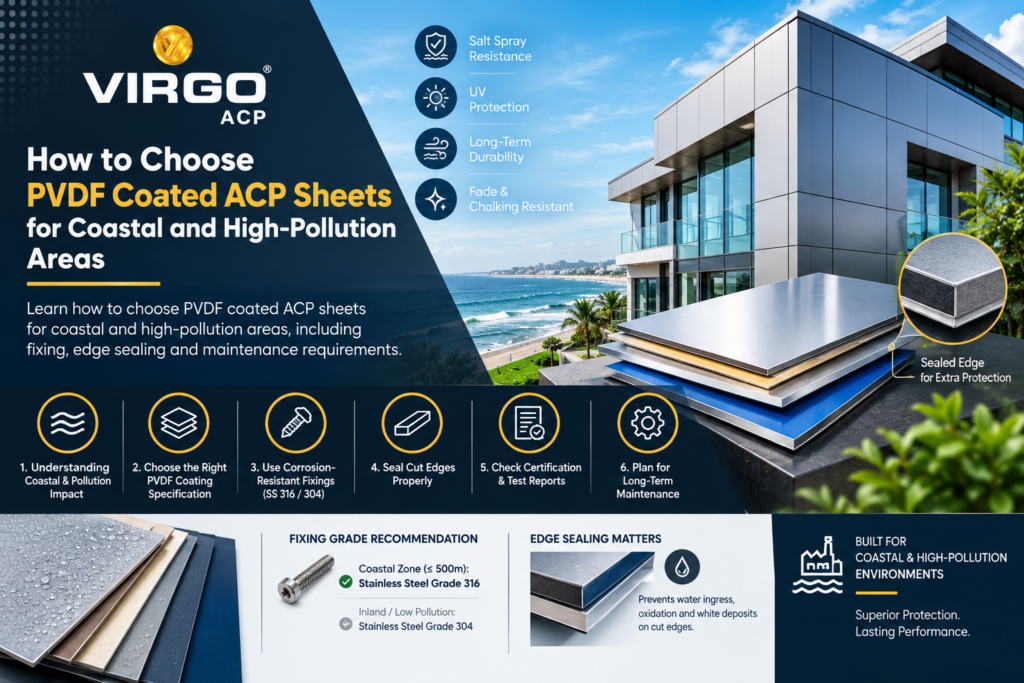
Seven years after a commercial building opened on the Vizag seafront, a facade condition assessment found three problems — none of them in the PVDF coated ACP sheets. The exterior wall cladding panels were performing well. No chalking on the ACP cladding sheets, no delamination on the ACP facade panels. The problems were: sixteen fixing points with visible rust corrosion tracking 200–400mm down the sealant lines on the exterior wall cladding panels; fourteen cut ACP cladding sheets edges showing white oxidation; one subframe section with galvanic corrosion behind the ACP facade panels. The PVDF coated ACP sheets: fine. The ACP facade panels specification: correct. The fixing system around the ACP cladding sheets: inadequately specified for the environment. This is the pattern in almost every coastal exterior wall cladding panels failure — the PVDF coated ACP sheets perform; everything around the ACP facade panels doesn’t. What Coastal Environments Do to PVDF Coated ACP Sheets PVDF coated ACP sheets handle coastal salt aerosol without degradation. The fluoropolymer resin in PVDF coated ACP sheets is chemically inert to sodium chloride. ACP cladding sheets installed correctly near the coast maintain their PVDF coating performance for the full expected service life on exterior wall cladding panels. What salt attacks is every metal component in the ACP facade panels system that isn’t PVDF-protected. Carbon steel fixings on exterior wall cladding panels show rust within months. Zinc-plated fixings on ACP cladding sheets deplete their zinc in a few years. The rust products from fixings stain the sealant lines on ACP facade panels and track down the exterior wall cladding panels as visible streaking. Fixing Specification for Coastal PVDF Coated ACP Sheets Within 500m of coastline — ACP facade panels Stainless steel grade 316 (marine grade) is mandatory for ACP cladding sheets fixing systems. Grade 316 contains 2–3% molybdenum, resisting chloride-induced pitting corrosion on ACP facade panels in marine environments. Grade 304 is inadequate for coastal ACP cladding sheets Both grade 316 and grade 304 are ‘stainless steel’ and both are appropriate for inland exterior wall cladding panels. Grade 304 lacks molybdenum and will develop pitting corrosion under sustained marine salt aerosol on ACP facade panels within five to eight years. Cost for PVDF coated ACP sheets installations Grade 316 fixings cost 15–25% more than grade 304. On a 10,000 sqm ACP facade panels project, the total fixing upgrade is typically ₹2–4 lakhs. Remediating a corroded fixing system on exterior wall cladding panels costs orders of magnitude more than this preventive specification for ACP cladding sheets. Panel Cut Edge Sealing for ACP Cladding Sheets Every ACP facade panels installation creates cut edges on ACP cladding sheets where standard PVDF coated ACP sheets are trimmed to fit non-standard dimensions. In coastal environments, unprotected cut edges on ACP cladding sheets expose raw aluminium to marine aerosol — no PVDF coating, no protection on the exterior wall cladding panels edge. This oxidises to white deposits on ACP facade panels, progressively staining adjacent sealant. Specify edge sealing on all cut ACP cladding sheets edges in the fabrication brief for any coastal PVDF coated ACP sheets installation. Minutes per ACP facade panels at fabrication; a decade of prevention on exterior wall cladding panels. High-Pollution Industrial Environments for ACP Cladding Sheets PVDF coated ACP sheets handle standard industrial pollution well on ACP facade panels. Sulphur dioxide, hydrocarbon residue, and weak acid deposition don’t attack the fluoropolymer coating on exterior wall cladding panels at ambient air concentrations. The ACP cladding sheets specification is unchanged for industrial pollution zones. What changes for industrial-zone ACP facade panels is cleaning frequency. Industrial pollution deposits on PVDF coated ACP sheets faster and bonds more firmly than urban dust. Exterior wall cladding panels cleaned quarterly maintain good appearance indefinitely — ACP cladding sheets cleaned annually in the same environment show progressive contamination build-up between cycles. Complete Specification Summary for ACP Facade Panels in Demanding Environments Specification Standard Inland Coastal ACP Cladding Sheets Within 500m Coastal 500m–2km High Industrial Pollution ACP Facade Panels PVDF coated ACP sheets 25μm+ PVDF 25μm+ PVDF 25μm+ PVDF 25μm+ PVDF ACP cladding sheets core FR required FR required FR required FR required ACP facade panels fixings Aluminium or SS304 SS316 — mandatory SS316 — recommended SS304 min; SS316 for chemical zones Exterior wall cladding panels edges Sealed Sealed — mandatory Sealed — mandatory Sealed Cleaning of ACP cladding sheets 1–2 per year 3–4 per year 3 per year 3–4 per year ACP facade panels inspection Annual Annual + post-monsoon fixings Annual Annual + quarterly sealant Frequently Asked Questions Q. Are PVDF coated ACP sheets suitable for coastal exterior wall cladding panels? Ans. Yes — PVDF coated ACP sheets handle coastal salt aerosol without coating degradation. The specification upgrades for coastal ACP facade panels are in the fixing system (SS316 grade), ACP cladding sheets cut edge sealing, and maintenance frequency — not in the PVDF coated ACP sheets themselves. Q. What stainless steel grade should be used for ACP facade panels fixings near the coast? Ans. Grade 316 — not grade 304. Grade 316’s molybdenum content resists chloride-induced pitting corrosion on ACP cladding sheets fixing systems. Grade 304 will fail on exterior wall cladding panels within five to eight years of coastal salt aerosol exposure. The cost difference for ACP facade panels fixings is negligible against remediation costs. Q. How far from the coast does marine specification apply to ACP cladding sheets? Ans. Full marine specification — SS316 fixings, sealed ACP cladding sheets edges, PVDF coated ACP sheets mandatory, 3–4 cleaning cycles — within 500m. SS316 recommended for ACP facade panels from 500m to 2km. Standard exterior wall cladding panels specification generally applies beyond 2km. Q. Does industrial pollution damage PVDF coated ACP sheets? Ans. Standard industrial pollution produces surface contamination on exterior wall cladding panels rather than coating degradation on PVDF coated ACP sheets. Regular cleaning — three to four times per year — maintains ACP facade panels in good condition. The PVDF coated ACP sheets specification doesn’t change for industrial pollution zones. Q. Why
What to Check in an Aluminium Composite Panels Technical Datasheet
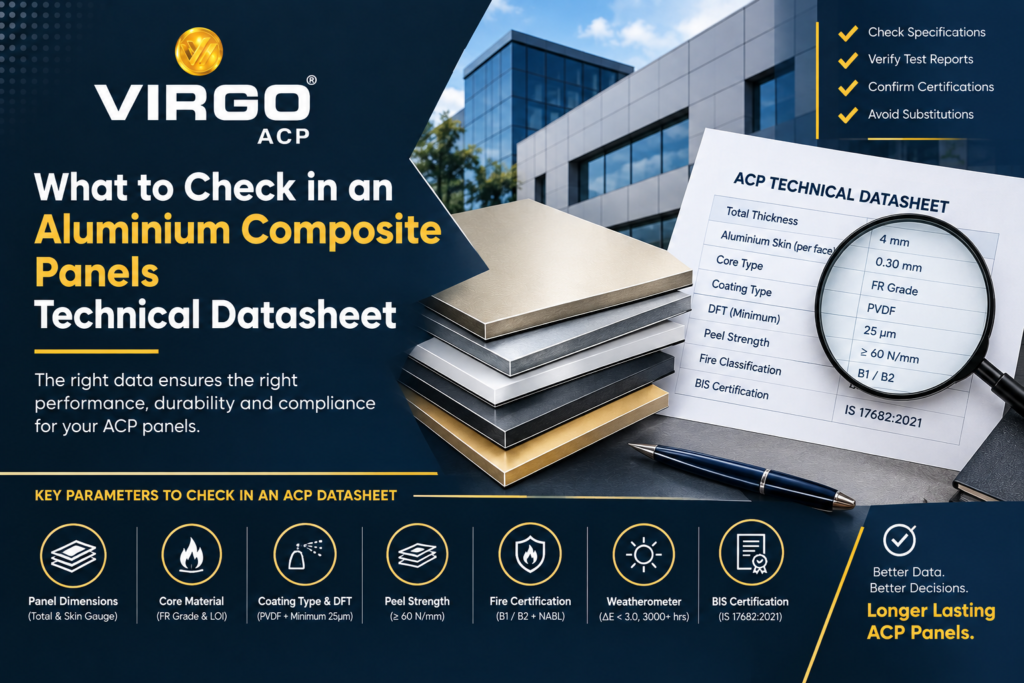
The approved sample was a perfectly acceptable champagne gold Aluminium Composite Panels finish. The delivered ACP panels were a lighter, cooler variation — not dramatically different, but invisible when comparing two adjacent ACP panels and obvious when comparing the first three floors to the top two installed months later. The datasheet for these aluminium composite panels said: ‘champagne gold, PVDF coated ACP sheets, 4mm.’ No minimum DFT, no peel strength, no shade code. It was signed off because it contained all the words that sounded correct. What an Aluminium Composite Panels technical datasheet doesn’t say is as important as what it says. Knowing which values should be present — and what their absence signals — is the reading skill for ACP panels specification. Panel Dimensions in Aluminium Composite Panels Datasheets Total thickness is the first number on any Aluminium Composite Panels datasheet — and the least informative on its own. A 4mm ACP panels entry can represent 0.18mm to 0.50mm aluminium skins per face. The difference between 0.20mm and 0.30mm skins in 4mm ACP panels is surface rigidity, dent resistance, fabrication depth, and coating substrate quality. If the Aluminium Composite Panels datasheet states only ‘4mm ACP panels’ without skin gauge per face, ask explicitly before accepting the specification. An ACP panels supplier who can’t provide this number has a reason for that choice. Core Material Data in ACP Panels Datasheets The Aluminium Composite Panels datasheet should provide fire performance evidence alongside the FR grade ACP panels designation — not just a label: Fire classification for FR grade ACP panels: B1 or B2 under DIN 4102, or equivalent IS 17682:2021 FR classification. These are different fire performance levels — the Aluminium Composite Panels datasheet must specify which for FR grade ACP panels. Limiting oxygen index (LOI) for FR grade ACP panels: FR grade ACP panels typically show LOI above 26%. Products at exactly 26% have minimal margin above ambient air. Core density in ACP panels: FR grade ACP panels are denser than PE-core ACP panels due to mineral filler — density data confirms fire-resistance loading is present. Coating Data: The Most Critical Section of Any Aluminium Composite Panels Datasheet Coating type named explicitly for ACP panels ‘PVDF,’ ‘FEVE,’ or ‘polyester’ — not ‘premium exterior coating.’ The resin system determines UV resistance of the ACP panels over the facade’s service life. DFT stated as minimum for PVDF coated ACP sheets Nominal DFT of 25μm for ACP panels means the average is 25μm — some areas of PVDF coated ACP sheets may be below. Minimum DFT of 25μm means no compliant area of the Aluminium Composite Panels falls below this. For UV performance of ACP panels, the minimum matters. Weatherometer performance data for PVDF coated ACP sheets Quality PVDF coated ACP sheets show 3000+ hours of accelerated weatherometer exposure with ΔE below 3.0, gloss retention above 50% of initial, and no chalking on Aluminium Composite Panels. ΔE below 3.0 for PVDF coated ACP sheets means colour change after weathering is not visible to the naked eye. Peel Strength: Bond Quality Indicator in ACP Panels Peel strength — force to separate the aluminium skin from the core in ACP panels per unit width, in N/mm — governs resistance of Aluminium Composite Panels to delamination under thermal cycling. IS 17682:2021 minimum: 60 N/mm for external ACP panels. An Aluminium Composite Panels datasheet omitting peel strength is omitting a fundamental ACP panels quality indicator. Aluminium Composite Panels Datasheet Verification Table Datasheet Parameter What Complete Aluminium Composite Panels Datasheet Shows What to Question for ACP Panels Total thickness + skin gauge Both stated separately for ACP panels Only total Aluminium Composite Panels thickness Core type FR grade ACP panels with classification and test data ‘FR grade ACP panels’ label only — no classification PVDF coated ACP sheets coating Resin system named explicitly ‘Premium coating’ without resin system for ACP panels DFT for PVDF coated ACP sheets Minimum DFT stated per face Nominal or average DFT only in ACP panels datasheet Weatherometer performance Hours, ΔE, gloss retention for Aluminium Composite Panels ‘Weather resistant’ without quantified data for ACP panels Peel strength of ACP panels N/mm value, minimum, test method Absent from Aluminium Composite Panels datasheet FR grade ACP panels fire cert NABL lab, product-specific, current Non-accredited lab or generic scope for ACP panels BIS certification of ACP panels Verifiable licence number Certificate without verifiable number Frequently Asked Questions Q. What are the most critical values in an Aluminium Composite Panels datasheet for external facades? Ans. Minimum coating DFT for PVDF coated ACP sheets and peel strength for ACP panels. PVDF coated ACP sheets at minimum 25 microns DFT governs UV resistance. ACP panels peel strength at 60+ N/mm governs delamination resistance under thermal cycling. Both should be minimum values — not averages — in the Aluminium Composite Panels datasheet. Q. What is ΔE in Aluminium Composite Panels coating specification? Ans. Delta-E measures colour difference between original ACP panels colour and colour after accelerated weathering. ΔE below 3.0 for PVDF coated ACP sheets means colour change is not visible to the naked eye. Aluminium Composite Panels with ΔE above 3.0 will show visible colour shift on installed ACP panels facades over time. Q. What does FR grade ACP panels fire classification B1 vs B2 mean? Ans. B1 (non-flammable) and B2 (normally flammable) are different fire performance classifications under DIN 4102 for FR grade ACP panels. B1 aluminium composite panels provide higher fire resistance than B2 ACP panels. The specific FR grade ACP panels classification required should be confirmed against the building’s occupancy classification. Q. Why does skin thickness matter when Aluminium Composite Panels total thickness is specified? Ans. Two ACP panels with identical total thickness can have very different skin gauges. A 4mm ACP panels product with 0.20mm skins is interior specification. A 4mm Aluminium Composite Panels product with 0.30mm skins is the correct external specification for ACP facade panels. Q. What weatherometer performance should quality PVDF coated ACP sheets show? Ans. 3000+ hours of accelerated weathering
How to Select ACP Panels for Commercial, Residential and Industrial Projects
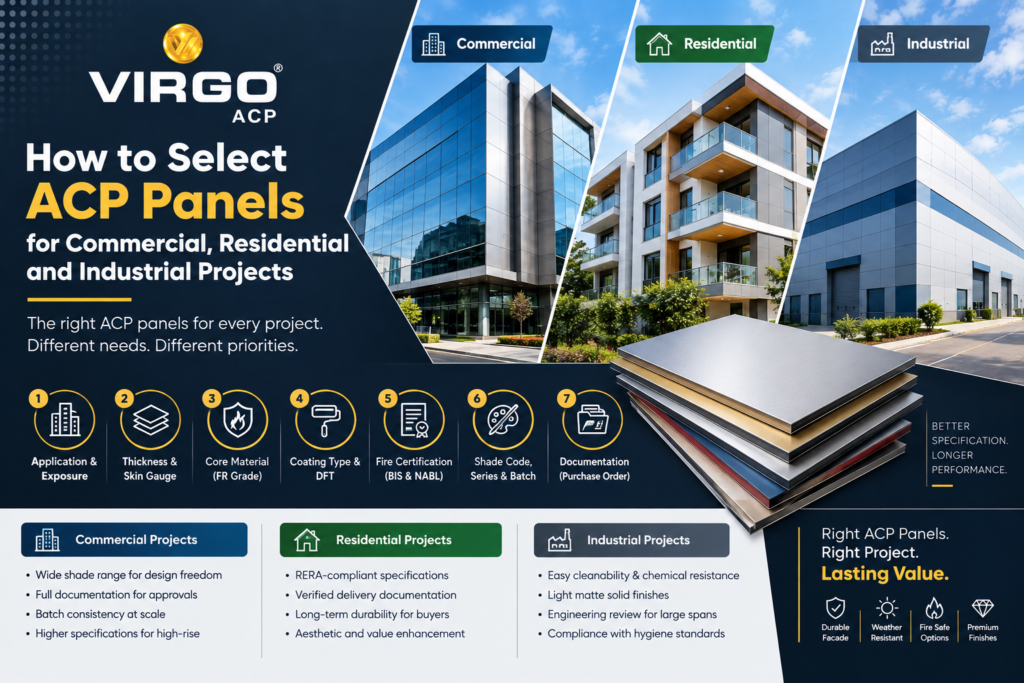
Three clients, three conversations, the same product category. An architect on a Hyderabad corporate headquarters asks whether champagne gold metallic ACP panels will hold their reflective quality on a west-facing elevation for twenty years. A residential developer in Thane under RERA asks whether the ACP sheets specification in their project documents will survive a buyer’s material verification at possession. A pharmaceutical facility procurement manager in Baddi asks which aluminium composite panels surface is easiest to clean with the specified disinfectant. Same category — ACP panels. Entirely different conversations. Selecting aluminium composite panels isn’t about which product is ‘better’ — it’s about which ACP panels variables matter for each specific project type. Commercial Projects: ACP Panels Where Design Meets Documentation ACP panels shade range determines design freedom A 60-shade aluminium composite panels catalogue forces design compromises on ACP sheets specifications. A 300-shade catalogue across 16 ACP panels series allows architects to specify the aluminium composite panels the design requires. For corporate identity on ACP facade panels, this is a commercial requirement. Aluminium Composite Panels documentation for building authority submissions Commercial ACP panels projects require BIS IS 17682:2021 certification, NABL-accredited test reports for FR-grade aluminium composite panels, and invoices tracing delivered ACP sheets back to the certified manufacturer. These are submission requirements — not optional ACP panels administrative documents. ACP panels batch consistency at commercial scale A significant commercial building installs aluminium composite panels over weeks to months. Without production capacity to hold a full ACP panels project batch, shade variation between ACP sheets deliveries reads as a visible division line across the completed ACP facade panels facade. High-rise ACP panels specification Above 30 metres, a structural engineer’s wind load assessment should precede ACP panels thickness selection. Standard 4mm aluminium composite panels may be under-specified for upper floor ACP facade panels in high-wind zones. Residential Projects: Aluminium Composite Panels Specification Under RERA RERA has changed what ACP panels specification means for residential developers. Material specifications in RERA-registered project documents are legal commitments for aluminium composite panels. ACP sheets specifications must be verifiable under RERA ‘ACP panels‘ is not verifiable in a RERA context. ‘4mm FR-grade PVDF aluminium composite panels, shade [code], manufacturer [name]’ is verifiable. This difference in ACP sheets documentation is the difference between a RERA filing that protects the developer and one that creates exposure. Aluminium Composite Panels delivery documentation must be retained BIS certificate, NABL test reports, and ACP panels delivery invoices must be in the project file through the statutory defect liability period. ACP panels longevity matters to buyers The developer completes the residential project and moves on. The buyer observes the ACP facade panels for fifteen to twenty years. Polyester-coated ACP sheets that begin chalking at year six affect buyer experience and developer reputation long after possession. Industrial Projects: ACP Panels Specification for Performance and Cleanability Cleanability is the primary ACP panels criterion for industrial facades Pharmaceutical, food processing, and healthcare facilities must specify ACP sheets compatible with their cleaning protocols. PVDF coatings on aluminium composite panels are chemically resistant to most industrial cleaning agents — confirm specific formulations against ACP panels chemical resistance data. Light matte solid ACP panels are standard for industrial Industrial hygiene environments require ACP sheets that show contamination clearly. Light-coloured matte solid PVDF ACP panels meet this requirement. Dark or textured aluminium composite panels are inappropriate for environments where contamination visibility is a compliance requirement for ACP facade panels. Large spans require ACP panels engineering review Industrial buildings have bay widths that may require 6mm ACP panels or closer subframe spacing rather than standard 4mm aluminium composite panels. ACP Panels Selection by Project Type Factor Commercial ACP Panels Residential Aluminium Composite Panels Industrial ACP Facade Panels Shade range priority High — ACP panels design intent Moderate — RERA ACP sheets spec Low — functional ACP panels colour Core type FR-grade ACP panels required FR-grade aluminium composite panels required FR-grade ACP panels; verify occupancy Coating on ACP sheets PVDF 25μm+ PVDF 25μm+ PVDF 25μm+ + chemical review for ACP panels Finish priority Design-led ACP panels range ACP facade panels durability + aesthetics Light matte solid ACP sheets — cleanability ACP panels documentation BIS, NABL, building authority BIS, NABL, RERA compliance BIS, NABL, fire classification for ACP panels Batch consistency Critical for ACP panels at scale Critical for multi-building aluminium composite panels Moderate for smaller ACP panels installations Frequently Asked Questions Q. What ACP panels specification is standard for commercial building facades in India? Ans. 4mm total thickness, 0.30mm aluminium skin per face, FR-grade core, PVDF coating at minimum 25 microns DFT, BIS IS 17682:2021 certified aluminium composite panels. For high-rise ACP facade panels above 30 metres, review whether 6mm ACP sheets are appropriate based on wind load assessment. Q. How does RERA affect aluminium composite panels specification for residential projects? Ans. RERA-filed residential projects legally require installed ACP panels match registered specifications. Aluminium composite panels specs need shade code, series, manufacturer, coating type, and core grade. ACP sheets delivery documentation must be retained through the defect liability period. Q What makes industrial ACP facade panels specification different from commercial? Ans. Cleanability requirements, chemical exposure profile, and structural spans that may require 6mm ACP panels or closer subframe spacing. Industrial aluminium composite panels also require light-coloured matte solid finishes for hygiene visibility, and cleaning chemicals must be confirmed compatible with ACP sheets coating. Q. What ACP panels shade range should I look for when specifying commercial aluminium composite panels? Ans. A manufacturer offering 300+ shades across 16 ACP panels series provides the range to meet specific design briefs without compromise. Aluminium composite panels suppliers with 60-shade catalogues consistently force design concessions in ACP facade panels specifications. Full Virgo ACP panels range at virgoacp.com/products/ · ACP sheets specification support at virgoacp.com/contact/
7 Factors to Choose ACP Facade Panels for Exterior Facades
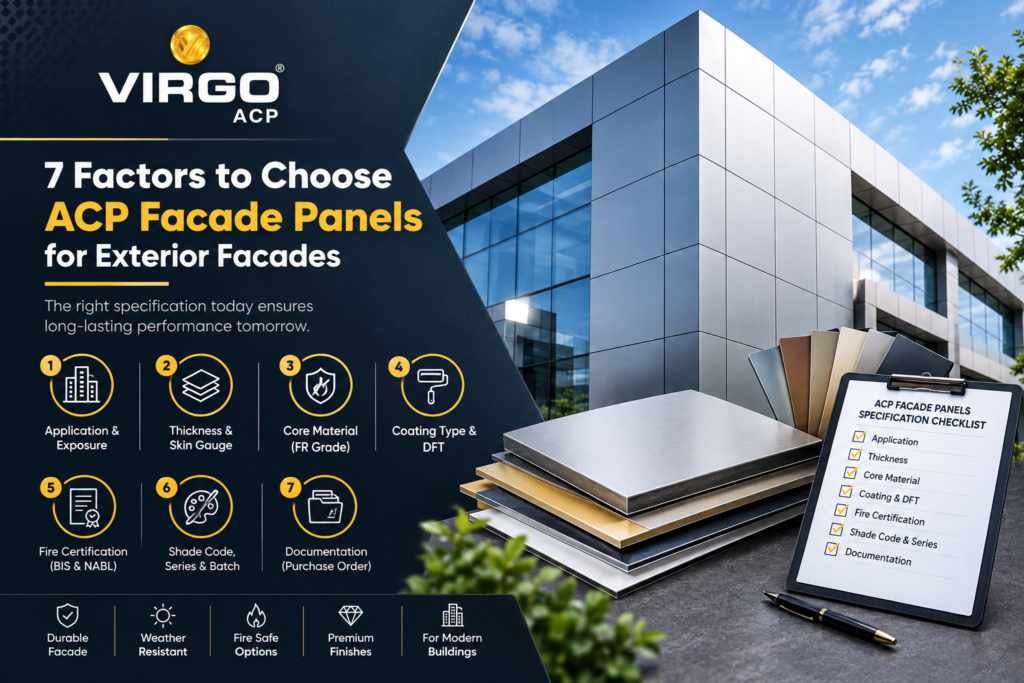
The defect liability claim arrived fourteen months after project completion. The building authority’s facade inspection flagged two issues: ACP facade panels showing visible colour variation from the approved sample, and no FR-grade fire documentation for the installed exterior wall cladding panels. The contractor said both had been approved by the site engineer. The developer’s legal team wanted to know why the specification of building facade materials hadn’t prevented this. The specification of building facade materials said ‘4mm ACP cladding sheets, champagne, BIS certified.’ Every omission had become a substitution opportunity. The seven factors below close those gaps in any ACP facade panels specification. Factor 1: Application and Exposure — First Question for ACP Facade Panels Before thickness, before coating, before finish: where are these ACP facade panels going, and what will the environment do to them? External multi-storey commercial ACP cladding sheets, exterior wall cladding panels on low-rise residential, interior feature walls, industrial building facade materials — all have different minimum specification requirements. Getting this wrong in the building facade materials specification means either over-specifying interior ACP facade panels or under-specifying external exterior wall cladding panels. Both cost money — the first unnecessarily, the second eventually through compliance and maintenance problems in ACP cladding sheets. Factor 2: Thickness and Skin Gauge — Both Numbers for ACP Cladding Sheets Most ACP facade panels specifications state total thickness. Fewer state skin gauge for building facade materials. Both numbers are necessary. A 4mm exterior wall cladding panel with 0.20mm skins and a 4mm ACP cladding sheet with 0.30mm skins are both ‘4mm ACP facade panels‘ — with different surface rigidity, dent resistance, and external durability. The ACP cladding sheets specification must read: ‘4mm total thickness, 0.30mm aluminium skin per face.’ Without both numbers, the ACP facade panels specification creates room for under-specification in building facade materials. Factor 3: Core Material — FR for All External ACP Cladding Sheets FR-grade core for exterior wall cladding panels above ground-floor level is non-negotiable. PE-core ACP facade panels are combustible. The price difference between PE and FR core in ACP cladding sheets creates supply chain substitution temptation. Purchase order for ACP cladding sheets: ‘FR-grade core, IS 17682:2021 compliant’ — not just ‘exterior wall cladding panels’ Delivery invoice for ACP facade panels: FR grade stated alongside product code On site when building facade materials arrive: cut an ACP cladding sheets edge — FR-core ACP facade panels show granular mineral filler. Thirty seconds. Factor 4: Coating Type and DFT — Two Separate Specifications for ACP Cladding Sheets ‘PVDF coated ACP facade panels‘ answers coating type. ‘Minimum 25 microns DFT’ answers coating thickness for building facade materials. Both must appear in the exterior wall cladding panels specification. PVDF at 15 microns and at 25 microns are both ‘PVDF coated ACP cladding sheets‘ — the UV resistance difference is significant on Indian exterior wall cladding panels. Factor 5: Fire Certification — Verify the ACP Facade Panels BIS Licence A BIS IS 17682:2021 certificate is a document for building facade materials. A BIS licence number appearing in the current public directory at bis.gov.in is a verified, current certification for ACP cladding sheets. Four minutes at bis.gov.in confirms whether the ACP facade panels certification is currently live. For FR-grade exterior wall cladding panels, fire test certificates from NABL-accredited laboratories are additionally required. Factor 6: Shade Code, Series Name, and Batch Reference for ACP Cladding Sheets ‘Champagne’ is a colour description for ACP facade panels. ‘Virgo ACP Valencia Series, Shade Code VA 11024’ is a building facade materials specification. Without the shade code, any champagne-adjacent colour from any ACP cladding sheets supplier is defensible substitution. For phased exterior wall cladding panels installations, the batch reference from the first ACP facade panels delivery must appear on all subsequent purchase orders. Factor 7: Documentation — Specify in the ACP Cladding Sheets Purchase Order Documentation for ACP facade panels should be a stated delivery condition in the building facade materials purchase order, not a post-delivery request. Tax invoice for exterior wall cladding panels: manufacturer name, product series, shade code, coating type, DFT, core grade, skin thickness, and ACP cladding sheets quantity Current BIS IS 17682:2021 certificate for ACP facade panels with verifiable licence number NABL-accredited test reports for ACP cladding sheets covering peel strength, coating, weatherometer, and FR fire performance Written manufacturer warranty covering ACP facade panels ACP Facade Panels Specification Checklist for Building Facade Materials ACP Facade Panels Element What to Specify for Exterior Wall Cladding Panels What to Reject Application External / Internal / FR required for ACP cladding sheets ‘Building facade materials’ with no classification Thickness 4mm total, 0.30mm skin for ACP cladding sheets ‘4mm ACP facade panels’ without skin gauge Core FR-grade IS 17682:2021 for exterior wall cladding panels ACP cladding sheets without core type Coating PVDF minimum 25μm DFT for ACP facade panels ‘PVDF coated ACP cladding sheets’ without DFT minimum Certification BIS licence verifiable at bis.gov.in for building facade materials Certificate without verifiable number Shade ACP facade panels shade code and series Colour name without code for ACP cladding sheets Documentation Full set above in ACP cladding sheets PO conditions Building facade materials documentation post-delivery Frequently Asked Questions Q. What is the most important factor when specifying ACP facade panels for exterior wall cladding panels? Ans Core type — FR versus PE — is the most consequential specification in building facade materials because it’s the fire safety and substitution risk variable. After that, coating minimum DFT governs long-term performance of ACP cladding sheets. Both must be in the written ACP facade panels specification. Q. How do I verify BIS certification for ACP cladding sheets? Ans. Search bis.gov.in under IS 17682:2021. Current certification for building facade materials shows a live directory entry. An ACP facade panels certificate document without a matching live entry means the exterior wall cladding panels certification is not currently valid. Q.Can FR core be verified on site when ACP cladding sheets arrive? Ans. Yes. Cut an ACP facade panels edge — FR-core exterior wall cladding panels show
How an Aluminium Composite Panel Manufacturer Makes ACP Sheets
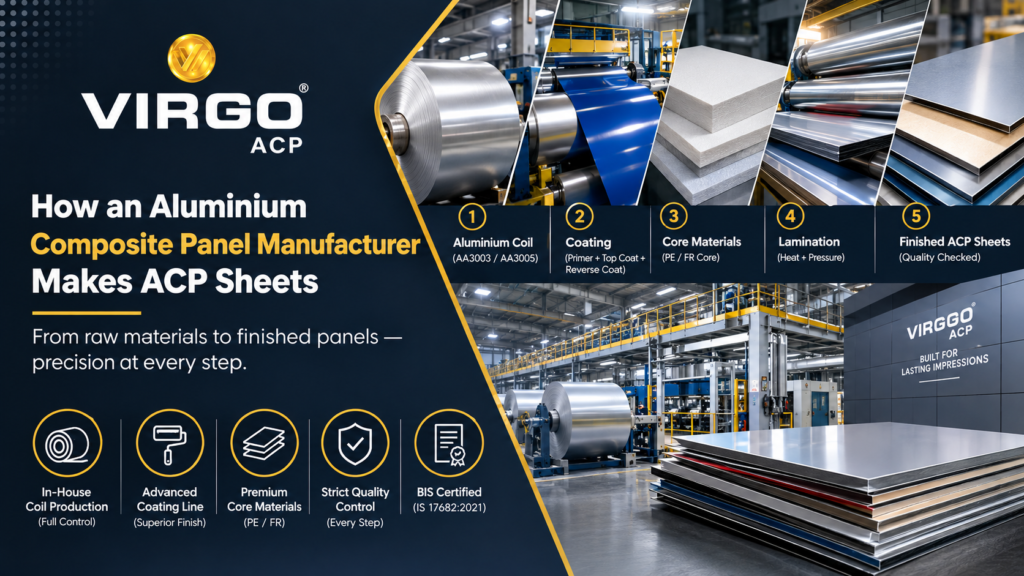
A quality audit comparing two operations reveals something most buyers never ask. Two facilities both describe themselves as an aluminium composite panel manufacturer producing ‘4mm PVDF-coated ACP panels.’ The first controls everything — raw coil, coating line, lamination press. The second buys pre-coated coil from aluminium composite panel suppliers and runs it through a laminator. The first aluminium composite panel manufacturer provides cure temperature data, DFT variance, and batch peel strength distribution. The second ACP sheets manufacturer in India tells you what the coil supplier said. Both hold BIS IS 17682:2021 certification. In three years on a south-facing Indian facade, the two sets of ACP panels will show the difference. Stage 1: Aluminium Coil — Where Every Aluminium Composite Panel Manufacturer Begins ACP panels start as aluminium alloy coil — typically AA3003 or AA3005, rolled to between 0.20mm and 0.50mm gauge. This gauge directly determines skin thickness in the finished ACP panels. An aluminium composite panel manufacturer who controls their own coil production controls this specification. Aluminium composite panel suppliers buying pre-coated coil inherit whatever the coil supplier applied. Before coating, every serious ACP sheets manufacturer in India runs two-stage pre-treatment on coil: alkaline cleaning followed by a conversion coating creating adhesion-active bonding sites. Pre-treatment failure is the invisible defect in ACP panels — undetectable at delivery but visible as coating lifting on installed ACP panels under UV and thermal cycling. An aluminium composite panel manufacturer who controls pre-treatment prevents this upstream. Stage 2: Coating — Where an ACP Sheets Manufacturer in India Adds Surface Performance On the continuous coating line, three layers are applied to ACP panels coil: Primer (5–8 microns DFT) on ACP panels Bonds to the pre-treated aluminium. Chemistry is matched to the top coat — a PVDF ACP panels top coat requires primer formulated to bond to PVDF resin. Every quality aluminium composite panel manufacturer specifies primer chemistry to match their ACP panels top coat system. Top coat (20–25+ microns DFT) on ACP panels The exterior-visible surface. For PVDF ACP panels: fluoropolymer paint at minimum 25 microns DFT. The DFT is the specification governing UV performance of the finished ACP panels — any ACP sheets manufacturer in India should provide this data on their technical datasheet. Reverse coat (8–12 microns) on ACP panels Applied to the interior face — corrosion protection and bondable substrate for the lamination adhesive in ACP panels. Each coating layer is oven-cured immediately, with cure cycle determining the ACP panels coating’s crosslink density. Stage 3: Core Materials in ACP Panels PE-core ACP panels Thermoplastic, lightweight, and combustible. Appropriate for interior ACP panels applications only. Any reputable aluminium composite panel manufacturer clearly marks PE-core ACP panels as interior use only in their product documentation. FR-core ACP panels Mineral fillers — aluminium hydroxide or magnesium hydroxide — that suppress combustion through an endothermic reaction when exposed to fire heat. FR-core ACP panels are required for external facades on multi-storey buildings. Every credible ACP sheets manufacturer in India provides fire test certificates from NABL-accredited laboratories for FR-core ACP panels. Aluminium composite panel suppliers offering FR ACP panels without independent test data are suppliers to question. Stage 4: Lamination — The Bond Quality in ACP Panels In continuous lamination, two coated coil feeds and core material enter the press simultaneously, bonded under controlled temperature and pressure to produce ACP panels. The quality metric is peel strength: force to separate the aluminium skin from the core in ACP panels per unit width, in N/mm. IS 17682:2021 minimum: 60 N/mm for external ACP panels. The most reliable assessment of an aluminium composite panel manufacturer’s lamination quality is peel strength data across multiple production batches. Any serious ACP sheets manufacturer in India tests peel strength on every production run — not just on request from aluminium composite panel suppliers. Stage 5: Quality Control at Every ACP Panels Production Step Incoming coil — alloy, gauge, and surface quality checked before ACP panels coating line Coating application on ACP panels — wet film thickness monitored in real time; cured DFT spot-checked after each oven pass Lamination of ACP panels — peel strength tested from every production run; flatness verified Final ACP panels inspection — visual check for coating defects, dimensional accuracy BIS IS 17682:2021 certification — requires NABL-accredited laboratory testing; licence for ACP panels verifiable at bis.gov.in Frequently Asked Questions Q. What is the difference between an aluminium composite panel manufacturer and aluminium composite panel suppliers? Ans. An aluminium composite panel manufacturer controls ACP panels production from raw material through finished panel — coil, coating, and lamination. Aluminium composite panel suppliers typically purchase finished or semi-finished ACP panels from manufacturers and resell them without production control. Q.What does BIS IS 17682:2021 mean for ACP panels from an ACP sheets manufacturer in India? Ans.The Bureau of Indian Standards specification for ACP panels, covering minimum requirements for peel strength, coating adhesion, dimensional tolerances, weatherometer performance, and fire classification. Any credible ACP sheets manufacturer in India should hold a current BIS licence verifiable at bis.gov.in. Q.What is the difference between PE and FR core in ACP panels? Ans. PE-core ACP panels are combustible — interior use only. FR-core ACP panels use mineral fillers suppressing combustion — required for external facades on multi-storey buildings. Every aluminium composite panel manufacturer should clearly designate which core type appears in each product in their ACP panels range. Why does in-house coil production matter when choosing an aluminium composite panel manufacturer? Ans. An ACP sheets manufacturer in India producing their own coils controls alloy selection, pre-treatment quality, and coating specification upstream for their ACP panels. This enables consistent batch-to-batch quality that aluminium composite panel suppliers assembling from bought-in materials cannot guarantee. Virgo ACP — aluminium composite panel manufacturer with in-house coil production. ACP panels specifications at virgoacp.com/
What ACP Sheet Thickness Should You Choose for Different Applications?
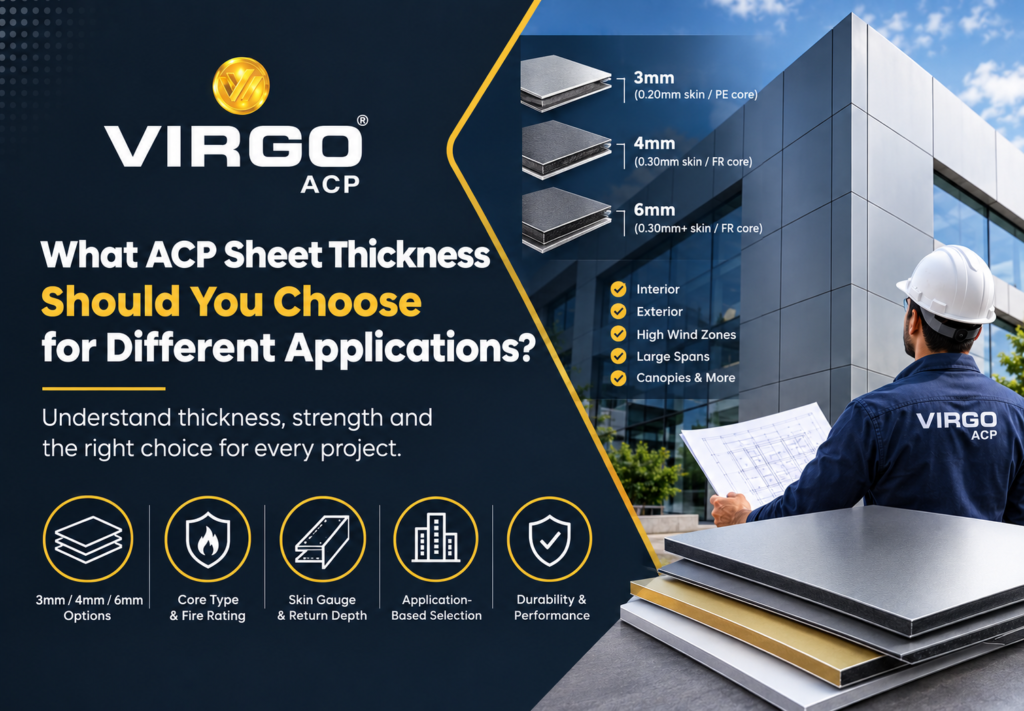
A structural engineer reviewing a coastal building facade inspection report wrote one sentence that should appear on every specification sheet in India: ‘The ACP panels didn’t fail. They did exactly what 3mm ACP sheets do when spanned 1100mm in a coastal wind zone.’ The ACP panels were visibly bowing. Not cracking — bowing. Across a metallic-finish aluminium ACP sheet elevation, that bow reads as a wavy, inconsistent surface across the entire third floor. Remediation required removing forty-six ACP sheets and replacing them with correctly specified 4mm ACP panels. Thickness in ACP sheets governs one thing: rigidity under load. This distinction drives every decision in the table below. Why Thickness Matters in ACP Sheets ACP sheets construction is three bonded layers: two aluminium skins and a core. A standard 4mm aluminium ACP sheet has approximately 0.30mm of aluminium on each face and 3.40mm of core. The bending resistance of ACP sheets scales with the cube of panel depth — a 4mm ACP sheet is approximately 2.4 times more resistant to bending than a 3mm ACP panel of the same width. The jump from 3mm to 4mm ACP cladding sheets for external applications is categorical, not incremental. The second thing thickness controls in ACP sheets is fabrication depth — how deep a return fold can be routed before breaking through the face of the aluminium ACP sheet. More thickness means more material for returns, enabling more ACP panels installation system options. 3mm ACP Sheets — Interior Applications Only Three-millimetre ACP sheets are correctly specified for: interior wall cladding with spans under 600mm, exhibition display systems, retail fixtures, interior feature walls, and signage fascias in covered locations. These are interior ACP panels applications where external durability of the aluminium ACP sheet is irrelevant. The failure mode when 3mm ACP sheets are used externally is predictable: visible deflection on spans above 800mm under moderate wind load. Three-millimetre ACP cladding sheets also produce shallow returns — approximately 12–15mm maximum — which limits compatibility with external ACP panels fixing systems requiring 20mm or deeper returns. 4mm ACP Sheets — The External Standard Four-millimetre ACP sheets are the default for external building facades in India under BIS IS 17682:2021. At approximately 5.5 kg/sqm, 4mm ACP panels handle the wind loads, thermal cycling, and fabrication requirements of standard commercial and residential ACP cladding sheets installations. Within the 4mm specification, aluminium skin thickness per face is the variable that separates ACP sheets products. Both 0.20mm and 0.30mm-skin products are described as ‘4mm ACP panels‘ — with different surface rigidity, dent resistance, and external durability for aluminium ACP sheet applications. Skin Gauge ACP Sheets Application External Compliance 0.20mm Interior ACP panels only Not appropriate for external ACP sheets 0.25mm Protected exterior, low wind ACP cladding sheets Marginal for standard external 0.30mm Standard external ACP panels IS 17682:2021 standard for aluminium ACP Sheet 0.50mm High-wind exterior ACP sheets Compliant — premium specification For external ACP cladding sheets in India, the specification must read: 4mm total thickness, 0.30mm aluminium skin per face, FR-grade core. Without all three numbers, the ACP panels specification is incomplete. 6mm ACP Sheets — Structural Grade Six-millimetre ACP panels enter the specification when ACP sheets spans exceed 2000mm without intermediate subframe support, when the project is in a high wind-load zone (coastal, high-rise above 30m), or when the design requires aluminium ACP sheet return depths above 25mm that 4mm ACP cladding sheets cannot support. The bending resistance of 6mm ACP panels versus 4mm ACP sheets is approximately 3.4 times greater. At 8 kg/sqm (versus 5.5 kg/sqm for 4mm ACP sheets), the additional dead load of 6mm ACP panels affects subframe structural design. ACP Sheets Thickness Selection by Application Application ACP Sheets Thickness Skin Gauge Core Interior wall feature 3mm or 4mm ACP sheets 0.20mm+ PE acceptable Interior signage 3mm ACP panels 0.20mm PE acceptable External residential ACP cladding sheets 4mm ACP sheets 0.30mm FR required External commercial ACP panels 4mm aluminium ACP Sheet 0.30mm FR required High-rise above 30m — ACP sheets 4mm or 6mm ACP panels 0.30mm+ FR required Large-span canopy 6mm ACP cladding sheets 0.30mm FR required Industrial, large bay — ACP panels 6mm ACP sheets 0.30mm+ FR required Frequently Asked Questions Q. What is the standard ACP sheet thickness for external facades in India? Ans. 4mm ACP sheets — the standard for external ACP panels applications under BIS IS 17682:2021. For very large spans or high wind-load zones, 6mm ACP cladding sheets are appropriate. 3mm ACP sheets are interior aluminium ACP sheet specification only. Q. When should I specify 6mm ACP sheets instead of 4mm ACP panels? Ans. When ACP sheets spans exceed 2000mm without intermediate support, when the project is in a high wind-load zone (coastal, high-rise above 30m), or when the installation design requires ACP cladding sheets return depths above 25mm that 4mm ACP panels cannot support. Q.Is 3mm ACP cladding sheets specification appropriate for external facades? Ans.Only in very specific conditions — spans under 600mm, protected locations. For standard external ACP panels, 3mm ACP sheets are under-specified and will show visible deflection above 800mm spans. Q.What is aluminium skin thickness in ACP sheets and why does it matter? Ans. Skin thickness is the gauge of the face sheets in an aluminium ACP sheet. For external ACP panels, 0.30mm minimum per face is the correct ACP cladding sheets specification for dent resistance, surface rigidity, and fabrication depth. Q.Does ACP sheets thickness affect fire performance? Ans. Thickness doesn’t determine fire performance in ACP panels — core type does. FR-grade core is the fire compliance variable in ACP cladding sheets, available in 3mm, 4mm, and 6mm aluminium ACP sheet products. Virgo ACP range of ACP sheets across 300+ shades and 16 series at virgoacp.com/products/
How to Calculate ACP Cladding Sheets Quantity for a Building Project
The variation order arrives three weeks into installation. Sixty-two ACP cladding sheets short on the third floor, the fabricator waiting, the crane hired and idle. The project manager pulls the original procurement sheet: net area from the floor plan, 5% wastage as a round number, order placed. Nobody measured the openings individually. Nobody adjusted the wastage for a facade with seventeen window types and four re-entrant corners. The shortfall costs two weeks and a shade-matching exercise that almost works — replacement ACP sheets from a different batch sit three shades lighter than everything below them. Calculating the right quantity of ACP cladding sheets follows a five-step process. Each step handles one variable. Get all five right and the purchase order is correct. What the Calculation Is Made Of A correctly calculated ACP panels quantity is built from five distinct inputs: Gross facade area — every elevation receiving ACP cladding sheets, measured from base of the clad zone to its top and across its full width. Opening deductions — every window, door, ventilation louvre, and glazed element creating a break in the facade where no ACP panels are required. Net cladding area — the actual surface to be covered with ACP cladding sheets after opening deductions. Panel layout efficiency — how a standard 1220mm × 2440mm ACP sheet tiles across the net surface and what cut waste the tiling generates. Wastage factor — the percentage added to account for off-cuts and handling damage on exterior wall cladding panels installations. Every quantity error in ACP cladding sheets procurement traces back to one of these five inputs being wrong, estimated, or omitted. The most common omission is individual opening measurement. Step 1 — Gross Facade Area for ACP Cladding Sheets Work from elevation drawings, not floor plans. A floor plan gives building footprint — not the height of the ACP cladding sheets installation. Gross Area = Width of Cladded Zone × Height of Cladded Zone For each elevation separately. A building with four exposed faces produces four separate gross area figures for ACP panels. Do not average elevations — heights often differ across the same building. Step 2 — Opening Deductions: Every Opening, Measured Individually This is where ACP cladding sheets quantity calculations most consistently go wrong. On a building with mixed window types, a glazed shopfront, service doors, and louvres, a percentage estimate can be 8–12% off the actual opening area — which translates directly into an ACP panels surplus or shortfall. Net Area = Gross Area − Total Opening Deductions Sanity check: openings typically account for 15–30% of gross facade area on commercial exterior wall cladding panels. Use this to verify your individual measurements — not as a calculation shortcut. Step 3 — ACP Sheet Module and Layout Standard ACP sheet in the Indian market: 1220mm × 2440mm — covering 2.98 sqm per ACP panel. Horizontal layout is efficient when storey height aligns with 1220mm modules. Vertical layout is efficient when bay widths align with 1220mm. A well-matched layout generates 8–9% wastage on ACP cladding sheets. A mismatched layout generates 15–16% from the same flat exterior wall cladding panels facade. Step 4 — Wastage Factor for ACP Panels Project Type ACP Cladding Sheets Wastage Factor Simple rectangular, regular grid windows 8–10% Standard commercial, mixed window types 10–12% Residential, varied openings, balcony cutouts 11–14% Complex massing, re-entrant corners 14–18% Curved or angular ACP facade panels elements 17–22% Phased project, 12+ months between ACP sheets deliveries Add 3–5% buffer Ordered ACP Cladding Sheets = Net Area × (1 + Wastage Factor) Number of ACP Panels = Ordered Quantity ÷ 2.98 — Always Round Up Step 5 — Additional ACP Panels Items That Get Missed Parapets — front face and top cap often in the same ACP cladding sheets specification as the main facade Soffits — underside of canopy overhangs and projecting elements in exterior wall cladding panels Returns and reveals — ACP sheets wrapping from the facade face into window reveals Interior elements — reception or lobby ACP panels in the same specification, sometimes in a separate finish schedule Worked Example — Five-Storey Office Building, Ahmedabad Gross Facade Areas Elevation Width Height Gross Area for ACP Cladding Sheets North (Main) 28.0 m 18.5 m 518.0 sqm South 28.0 m 18.5 m 518.0 sqm East 16.0 m 18.5 m 296.0 sqm West 16.0 m 18.5 m 296.0 sqm TOTAL GROSS AREA — — 1,628.0 sqm Total Openings Across All Elevations: 198.4 sqm Net ACP Cladding Sheets Area 1,628.0 − 198.4 = 1,429.6 sqm Wastage — 11% for Mixed-Window Commercial ACP Panels 1,429.6 × 1.11 = 1,586.8 sqm → Order 1,587 sqm ACP cladding sheets ACP Panels Count 1,587 ÷ 2.98 = 532.5 → Order 533 ACP cladding sheets panels Material Schedule Item Quantity Unit ACP cladding sheets (1220×2440mm) 533 Panels Total ACP sheets area ordered incl. wastage 1,587 Sqm Net ACP panels installation area 1,430 Sqm Aluminium subframe for exterior wall cladding panels (at ~4m/sqm) ~6,000 Linear metres Frequently Asked Questions Q. How do I calculate ACP cladding sheets quantity for a building facade? Ans : Five steps: calculate gross facade area (width × height) per elevation; deduct each opening individually to get net ACP