Seven years after a commercial building opened on the Vizag seafront, a facade condition assessment found three problems — none of them in the PVDF coated ACP sheets. The exterior wall cladding panels were performing well. No chalking on the ACP cladding sheets, no delamination on the ACP facade panels. The problems were: sixteen fixing points with visible rust corrosion tracking 200–400mm down the sealant lines on the exterior wall cladding panels; fourteen cut ACP cladding sheets edges showing white oxidation; one subframe section with galvanic corrosion behind the ACP facade panels.
The PVDF coated ACP sheets: fine. The ACP facade panels specification: correct. The fixing system around the ACP cladding sheets: inadequately specified for the environment. This is the pattern in almost every coastal exterior wall cladding panels failure — the PVDF coated ACP sheets perform; everything around the ACP facade panels doesn’t.
What Coastal Environments Do to PVDF Coated ACP Sheets
PVDF coated ACP sheets handle coastal salt aerosol without degradation. The fluoropolymer resin in PVDF coated ACP sheets is chemically inert to sodium chloride. ACP cladding sheets installed correctly near the coast maintain their PVDF coating performance for the full expected service life on exterior wall cladding panels.
What salt attacks is every metal component in the ACP facade panels system that isn’t PVDF-protected. Carbon steel fixings on exterior wall cladding panels show rust within months. Zinc-plated fixings on ACP cladding sheets deplete their zinc in a few years. The rust products from fixings stain the sealant lines on ACP facade panels and track down the exterior wall cladding panels as visible streaking.
Fixing Specification for Coastal PVDF Coated ACP Sheets
Within 500m of coastline — ACP facade panels
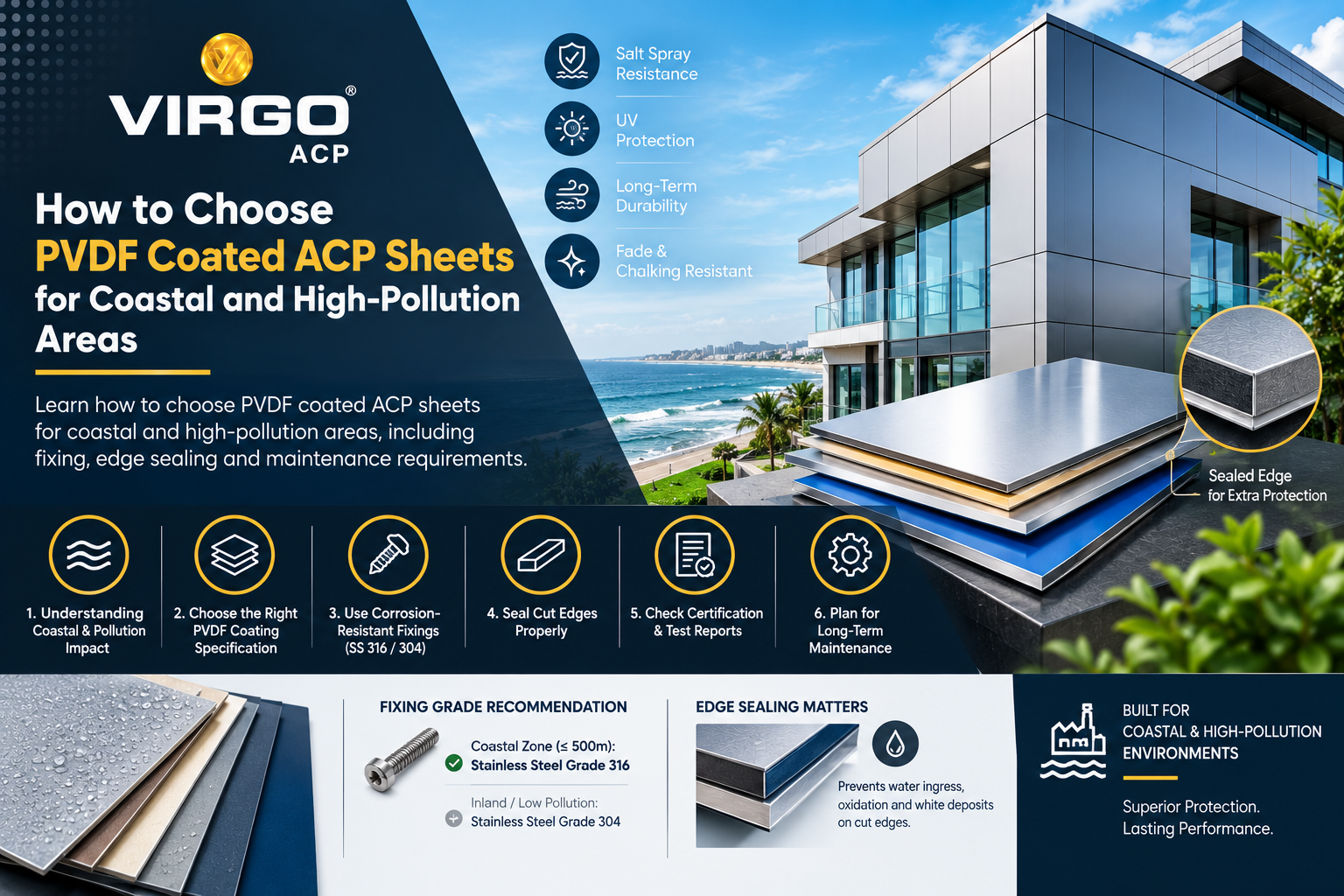
Stainless steel grade 316 (marine grade) is mandatory for ACP cladding sheets fixing systems. Grade 316 contains 2–3% molybdenum, resisting chloride-induced pitting corrosion on ACP facade panels in marine environments.
Grade 304 is inadequate for coastal ACP cladding sheets
Both grade 316 and grade 304 are ‘stainless steel’ and both are appropriate for inland exterior wall cladding panels. Grade 304 lacks molybdenum and will develop pitting corrosion under sustained marine salt aerosol on ACP facade panels within five to eight years.
Cost for PVDF coated ACP sheets installations
Grade 316 fixings cost 15–25% more than grade 304. On a 10,000 sqm ACP facade panels project, the total fixing upgrade is typically ₹2–4 lakhs. Remediating a corroded fixing system on exterior wall cladding panels costs orders of magnitude more than this preventive specification for ACP cladding sheets.
Panel Cut Edge Sealing for ACP Cladding Sheets
Every ACP facade panels installation creates cut edges on ACP cladding sheets where standard PVDF coated ACP sheets are trimmed to fit non-standard dimensions. In coastal environments, unprotected cut edges on ACP cladding sheets expose raw aluminium to marine aerosol — no PVDF coating, no protection on the exterior wall cladding panels edge. This oxidises to white deposits on ACP facade panels, progressively staining adjacent sealant.
Specify edge sealing on all cut ACP cladding sheets edges in the fabrication brief for any coastal PVDF coated ACP sheets installation. Minutes per ACP facade panels at fabrication; a decade of prevention on exterior wall cladding panels.
High-Pollution Industrial Environments for ACP Cladding Sheets
PVDF coated ACP sheets handle standard industrial pollution well on ACP facade panels. Sulphur dioxide, hydrocarbon residue, and weak acid deposition don’t attack the fluoropolymer coating on exterior wall cladding panels at ambient air concentrations. The ACP cladding sheets specification is unchanged for industrial pollution zones.
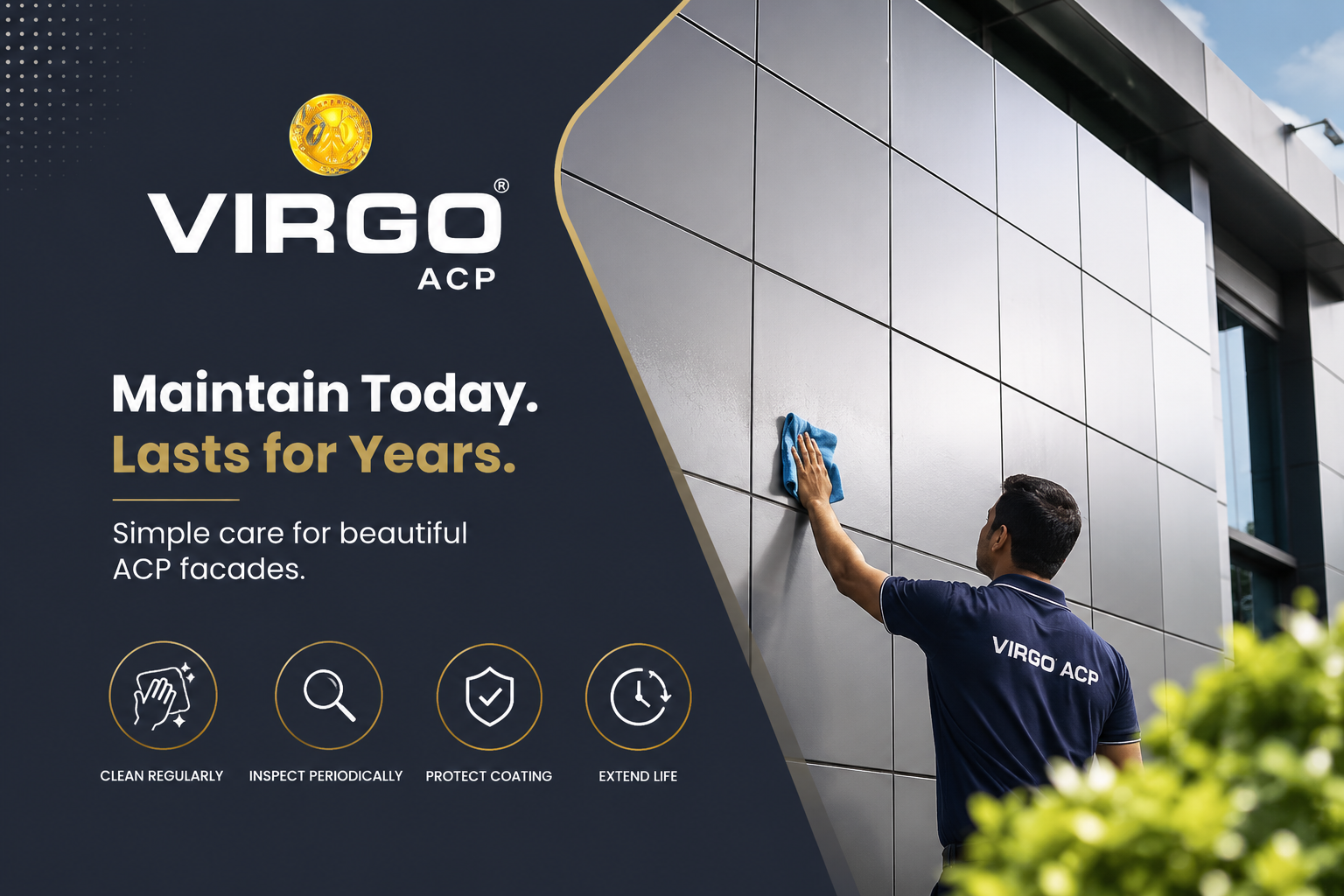
What changes for industrial-zone ACP facade panels is cleaning frequency. Industrial pollution deposits on PVDF coated ACP sheets faster and bonds more firmly than urban dust. Exterior wall cladding panels cleaned quarterly maintain good appearance indefinitely — ACP cladding sheets cleaned annually in the same environment show progressive contamination build-up between cycles.
Complete Specification Summary for ACP Facade Panels in Demanding Environments
Specification | Standard Inland | Coastal ACP Cladding Sheets Within 500m | Coastal 500m–2km | High Industrial Pollution ACP Facade Panels |
PVDF coated ACP sheets | 25μm+ PVDF | 25μm+ PVDF | 25μm+ PVDF | 25μm+ PVDF |
ACP cladding sheets core | FR required | FR required | FR required | FR required |
ACP facade panels fixings | Aluminium or SS304 | SS316 — mandatory | SS316 — recommended | SS304 min; SS316 for chemical zones |
Exterior wall cladding panels edges | Sealed | Sealed — mandatory | Sealed — mandatory | Sealed |
Cleaning of ACP cladding sheets | 1–2 per year | 3–4 per year | 3 per year | 3–4 per year |
ACP facade panels inspection | Annual | Annual + post-monsoon fixings | Annual | Annual + quarterly sealant |
Frequently Asked Questions
Q. Are PVDF coated ACP sheets suitable for coastal exterior wall cladding panels?
Ans. Yes — PVDF coated ACP sheets handle coastal salt aerosol without coating degradation. The specification upgrades for coastal ACP facade panels are in the fixing system (SS316 grade), ACP cladding sheets cut edge sealing, and maintenance frequency — not in the PVDF coated ACP sheets themselves.
Q. What stainless steel grade should be used for ACP facade panels fixings near the coast?
Ans. Grade 316 — not grade 304. Grade 316’s molybdenum content resists chloride-induced pitting corrosion on ACP cladding sheets fixing systems. Grade 304 will fail on exterior wall cladding panels within five to eight years of coastal salt aerosol exposure. The cost difference for ACP facade panels fixings is negligible against remediation costs.
Q. How far from the coast does marine specification apply to ACP cladding sheets?
Ans. Full marine specification — SS316 fixings, sealed ACP cladding sheets edges, PVDF coated ACP sheets mandatory, 3–4 cleaning cycles — within 500m. SS316 recommended for ACP facade panels from 500m to 2km. Standard exterior wall cladding panels specification generally applies beyond 2km.
Q. Does industrial pollution damage PVDF coated ACP sheets?
Ans. Standard industrial pollution produces surface contamination on exterior wall cladding panels rather than coating degradation on PVDF coated ACP sheets. Regular cleaning — three to four times per year — maintains ACP facade panels in good condition. The PVDF coated ACP sheets specification doesn’t change for industrial pollution zones.
Q. Why do coastal ACP facade panels show rust staining when PVDF coated ACP sheets are correctly specified?
Ans. Rust staining on ACP cladding sheets almost always comes from the fixings, not the PVDF coated ACP sheets themselves. Carbon steel or zinc-plated fixings corrode in marine environments and track rust down the exterior wall cladding panels sealant lines. The solution is SS316 fixings on all ACP facade panels in coastal locations — specified before installation, not specified after rust staining appears on ACP cladding sheets.
Q. What is the most common mistake in coastal ACP cladding sheets specification?
Ans. Specifying standard zinc-plated fixings on ACP facade panels because nothing in the exterior wall cladding panels specification explicitly required marine-grade fixings. This is invisible at ACP cladding sheets completion and consequential at year five to seven when rust staining begins on every PVDF coated ACP sheets fixing point.
Virgo ACP PVDF coated ACP sheets for ACP facade panels in coastal and industrial environments at virgoacp.com/products/