
How to Choose the Right ACP Sheet for Building Facades?
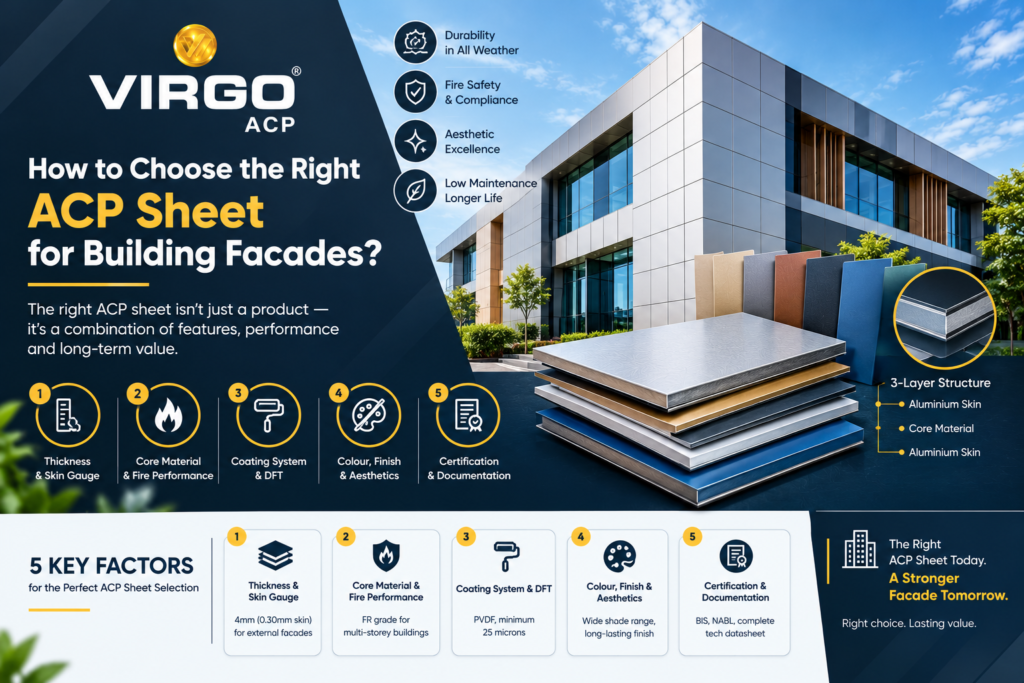
An architect in Pune once said that the most important decision on a commercial facade project isn’t which ACP sheet for building facade you choose — it’s that you understand why you’re choosing it. He had seen three projects on the same street where contractors picked the cheapest available ACP facade sheets. Two had visible surface degradation within four years. The third, where a proper ACP sheet selection guide had been followed, looked exactly as specified eight years later. The difference wasn’t luck. It was methodology. Choosing the right ACP sheet for building facade applications isn’t complicated once you understand the five variables that drive performance. This guide breaks each one down. What Is an ACP Sheet for Building Facades? An ACP sheet for building facade is a three-layer composite panel: two aluminium face sheets permanently bonded to a core material. The aluminium skins give the ACP facade sheets their rigidity, weather resistance, and paintable surface. The core determines weight, fire behaviour, and structural characteristics. ACP sheets for building facades are used externally because they handle UV exposure, rain, temperature cycling, and pollution without absorbing moisture or corroding. The best ACP sheet for facade applications combines all of these properties in a specification matched to the specific building, environment, and performance requirements of the project. An aluminium composite panel for facade installation typically covers large external wall surfaces efficiently with minimal structural dead load. Why Is Choosing the Right ACP Sheet for Building Facade Important? The wrong ACP sheet for building facade doesn’t announce itself at installation. It announces itself three to five years later — when the coating starts chalking on a south-facing elevation, when ACP facade sheets bow across a wide bay because skin gauge was too thin, or when the building authority asks for FR documentation that doesn’t exist. Structural requirements — thickness and skin gauge of aluminium composite panel for facade determines performance under wind load Appearance and durability — coating system on ACP sheets for building facades governs how long the facade looks as it did at installation Weather exposure — UV, monsoon, coastal salt, and pollution attack ACP facade sheets differently; the correct ACP sheet for exterior facade accounts for all of these Fire safety — the core material in an ACP sheet for building facade is the fire safety variable; PE-core burns, FR-core suppresses combustion Long-term maintenance — the best ACP sheet for facade choice determines how much cleaning and maintenance the building will require Key Factors When Choosing an ACP Sheet for Building Facade ACP Sheet Thickness The standard aluminium composite panel for facade applications is 4mm total thickness — the IS 17682:2021 default for external ACP sheets for building facades. Three-millimetre ACP facade sheets are appropriate for interior applications only. Six-millimetre is specified for spans exceeding 2000mm without intermediate subframe support. Aluminium Skin Thickness Both 0.20mm and 0.30mm-skin products are labelled as ‘4mm ACP facade sheets.’ For external ACP sheet for building facade applications, 0.30mm aluminium skin per face is the minimum correct specification under IS 17682:2021. Economy ACP sheets for building facades with 0.20mm skins underdeliver on surface rigidity and dent resistance. Always request skin gauge separately as part of any ACP sheet selection guide process. Core Material and Fire Performance This is the most consequential variable in any ACP sheet for building facade specification. PE (polyethylene) core in normal ACP facade sheets is combustible — not appropriate for external multi-storey ACP sheets for building facades. FR (fire-retardant) core in the best ACP sheet for facade applications contains mineral fillers that suppress combustion. This is a fire safety requirement, not a premium specification. Cut an ACP sheet for exterior facade panel edge — FR-core shows visible granular mineral content. PE-core is a uniform solid plastic. ACP Surface Coating PVDF (polyvinylidene fluoride) at minimum 25 microns DFT is the correct coating for external ACP sheets for building facades in India. India’s UV index exceeds 10 for six to eight months per year — polyester-coated ACP facade sheets begin chalking within three to five years on south-facing elevations. The best ACP sheet for facade UV resistance uses PVDF coating, which resists UV degradation through its fluorine-carbon molecular bond for 20+ years. Colour and Finish The best ACP sheet for facade applications comes in a finish that matches design intent and can be maintained at the cleaning frequency the building management will realistically commit to. Dark ACP facade sheets show dust accumulation faster in polluted environments. Matte finishes are most forgiving for the best ACP sheet for building facade in high-pollution locations with lower cleaning budgets. How to Choose ACP Sheets for Building Facades Based on Building Type Building Type Best ACP Sheet for Facade Specification Residential FR-core ACP sheets for building facades, PVDF 25μm+, precise shade codes for RERA documentation Commercial FR-core best ACP sheet for facade, PVDF 25μm+, 300+ shade range, batch consistency for phased ACP facade sheets Corporate offices ACP sheet for building facade with precise brand colour matching, PVDF for 20-year colour retention on ACP facade sheets Retail buildings FR-core ACP sheet for exterior facade, high-chroma or metallic ACP facade sheets for visibility Institutional FR-core aluminium composite panel for facade, BIS IS 17682:2021 certified, NABL fire test documentation How Indian Weather Conditions Affect ACP Sheet for Exterior Facade Selection Heat and sunlight South-facing ACP facade sheets experience surface temperatures above 65°C in Indian summers. The best ACP sheet for building facade in high-UV zones requires PVDF coating at 25+ microns DFT — polyester ACP sheets for building facades fail under this UV load within three to five years. UV exposure India’s extreme UV is the primary reason polyester-coated ACP facade sheets fail early. PVDF coating on the best ACP sheet for facade applications resists UV through its fluorine-carbon molecular bond. Rain and humidity PVDF-coated aluminium composite panel for facade is waterproof. The risk in monsoon conditions is in installation details — joint sealant and cavity drainage around ACP sheets for building facades. Dust and pollution PVDF-coated ACP
How to Choose PVDF Coated ACP Sheets for Coastal and High-Pollution Areas
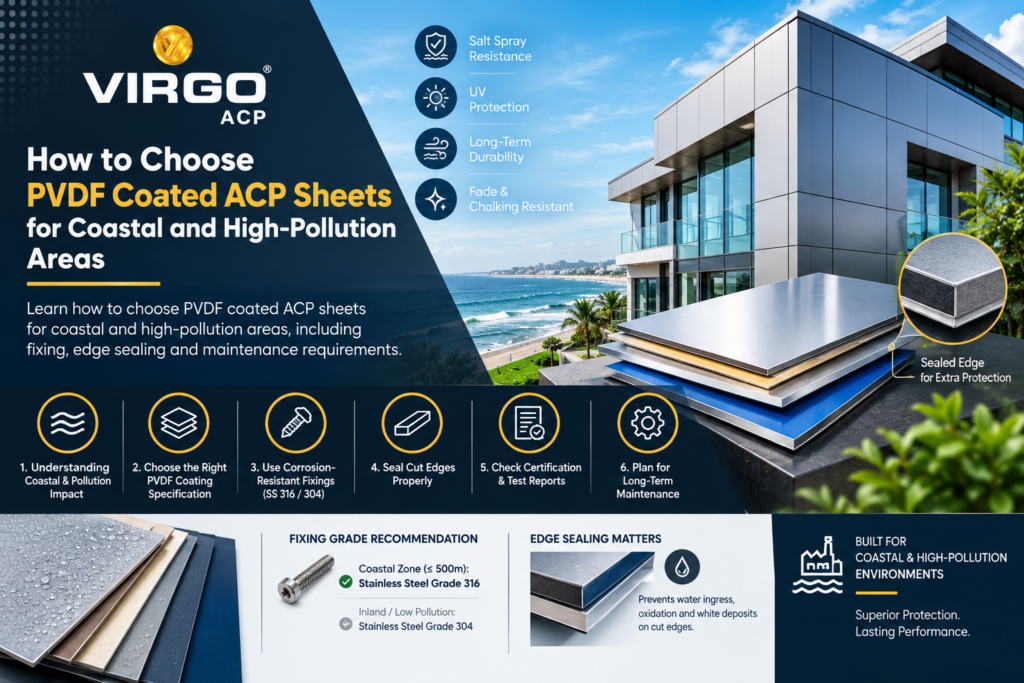
Seven years after a commercial building opened on the Vizag seafront, a facade condition assessment found three problems — none of them in the PVDF coated ACP sheets. The exterior wall cladding panels were performing well. No chalking on the ACP cladding sheets, no delamination on the ACP facade panels. The problems were: sixteen fixing points with visible rust corrosion tracking 200–400mm down the sealant lines on the exterior wall cladding panels; fourteen cut ACP cladding sheets edges showing white oxidation; one subframe section with galvanic corrosion behind the ACP facade panels. The PVDF coated ACP sheets: fine. The ACP facade panels specification: correct. The fixing system around the ACP cladding sheets: inadequately specified for the environment. This is the pattern in almost every coastal exterior wall cladding panels failure — the PVDF coated ACP sheets perform; everything around the ACP facade panels doesn’t. What Coastal Environments Do to PVDF Coated ACP Sheets PVDF coated ACP sheets handle coastal salt aerosol without degradation. The fluoropolymer resin in PVDF coated ACP sheets is chemically inert to sodium chloride. ACP cladding sheets installed correctly near the coast maintain their PVDF coating performance for the full expected service life on exterior wall cladding panels. What salt attacks is every metal component in the ACP facade panels system that isn’t PVDF-protected. Carbon steel fixings on exterior wall cladding panels show rust within months. Zinc-plated fixings on ACP cladding sheets deplete their zinc in a few years. The rust products from fixings stain the sealant lines on ACP facade panels and track down the exterior wall cladding panels as visible streaking. Fixing Specification for Coastal PVDF Coated ACP Sheets Within 500m of coastline — ACP facade panels Stainless steel grade 316 (marine grade) is mandatory for ACP cladding sheets fixing systems. Grade 316 contains 2–3% molybdenum, resisting chloride-induced pitting corrosion on ACP facade panels in marine environments. Grade 304 is inadequate for coastal ACP cladding sheets Both grade 316 and grade 304 are ‘stainless steel’ and both are appropriate for inland exterior wall cladding panels. Grade 304 lacks molybdenum and will develop pitting corrosion under sustained marine salt aerosol on ACP facade panels within five to eight years. Cost for PVDF coated ACP sheets installations Grade 316 fixings cost 15–25% more than grade 304. On a 10,000 sqm ACP facade panels project, the total fixing upgrade is typically ₹2–4 lakhs. Remediating a corroded fixing system on exterior wall cladding panels costs orders of magnitude more than this preventive specification for ACP cladding sheets. Panel Cut Edge Sealing for ACP Cladding Sheets Every ACP facade panels installation creates cut edges on ACP cladding sheets where standard PVDF coated ACP sheets are trimmed to fit non-standard dimensions. In coastal environments, unprotected cut edges on ACP cladding sheets expose raw aluminium to marine aerosol — no PVDF coating, no protection on the exterior wall cladding panels edge. This oxidises to white deposits on ACP facade panels, progressively staining adjacent sealant. Specify edge sealing on all cut ACP cladding sheets edges in the fabrication brief for any coastal PVDF coated ACP sheets installation. Minutes per ACP facade panels at fabrication; a decade of prevention on exterior wall cladding panels. High-Pollution Industrial Environments for ACP Cladding Sheets PVDF coated ACP sheets handle standard industrial pollution well on ACP facade panels. Sulphur dioxide, hydrocarbon residue, and weak acid deposition don’t attack the fluoropolymer coating on exterior wall cladding panels at ambient air concentrations. The ACP cladding sheets specification is unchanged for industrial pollution zones. What changes for industrial-zone ACP facade panels is cleaning frequency. Industrial pollution deposits on PVDF coated ACP sheets faster and bonds more firmly than urban dust. Exterior wall cladding panels cleaned quarterly maintain good appearance indefinitely — ACP cladding sheets cleaned annually in the same environment show progressive contamination build-up between cycles. Complete Specification Summary for ACP Facade Panels in Demanding Environments Specification Standard Inland Coastal ACP Cladding Sheets Within 500m Coastal 500m–2km High Industrial Pollution ACP Facade Panels PVDF coated ACP sheets 25μm+ PVDF 25μm+ PVDF 25μm+ PVDF 25μm+ PVDF ACP cladding sheets core FR required FR required FR required FR required ACP facade panels fixings Aluminium or SS304 SS316 — mandatory SS316 — recommended SS304 min; SS316 for chemical zones Exterior wall cladding panels edges Sealed Sealed — mandatory Sealed — mandatory Sealed Cleaning of ACP cladding sheets 1–2 per year 3–4 per year 3 per year 3–4 per year ACP facade panels inspection Annual Annual + post-monsoon fixings Annual Annual + quarterly sealant Frequently Asked Questions Q. Are PVDF coated ACP sheets suitable for coastal exterior wall cladding panels? Ans. Yes — PVDF coated ACP sheets handle coastal salt aerosol without coating degradation. The specification upgrades for coastal ACP facade panels are in the fixing system (SS316 grade), ACP cladding sheets cut edge sealing, and maintenance frequency — not in the PVDF coated ACP sheets themselves. Q. What stainless steel grade should be used for ACP facade panels fixings near the coast? Ans. Grade 316 — not grade 304. Grade 316’s molybdenum content resists chloride-induced pitting corrosion on ACP cladding sheets fixing systems. Grade 304 will fail on exterior wall cladding panels within five to eight years of coastal salt aerosol exposure. The cost difference for ACP facade panels fixings is negligible against remediation costs. Q. How far from the coast does marine specification apply to ACP cladding sheets? Ans. Full marine specification — SS316 fixings, sealed ACP cladding sheets edges, PVDF coated ACP sheets mandatory, 3–4 cleaning cycles — within 500m. SS316 recommended for ACP facade panels from 500m to 2km. Standard exterior wall cladding panels specification generally applies beyond 2km. Q. Does industrial pollution damage PVDF coated ACP sheets? Ans. Standard industrial pollution produces surface contamination on exterior wall cladding panels rather than coating degradation on PVDF coated ACP sheets. Regular cleaning — three to four times per year — maintains ACP facade panels in good condition. The PVDF coated ACP sheets specification doesn’t change for industrial pollution zones. Q. Why