
7 Factors to Choose ACP Facade Panels for Exterior Facades
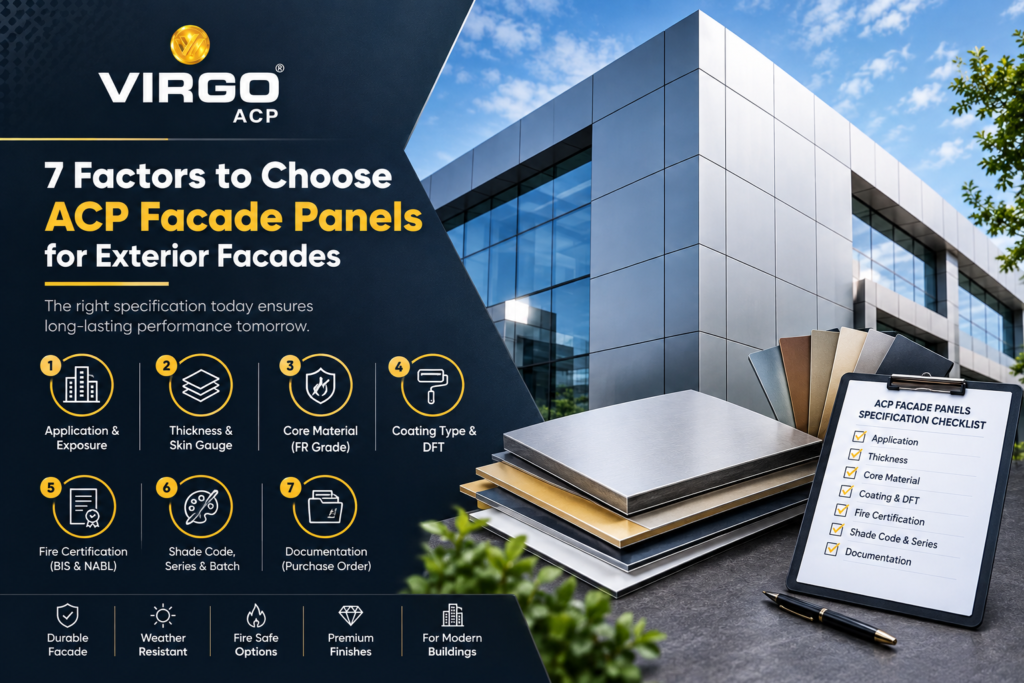
The defect liability claim arrived fourteen months after project completion. The building authority’s facade inspection flagged two issues: ACP facade panels showing visible colour variation from the approved sample, and no FR-grade fire documentation for the installed exterior wall cladding panels. The contractor said both had been approved by the site engineer. The developer’s legal team wanted to know why the specification of building facade materials hadn’t prevented this. The specification of building facade materials said ‘4mm ACP cladding sheets, champagne, BIS certified.’ Every omission had become a substitution opportunity. The seven factors below close those gaps in any ACP facade panels specification. Factor 1: Application and Exposure — First Question for ACP Facade Panels Before thickness, before coating, before finish: where are these ACP facade panels going, and what will the environment do to them? External multi-storey commercial ACP cladding sheets, exterior wall cladding panels on low-rise residential, interior feature walls, industrial building facade materials — all have different minimum specification requirements. Getting this wrong in the building facade materials specification means either over-specifying interior ACP facade panels or under-specifying external exterior wall cladding panels. Both cost money — the first unnecessarily, the second eventually through compliance and maintenance problems in ACP cladding sheets. Factor 2: Thickness and Skin Gauge — Both Numbers for ACP Cladding Sheets Most ACP facade panels specifications state total thickness. Fewer state skin gauge for building facade materials. Both numbers are necessary. A 4mm exterior wall cladding panel with 0.20mm skins and a 4mm ACP cladding sheet with 0.30mm skins are both ‘4mm ACP facade panels‘ — with different surface rigidity, dent resistance, and external durability. The ACP cladding sheets specification must read: ‘4mm total thickness, 0.30mm aluminium skin per face.’ Without both numbers, the ACP facade panels specification creates room for under-specification in building facade materials. Factor 3: Core Material — FR for All External ACP Cladding Sheets FR-grade core for exterior wall cladding panels above ground-floor level is non-negotiable. PE-core ACP facade panels are combustible. The price difference between PE and FR core in ACP cladding sheets creates supply chain substitution temptation. Purchase order for ACP cladding sheets: ‘FR-grade core, IS 17682:2021 compliant’ — not just ‘exterior wall cladding panels’ Delivery invoice for ACP facade panels: FR grade stated alongside product code On site when building facade materials arrive: cut an ACP cladding sheets edge — FR-core ACP facade panels show granular mineral filler. Thirty seconds. Factor 4: Coating Type and DFT — Two Separate Specifications for ACP Cladding Sheets ‘PVDF coated ACP facade panels‘ answers coating type. ‘Minimum 25 microns DFT’ answers coating thickness for building facade materials. Both must appear in the exterior wall cladding panels specification. PVDF at 15 microns and at 25 microns are both ‘PVDF coated ACP cladding sheets‘ — the UV resistance difference is significant on Indian exterior wall cladding panels. Factor 5: Fire Certification — Verify the ACP Facade Panels BIS Licence A BIS IS 17682:2021 certificate is a document for building facade materials. A BIS licence number appearing in the current public directory at bis.gov.in is a verified, current certification for ACP cladding sheets. Four minutes at bis.gov.in confirms whether the ACP facade panels certification is currently live. For FR-grade exterior wall cladding panels, fire test certificates from NABL-accredited laboratories are additionally required. Factor 6: Shade Code, Series Name, and Batch Reference for ACP Cladding Sheets ‘Champagne’ is a colour description for ACP facade panels. ‘Virgo ACP Valencia Series, Shade Code VA 11024’ is a building facade materials specification. Without the shade code, any champagne-adjacent colour from any ACP cladding sheets supplier is defensible substitution. For phased exterior wall cladding panels installations, the batch reference from the first ACP facade panels delivery must appear on all subsequent purchase orders. Factor 7: Documentation — Specify in the ACP Cladding Sheets Purchase Order Documentation for ACP facade panels should be a stated delivery condition in the building facade materials purchase order, not a post-delivery request. Tax invoice for exterior wall cladding panels: manufacturer name, product series, shade code, coating type, DFT, core grade, skin thickness, and ACP cladding sheets quantity Current BIS IS 17682:2021 certificate for ACP facade panels with verifiable licence number NABL-accredited test reports for ACP cladding sheets covering peel strength, coating, weatherometer, and FR fire performance Written manufacturer warranty covering ACP facade panels ACP Facade Panels Specification Checklist for Building Facade Materials ACP Facade Panels Element What to Specify for Exterior Wall Cladding Panels What to Reject Application External / Internal / FR required for ACP cladding sheets ‘Building facade materials’ with no classification Thickness 4mm total, 0.30mm skin for ACP cladding sheets ‘4mm ACP facade panels’ without skin gauge Core FR-grade IS 17682:2021 for exterior wall cladding panels ACP cladding sheets without core type Coating PVDF minimum 25μm DFT for ACP facade panels ‘PVDF coated ACP cladding sheets’ without DFT minimum Certification BIS licence verifiable at bis.gov.in for building facade materials Certificate without verifiable number Shade ACP facade panels shade code and series Colour name without code for ACP cladding sheets Documentation Full set above in ACP cladding sheets PO conditions Building facade materials documentation post-delivery Frequently Asked Questions Q. What is the most important factor when specifying ACP facade panels for exterior wall cladding panels? Ans Core type — FR versus PE — is the most consequential specification in building facade materials because it’s the fire safety and substitution risk variable. After that, coating minimum DFT governs long-term performance of ACP cladding sheets. Both must be in the written ACP facade panels specification. Q. How do I verify BIS certification for ACP cladding sheets? Ans. Search bis.gov.in under IS 17682:2021. Current certification for building facade materials shows a live directory entry. An ACP facade panels certificate document without a matching live entry means the exterior wall cladding panels certification is not currently valid. Q.Can FR core be verified on site when ACP cladding sheets arrive? Ans. Yes. Cut an ACP facade panels edge — FR-core exterior wall cladding panels show
What ACP Sheet Thickness Should You Choose for Different Applications?
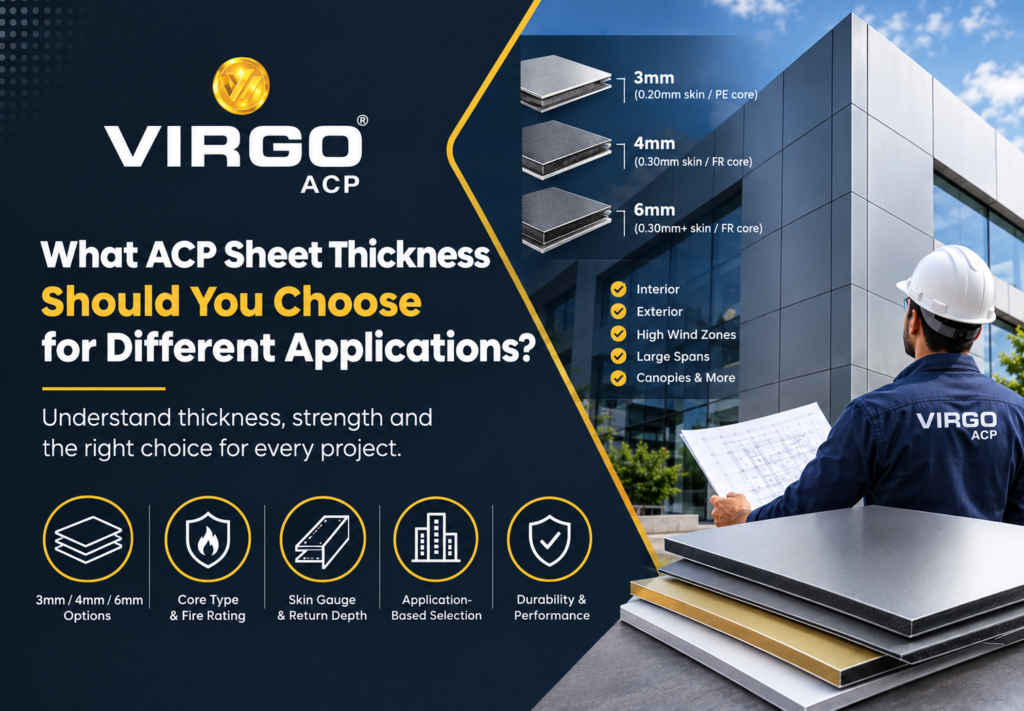
A structural engineer reviewing a coastal building facade inspection report wrote one sentence that should appear on every specification sheet in India: ‘The ACP panels didn’t fail. They did exactly what 3mm ACP sheets do when spanned 1100mm in a coastal wind zone.’ The ACP panels were visibly bowing. Not cracking — bowing. Across a metallic-finish aluminium ACP sheet elevation, that bow reads as a wavy, inconsistent surface across the entire third floor. Remediation required removing forty-six ACP sheets and replacing them with correctly specified 4mm ACP panels. Thickness in ACP sheets governs one thing: rigidity under load. This distinction drives every decision in the table below. Why Thickness Matters in ACP Sheets ACP sheets construction is three bonded layers: two aluminium skins and a core. A standard 4mm aluminium ACP sheet has approximately 0.30mm of aluminium on each face and 3.40mm of core. The bending resistance of ACP sheets scales with the cube of panel depth — a 4mm ACP sheet is approximately 2.4 times more resistant to bending than a 3mm ACP panel of the same width. The jump from 3mm to 4mm ACP cladding sheets for external applications is categorical, not incremental. The second thing thickness controls in ACP sheets is fabrication depth — how deep a return fold can be routed before breaking through the face of the aluminium ACP sheet. More thickness means more material for returns, enabling more ACP panels installation system options. 3mm ACP Sheets — Interior Applications Only Three-millimetre ACP sheets are correctly specified for: interior wall cladding with spans under 600mm, exhibition display systems, retail fixtures, interior feature walls, and signage fascias in covered locations. These are interior ACP panels applications where external durability of the aluminium ACP sheet is irrelevant. The failure mode when 3mm ACP sheets are used externally is predictable: visible deflection on spans above 800mm under moderate wind load. Three-millimetre ACP cladding sheets also produce shallow returns — approximately 12–15mm maximum — which limits compatibility with external ACP panels fixing systems requiring 20mm or deeper returns. 4mm ACP Sheets — The External Standard Four-millimetre ACP sheets are the default for external building facades in India under BIS IS 17682:2021. At approximately 5.5 kg/sqm, 4mm ACP panels handle the wind loads, thermal cycling, and fabrication requirements of standard commercial and residential ACP cladding sheets installations. Within the 4mm specification, aluminium skin thickness per face is the variable that separates ACP sheets products. Both 0.20mm and 0.30mm-skin products are described as ‘4mm ACP panels‘ — with different surface rigidity, dent resistance, and external durability for aluminium ACP sheet applications. Skin Gauge ACP Sheets Application External Compliance 0.20mm Interior ACP panels only Not appropriate for external ACP sheets 0.25mm Protected exterior, low wind ACP cladding sheets Marginal for standard external 0.30mm Standard external ACP panels IS 17682:2021 standard for aluminium ACP Sheet 0.50mm High-wind exterior ACP sheets Compliant — premium specification For external ACP cladding sheets in India, the specification must read: 4mm total thickness, 0.30mm aluminium skin per face, FR-grade core. Without all three numbers, the ACP panels specification is incomplete. 6mm ACP Sheets — Structural Grade Six-millimetre ACP panels enter the specification when ACP sheets spans exceed 2000mm without intermediate subframe support, when the project is in a high wind-load zone (coastal, high-rise above 30m), or when the design requires aluminium ACP sheet return depths above 25mm that 4mm ACP cladding sheets cannot support. The bending resistance of 6mm ACP panels versus 4mm ACP sheets is approximately 3.4 times greater. At 8 kg/sqm (versus 5.5 kg/sqm for 4mm ACP sheets), the additional dead load of 6mm ACP panels affects subframe structural design. ACP Sheets Thickness Selection by Application Application ACP Sheets Thickness Skin Gauge Core Interior wall feature 3mm or 4mm ACP sheets 0.20mm+ PE acceptable Interior signage 3mm ACP panels 0.20mm PE acceptable External residential ACP cladding sheets 4mm ACP sheets 0.30mm FR required External commercial ACP panels 4mm aluminium ACP Sheet 0.30mm FR required High-rise above 30m — ACP sheets 4mm or 6mm ACP panels 0.30mm+ FR required Large-span canopy 6mm ACP cladding sheets 0.30mm FR required Industrial, large bay — ACP panels 6mm ACP sheets 0.30mm+ FR required Frequently Asked Questions Q. What is the standard ACP sheet thickness for external facades in India? Ans. 4mm ACP sheets — the standard for external ACP panels applications under BIS IS 17682:2021. For very large spans or high wind-load zones, 6mm ACP cladding sheets are appropriate. 3mm ACP sheets are interior aluminium ACP sheet specification only. Q. When should I specify 6mm ACP sheets instead of 4mm ACP panels? Ans. When ACP sheets spans exceed 2000mm without intermediate support, when the project is in a high wind-load zone (coastal, high-rise above 30m), or when the installation design requires ACP cladding sheets return depths above 25mm that 4mm ACP panels cannot support. Q.Is 3mm ACP cladding sheets specification appropriate for external facades? Ans.Only in very specific conditions — spans under 600mm, protected locations. For standard external ACP panels, 3mm ACP sheets are under-specified and will show visible deflection above 800mm spans. Q.What is aluminium skin thickness in ACP sheets and why does it matter? Ans. Skin thickness is the gauge of the face sheets in an aluminium ACP sheet. For external ACP panels, 0.30mm minimum per face is the correct ACP cladding sheets specification for dent resistance, surface rigidity, and fabrication depth. Q.Does ACP sheets thickness affect fire performance? Ans. Thickness doesn’t determine fire performance in ACP panels — core type does. FR-grade core is the fire compliance variable in ACP cladding sheets, available in 3mm, 4mm, and 6mm aluminium ACP sheet products. Virgo ACP range of ACP sheets across 300+ shades and 16 series at virgoacp.com/products/