Two commercial buildings were completed in the same year in Ahmedabad. Both had ACP cladding sheets on their primary external elevations. Both used 4mm panels. Both were in comparable urban locations with similar UV exposure. At year six, one building’s ACP facade panels looked precisely as they did at handover. The other had visible chalking on the south elevation, colour shift on the west panels, and a noticeable differential between two sections installed from different deliveries.
The difference was not the building, the location, or the weather. The difference was the ACP sheet lifespan specification: the first used PVDF coated ACP sheets from a reputable Aluminium composite panel supplier at 27 microns DFT, FR-grade core, 0.30mm aluminium skin. The second used polyester-coated ACP cladding sheets from an ACP sheet dealer at a lower price point. Same dimension. Same appearance at handover. Very different ACP sheet lifespan outcomes.
What 'ACP Sheet Lifespan' Actually Means
ACP sheet lifespan is not a fixed number — it is a range. And the position within that range is determined almost entirely by decisions made at specification and procurement stage.
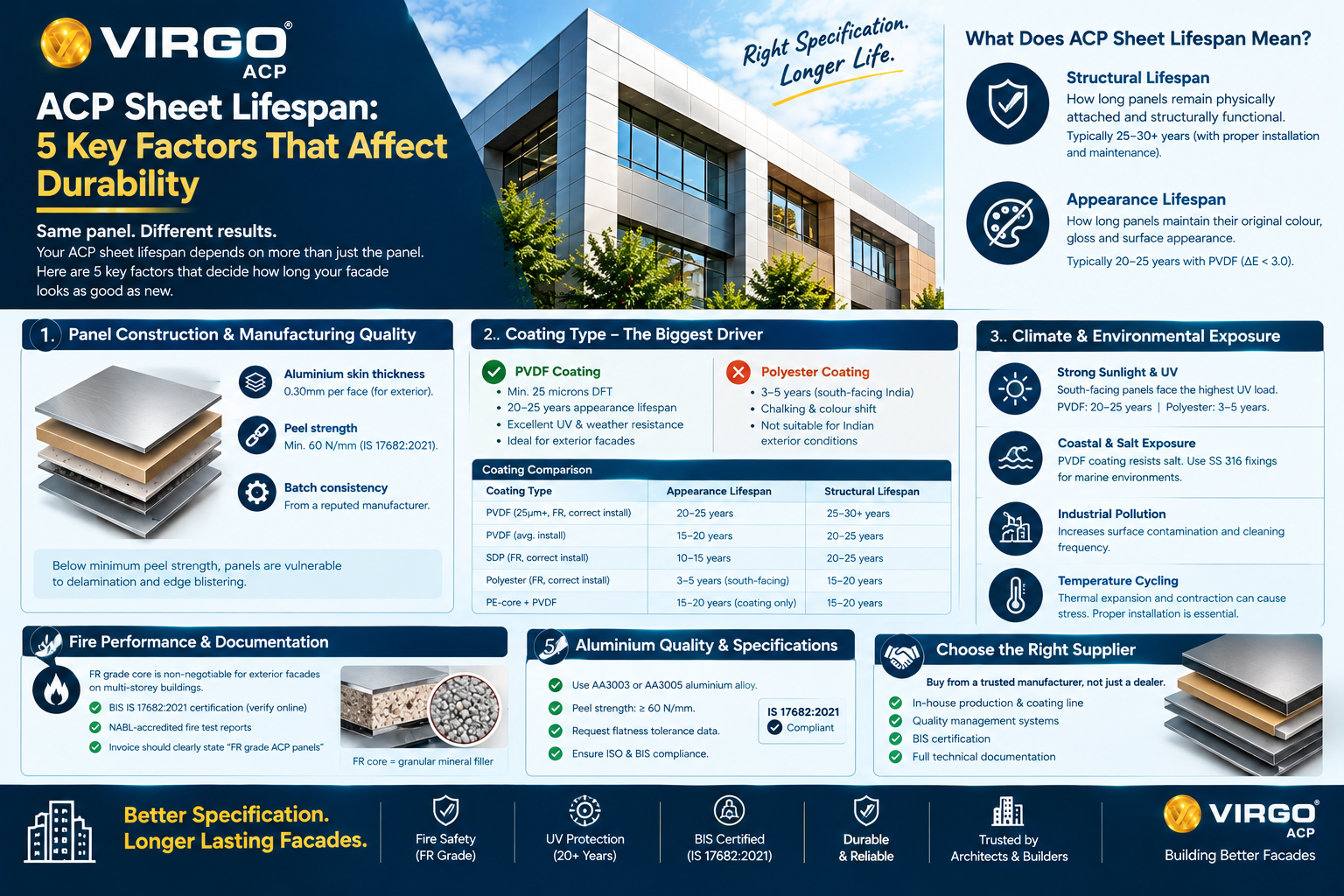
Structural lifespan
The length of time ACP facade panels remain physically attached, mechanically sound, and structurally functional. For correctly specified and installed exterior wall cladding panels from quality Aluminium composite panel suppliers, structural performance is typically 25–30+ years with periodic sealant maintenance.
Appearance lifespan
How long ACP cladding sheets maintain their original colour, gloss level, and surface appearance within acceptable tolerance (typically ΔE < 3.0 — the threshold below which colour change is not visible to the naked eye). This is where the ACP sheet lifespan difference between PVDF coated ACP sheets and polyester-coated ACP sheets is most consequential in Indian conditions.
Factor 1: Panel Construction and Manufacturing Quality
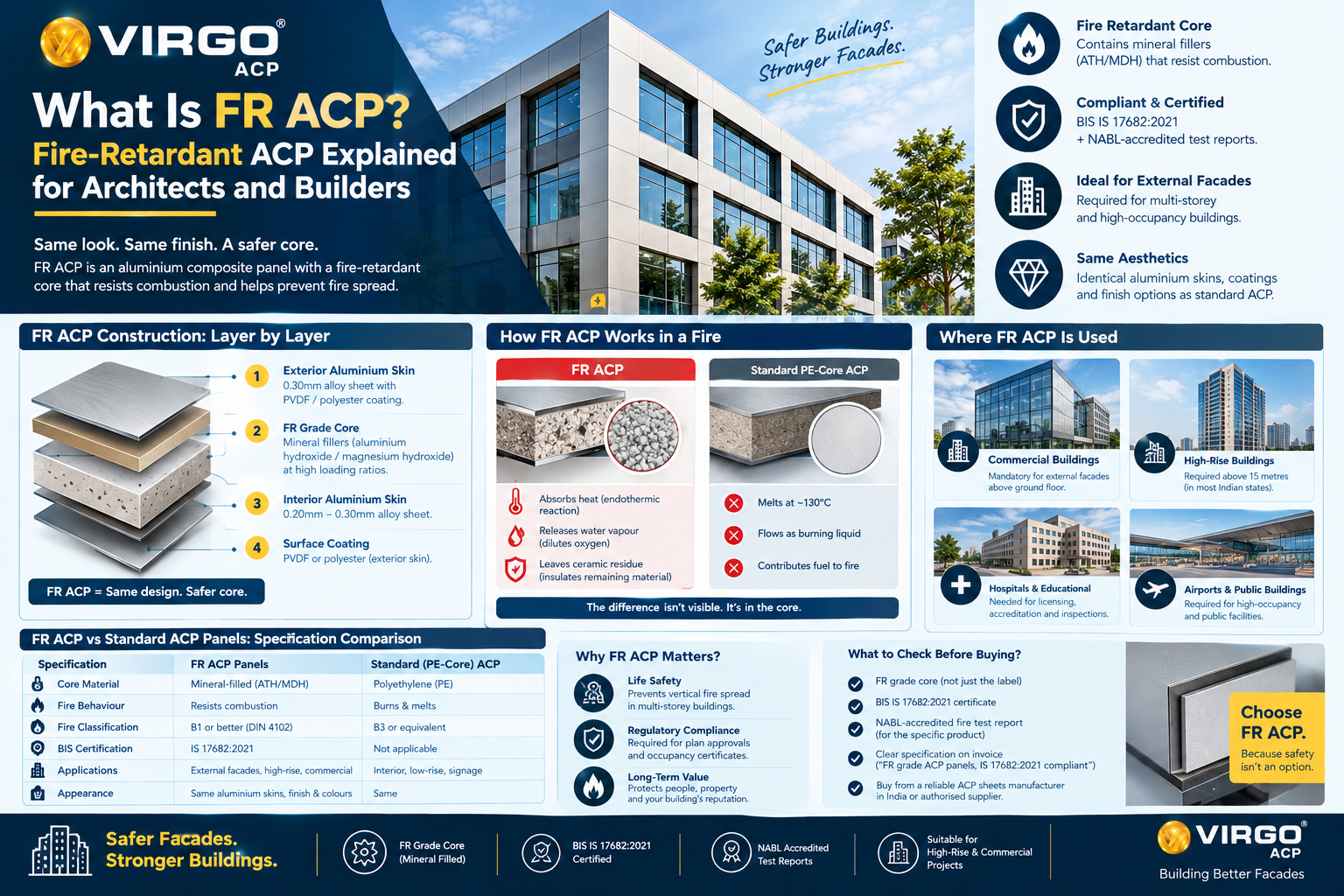
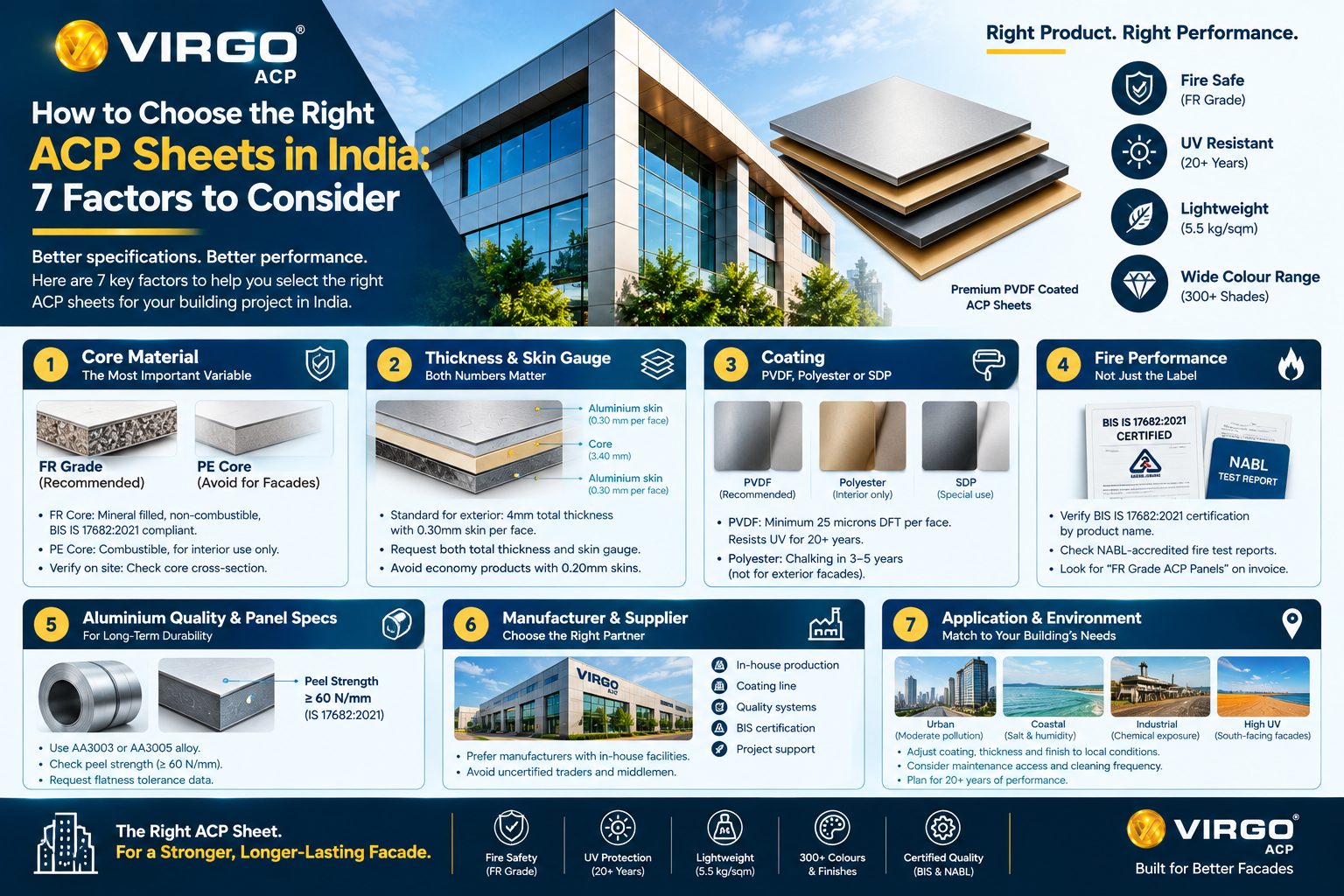
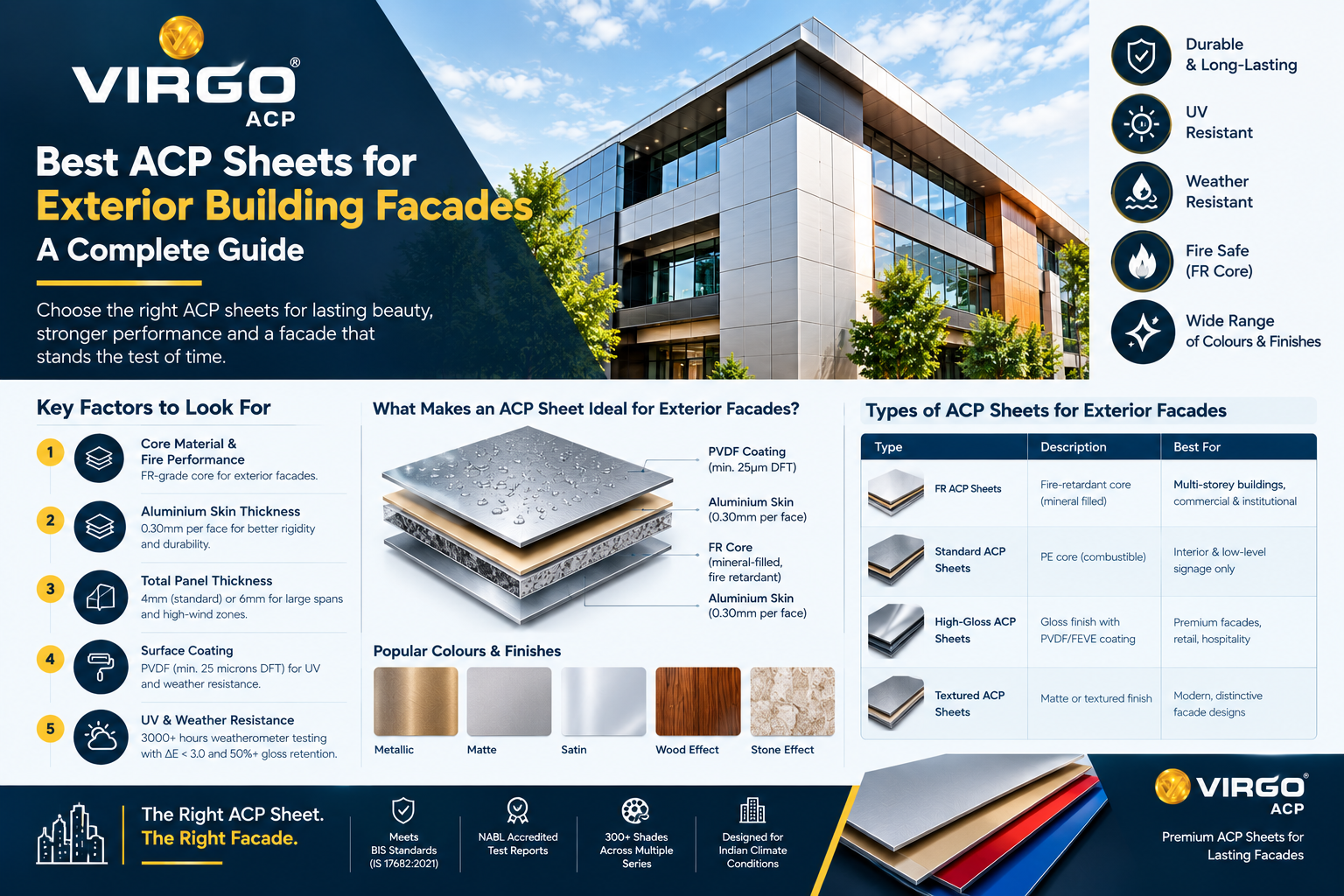
ACP sheet lifespan begins with what the panel is made of. Aluminium skin thickness (0.30mm per face for external ACP facade panels), peel strength (minimum 60 N/mm per IS 17682:2021 for external ACP cladding sheets), and batch consistency from Aluminium composite panel suppliers all directly affect ACP sheet lifespan. Below minimum peel strength, ACP sheets are vulnerable to delamination — the skin lifting from the core at panel edges — under Indian thermal cycling, manifesting as visible blistering at ACP facade panels edges.
Factor 2: Coating Type — The Biggest Driver of ACP Sheet Lifespan
PVDF coated ACP sheets
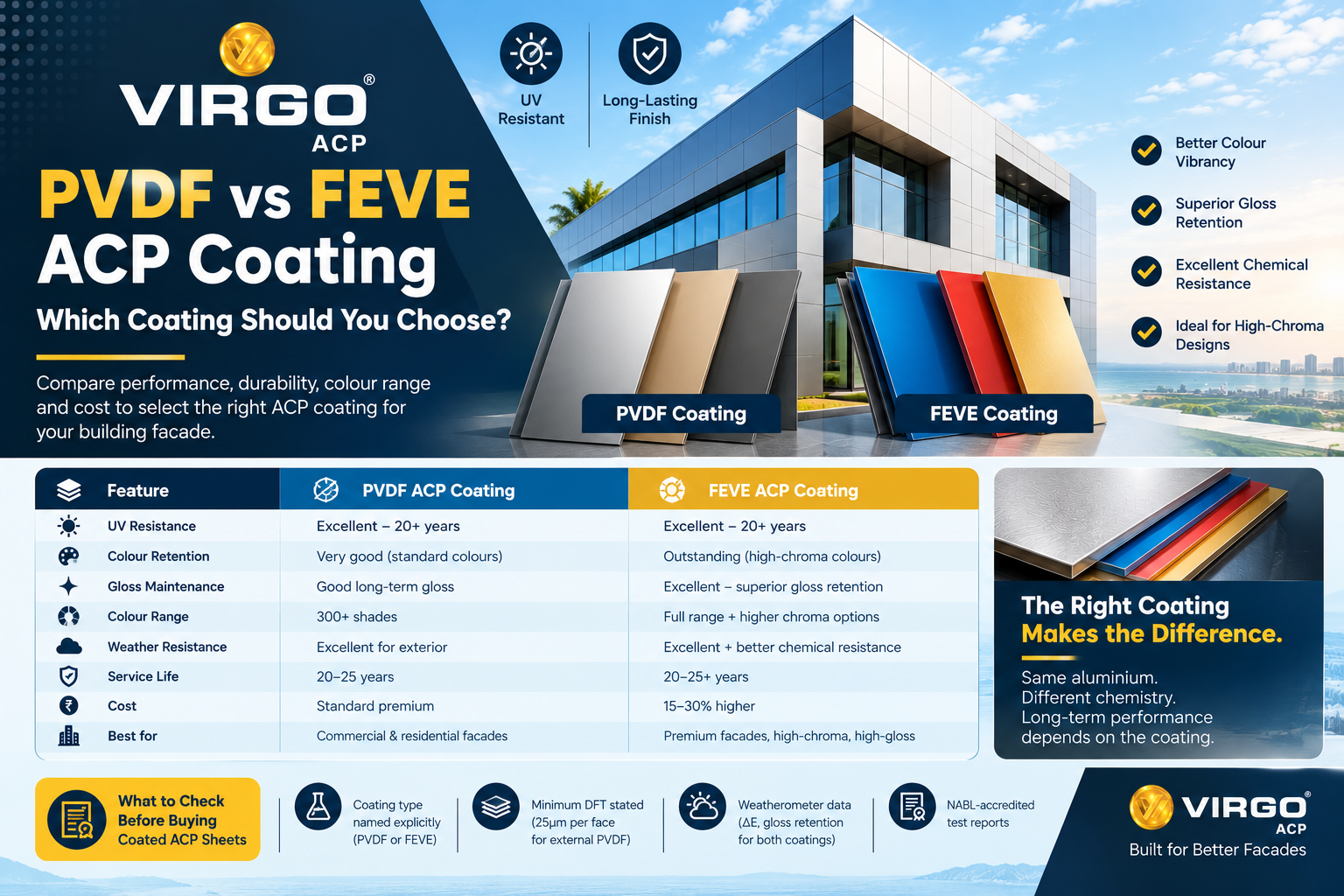
PVDF coating applied at minimum 25 microns DFT provides an expected appearance ACP sheet lifespan of 20–25 years on Indian external ACP cladding sheets. PVDF coated ACP sheets maintain colour (ΔE < 3.0) and gloss (above 50% of initial) for the documented service life under India’s UV index 10+ conditions. This is the non-negotiable coating specification for ACP sheet lifespan on Indian external ACP facade panels.
Polyester coated ACP sheets
Appearance ACP sheet lifespan on Indian south-facing external facades: three to five years before visible chalking and colour shift begin. Polyester ACP cladding sheets are not appropriate for external exterior wall cladding panels on Indian buildings with direct sunlight. The ACP sheet lifespan for polyester coating is simply too short for the Indian UV environment.
Coating Specification | ACP Sheet Lifespan (Appearance) | ACP Sheet Lifespan (Structural) |
PVDF coated ACP sheets 25μm+ DFT, FR grade, correct install | 20–25 years | 25–30+ years |
PVDF coated ACP sheets 25μm+ DFT, FR grade, average install | 15–20 years | 20–25 years |
SDP coated ACP cladding sheets, FR grade, correct install | 10–15 years | 20–25 years |
Polyester coated ACP facade panels, FR grade, correct install | 3–5 years (south-facing India) | 15–20 years structural |
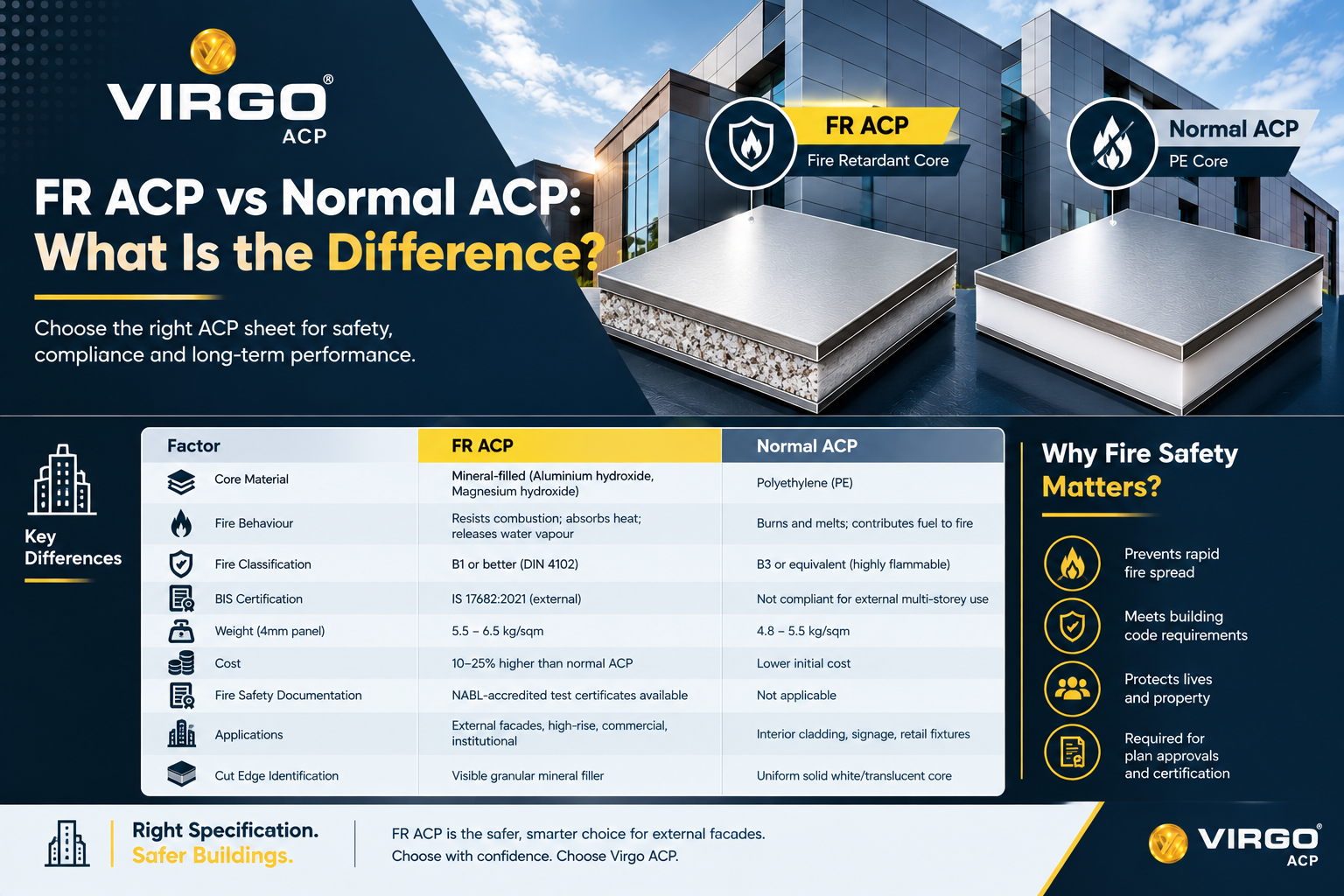
PE-core ACP sheets, PVDF coated, correct install | 15–20 years (coating only) | 15–20 years — fire non-compliant exterior wall cladding panels |
Factor 3: Climate and Environmental Exposure
Strong sunlight and UV — highest ACP sheet lifespan risk
South-facing PVDF coated ACP sheets in hot dry regions experience the most intensive UV load. ACP sheet lifespan for correctly specified PVDF coated ACP sheets: 20–25 years. For polyester-coated ACP cladding sheets: three to five years before visible degradation — explaining the Ahmedabad building comparison in this guide’s opening.
Coastal and salt exposure
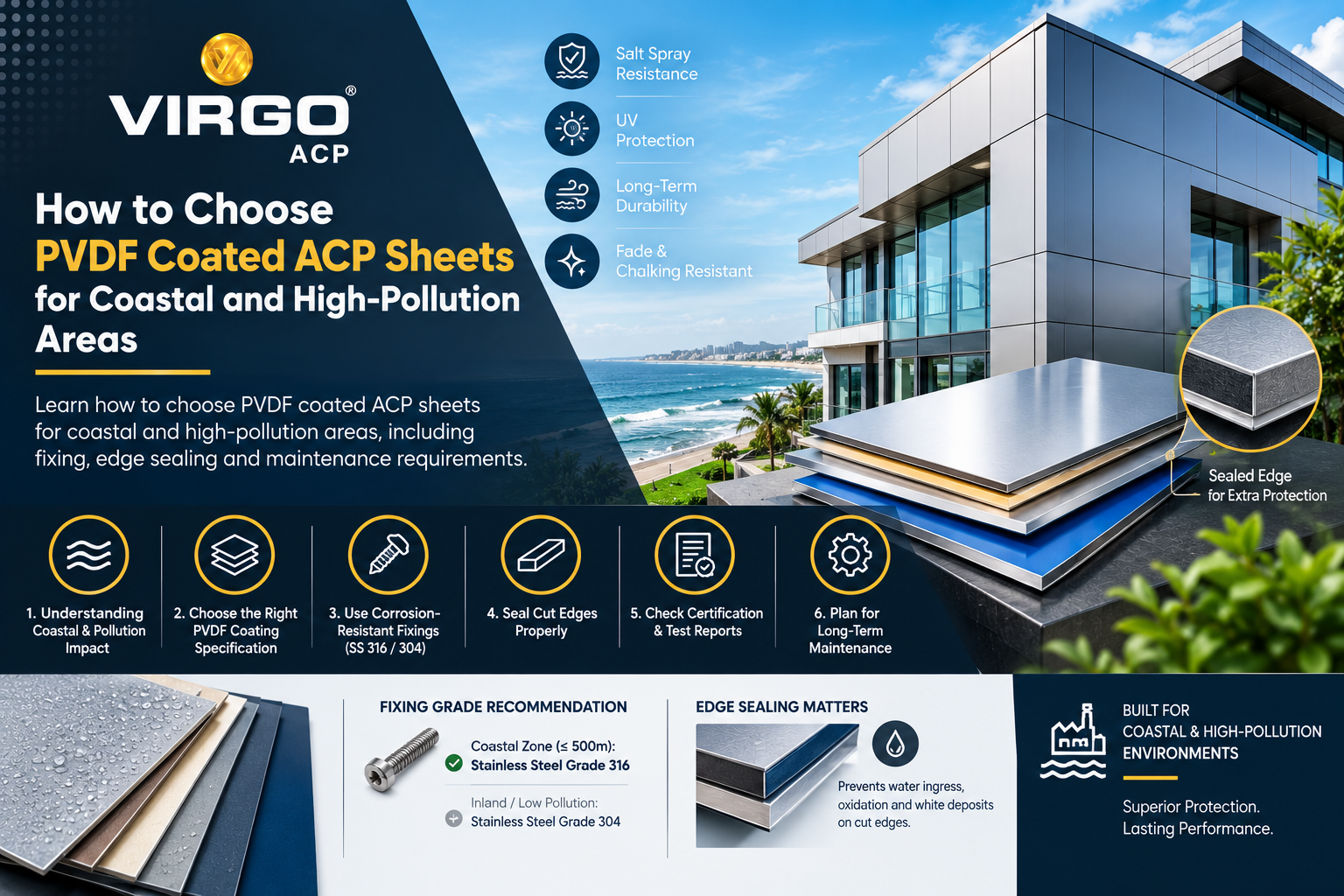
ACP sheet lifespan for the ACP facade panels themselves is not significantly reduced by coastal salt — PVDF coating is chemically inert to sodium chloride. ACP sheet lifespan for the fixing system is reduced: zinc-plated steel fixings corrode in marine environments. Stainless steel grade 316 fixings extend fixing system ACP sheet lifespan to match the PVDF coated ACP sheets coating life.
Industrial pollution
Surface contamination accumulates faster on exterior wall cladding panels in high-pollution environments. PVDF coated ACP sheets clean more completely than polyester alternatives — the appearance ACP sheet lifespan is maintained longer with higher cleaning frequency (three to four times per year from quality Aluminium composite panel suppliers specifications).
Factor 4: Installation Quality
The ACP sheet lifespan of correctly specified PVDF coated ACP sheets can be significantly shortened by poor installation. Subframe design, fixing specification, joint sealant, cavity drainage, and panel edge sealing all affect the operational ACP sheet lifespan of ACP facade panels in ways that the panel specification alone cannot compensate for.
Factor 5: Location and Orientation
Not all ACP cladding sheets on the same building have the same ACP sheet lifespan exposure. South-facing exterior wall cladding panels face maximum UV — PVDF coated ACP sheets handle this; polyester coating does not. North-facing ACP facade panels receive less direct UV but may show earlier biological growth staining in humid monsoon seasons. Shaded ACP cladding sheets have longer UV-related ACP sheet lifespan but require monitoring for biological growth accumulation.
Signs of ACP Sheet Lifespan Degradation
- Coating chalking on ACP cladding sheets — white powder transfer when rubbing cloth across PVDF coated ACP sheets; on correctly specified panels at 25+ microns DFT, should not appear before 15 years
- Colour shift on ACP facade panels — ΔE above 3.0 between original and current colour; visible colour change on ACP sheets that PVDF coated ACP sheets resist for 20+ years
- Joint and sealant failure on exterior wall cladding panels — cracked or absent sealant at ACP cladding sheets joints; primary water ingress pathway reducing ACP sheet lifespan
- Panel edge delamination on ACP facade panels — blistering or skin lifting at edges; low peel strength failing under Indian thermal cycling conditions
How to Extend ACP Sheet Lifespan
- Specify PVDF coated ACP sheets at 25+ microns DFT — the single biggest determinant of ACP sheet lifespan
- Source FR grade ACP cladding sheets from a certified Aluminium composite panel supplier with production traceability
- Install correctly — subframe design, fixing specification, sealant specification, and cavity drainage management are as important to ACP sheet lifespan as the PVDF coated ACP sheets specification
- Clean regularly — PVDF coated ACP sheets twice per year standard; three to four times per year for coastal or high-pollution exterior wall cladding panels
- Inspect and repair promptly — annual inspection of joint sealant and ACP facade panels alignment; prompt sealant repair extends effective ACP sheet lifespan
Frequently Asked Questions
Q. How many years do ACP sheets last on external building facades?
Ans. ACP sheet lifespan depends on coating specification, climate, and installation quality. PVDF coated ACP sheets at 25+ microns DFT from a reputable Aluminium composite panel supplier maintain appearance for 20–25 years on Indian external ACP facade panels. Structural lifespan is 25–30+ years with periodic maintenance. Polyester-coated ACP cladding sheets on south-facing Indian facades show visible degradation within three to five years.
Q. Do ACP sheets fade over time?
Ans. PVDF coated ACP sheets resist UV-driven colour fading — the fluorine-carbon bond in PVDF maintains ACP sheet lifespan colour stability for 20+ years on Indian exterior wall cladding panels. Polyester-coated ACP sheets fade significantly faster under India’s UV index 10+ conditions. ACP sheet lifespan for colour retention is directly tied to coating type and DFT from the Aluminium composite panel supplier.
Q. Are PVDF coated ACP sheets suitable for outdoor use in India?
Ans. Yes — PVDF coated ACP sheets are the correct specification for outdoor ACP facade panels in India. PVDF coating resists UV degradation, handles monsoon rainfall, and maintains surface appearance for 20+ years. ACP sheet lifespan of 20–25 years is achievable with correctly specified PVDF coated ACP sheets from a reputable Aluminium composite panel supplier.
Q. Does rain damage ACP cladding sheets?
Ans. Correctly specified PVDF coated ACP cladding sheets are waterproof — monsoon rainfall doesn’t damage the ACP facade panels. The ACP sheet lifespan risk in high-rainfall environments is at installation details: failed sealant at ACP sheets joints allows water ingress behind exterior wall cladding panels. Regular joint inspection extends ACP sheet lifespan.
Q. Can ACP sheets be used in coastal areas?
Ans. Yes — PVDF coated ACP sheets handle coastal salt aerosol without coating degradation. ACP sheet lifespan in coastal environments is comparable to inland installations when correctly specified with stainless steel grade 316 fixings and sealed cut panel edges. Contact a qualified Aluminium composite panel supplier for coastal ACP facade panels specification guidance.
Q. How does manufacturer quality affect ACP sheet lifespan?
Ans. Significantly. ACP cladding sheets from an Aluminium composite panel supplier with in-house coil production and documented quality management maintain ACP sheet lifespan specification consistently across batches. Economy ACP sheets from unverified sources may have variable skin gauge, coating DFT, and peel strength — each reducing the operational ACP sheet lifespan below specification. Always verify the Aluminium composite panel suppliers’ BIS IS 17682:2021 certification and request technical datasheet data before purchasing.
Virgo ACP offers PVDF coated ACP sheets with 20–25 year ACP sheet lifespan on Indian external ACP facade panels. BIS IS 17682:2021 certified. Speak with the technical team at virgoacp.com/contact/