
How Weather and UV Exposure Affect ACP Facades
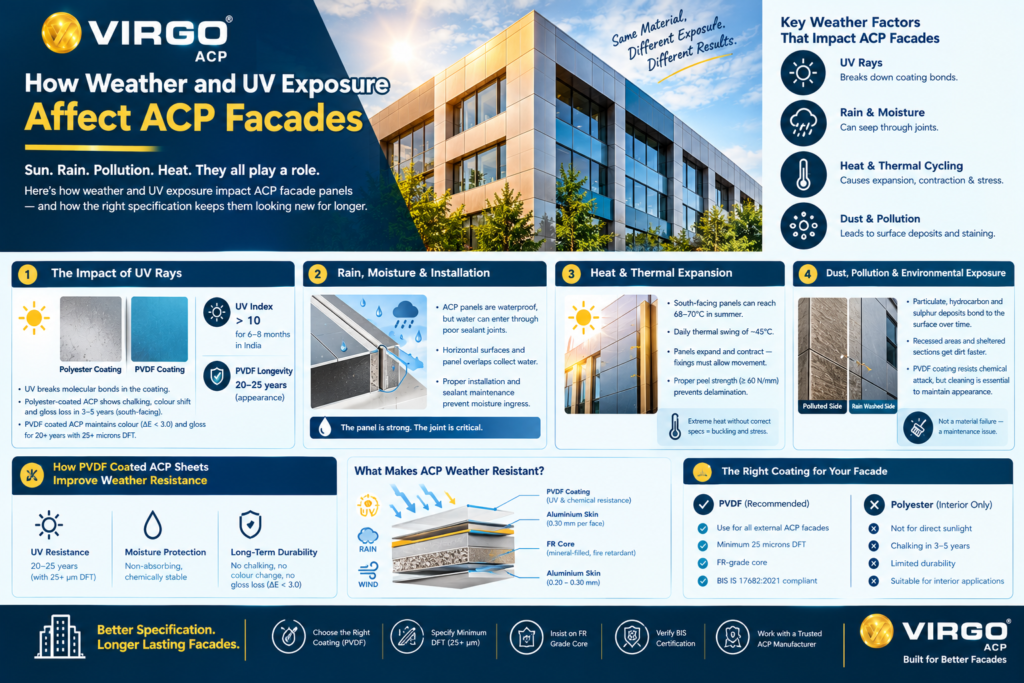
Three years after a commercial tower opened in Bengaluru’s outer ring road corridor, the project architect visited the site for a maintenance review. The ACP facade panels on the south and west elevations had chalked — not dramatically, but visibly. A pale whitish haze on what had been a sharp champagne gold. The north elevation looked exactly as it had at handover. The building had used the same specification on all four elevations: 4mm ACP cladding sheets, ‘PVDF coating,’ FR-grade core. The difference between the north and south ACP facade panels three years on was not the material — it was the UV load each face had endured. The south and west PVDF coated ACP sheets had been applied at 17 microns DFT. At below-minimum DFT, the PVDF resin couldn’t withstand nine months of UV index 10+ without beginning to break down. This is what weather and UV exposure actually do to ACP facade panels — gradual, specific degradation that is entirely predictable and entirely preventable with the correct specification. How Different Weather Conditions Affect ACP Facade Panels Impact of UV Rays on ACP Sheets UV radiation is the dominant weathering mechanism for ACP facade panels in India. The UV index across most of the country exceeds 10 for six to eight months per year. What UV does to ACP sheets is photochemical: high-energy UV photons break molecular bonds in the surface coating binder. For polyester-coated Aluminium Composite Panels, this produces chalking, colour shift, and gloss reduction — typically visible within three to five years on south-facing ACP facade panels. PVDF coated ACP sheets resist this because the fluorine-carbon bond in polyvinylidene fluoride is among the most UV-stable molecular structures in industrial chemistry. Correctly applied at minimum 25 microns DFT, PVDF coated ACP sheets maintain colour (ΔE < 3.0) and gloss for 20+ years on Indian external ACP facade panels. The difference between polyester and PVDF coated ACP sheets on a south-facing Indian facade is not gradual — at year five to seven, polyester-coated building facade materials show visible decline while PVDF coated ACP sheets look essentially unchanged. Effect of Heavy Rain and Moisture on Exterior Wall Cladding Panels Correctly specified ACP cladding sheets are waterproof — the aluminium skins in Aluminium Composite Panels don’t absorb moisture, don’t corrode, and don’t swell. The moisture risk for ACP facade panels is not in the panels — it’s in the installation details around them. Failed or absent sealant at ACP sheets panel joints allows water ingress behind the exterior wall cladding panels. Horizontal surfaces on ACP cladding sheets — ledges, parapet caps, panel overlaps — concentrate monsoon water against building facade materials joint lines, driving moisture into the wall assembly through minor sealant gaps. High Temperatures and Thermal Expansion of ACP Facade Panels A south-facing ACP cladding sheets panel in Nagpur can reach 68–70°C at midday in summer and cool to 25°C overnight — a 45°C daily thermal swing repeating every summer day for twenty years. Aluminium Composite Panels expand and contract predictably with this temperature cycling. When these movement allowances are inadequate — when fixings prevent thermal expansion — the stress transfers into the ACP cladding sheets panel tray itself, producing visible buckling on south-facing exterior wall cladding panels in extreme heat zones. The skin-to-core bond in ACP facade panels is also tested by thermal cycling. Panels with adequate peel strength (60 N/mm minimum per IS 17682:2021) handle this without delamination. Under-specified building facade materials develop edge blistering as the skin-to-core bond progressively weakens. Dust, Pollution and Environmental Exposure of ACP Sheets India’s urban pollution deposits particulate, hydrocarbon residue, and sulphur compounds on ACP facade panels continuously. Surface contamination on exterior wall cladding panels is a maintenance issue rather than a material degradation issue for correctly specified PVDF coated ACP sheets — PVDF doesn’t react with standard industrial pollutants, but contamination deposits bond progressively if not removed. Differential soiling patterns develop on ACP cladding sheets in polluted environments: rain-washed exposed Aluminium Composite Panels faces stay relatively clean; recessed details and sheltered sections accumulate contamination faster. How PVDF Coated ACP Sheets Improve Weather Resistance UV Resistance and Colour Retention PVDF coated ACP sheets at 25+ microns DFT maintain colour (ΔE < 3.0) and gloss for 20–25 years on south-facing Indian ACP facade panels — documented in weatherometer testing at 3000+ hours accelerated exposure. Standard polyester-coated ACP sheets and ACP cladding sheets begin showing UV-driven chalking within three to five years on Indian south-facing ACP facade panels. The visual difference between PVDF coated ACP sheets and polyester ACP facade panels at year seven is not subtle on Indian building facade materials. Protection Against Moisture and Weathering PVDF coated ACP sheets don’t absorb moisture and their coating doesn’t react with the weak acids present in Indian pollution and acid rain. Aluminium Composite Panels with PVDF coating maintain their surface integrity across monsoon-dry season cycles without swelling, lifting, or developing the surface porosity that accelerates staining on other exterior wall cladding panels. Selecting the Right Coating for Exterior ACP Facade Panels For any external ACP sheets application in India, PVDF coating is the correct specification. The additional specification that matters is minimum DFT — 25 microns per face. ‘PVDF coated ACP facade panels’ on a product description is insufficient without DFT confirmation. Two ACP cladding sheets products both described as ‘PVDF coated’ can have 15-micron and 27-micron coatings — with significantly different UV resistance over their service life as building facade materials. Factors That Influence the Lifespan of ACP Facade Panels Panel and Coating Quality PVDF coated ACP sheets from a BIS IS 17682:2021 certified manufacturer with current NABL-accredited test documentation represent the quality baseline for external ACP facade panels. The combination of FR-grade core, 0.30mm aluminium skin per face, and PVDF coating at 25+ microns DFT is the specification for ACP cladding sheets that perform across India’s full climate range. Aluminium Skin Thickness and Core Specification ACP cladding sheets with 0.30mm aluminium skin per face on external ACP facade panels provide surface rigidity,
ACP Sheet Lifespan: 5 Key Factors That Affect Durability
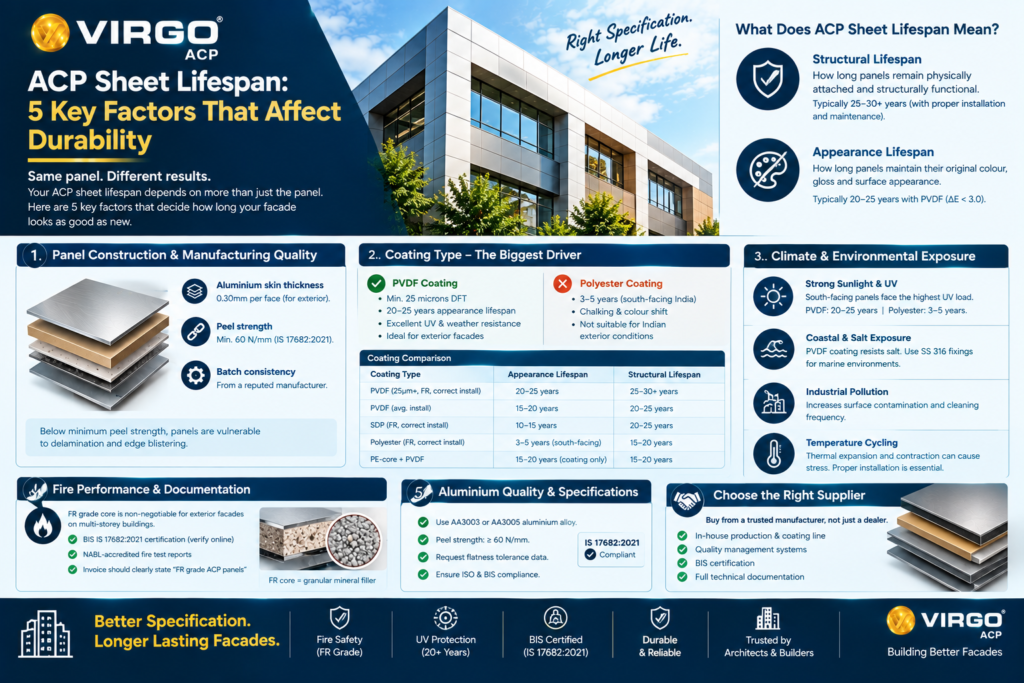
Two commercial buildings were completed in the same year in Ahmedabad. Both had ACP cladding sheets on their primary external elevations. Both used 4mm panels. Both were in comparable urban locations with similar UV exposure. At year six, one building’s ACP facade panels looked precisely as they did at handover. The other had visible chalking on the south elevation, colour shift on the west panels, and a noticeable differential between two sections installed from different deliveries. The difference was not the building, the location, or the weather. The difference was the ACP sheet lifespan specification: the first used PVDF coated ACP sheets from a reputable Aluminium composite panel supplier at 27 microns DFT, FR-grade core, 0.30mm aluminium skin. The second used polyester-coated ACP cladding sheets from an ACP sheet dealer at a lower price point. Same dimension. Same appearance at handover. Very different ACP sheet lifespan outcomes. What ‘ACP Sheet Lifespan’ Actually Means ACP sheet lifespan is not a fixed number — it is a range. And the position within that range is determined almost entirely by decisions made at specification and procurement stage. Structural lifespan The length of time ACP facade panels remain physically attached, mechanically sound, and structurally functional. For correctly specified and installed exterior wall cladding panels from quality Aluminium composite panel suppliers, structural performance is typically 25–30+ years with periodic sealant maintenance. Appearance lifespan How long ACP cladding sheets maintain their original colour, gloss level, and surface appearance within acceptable tolerance (typically ΔE < 3.0 — the threshold below which colour change is not visible to the naked eye). This is where the ACP sheet lifespan difference between PVDF coated ACP sheets and polyester-coated ACP sheets is most consequential in Indian conditions. Factor 1: Panel Construction and Manufacturing Quality ACP sheet lifespan begins with what the panel is made of. Aluminium skin thickness (0.30mm per face for external ACP facade panels), peel strength (minimum 60 N/mm per IS 17682:2021 for external ACP cladding sheets), and batch consistency from Aluminium composite panel suppliers all directly affect ACP sheet lifespan. Below minimum peel strength, ACP sheets are vulnerable to delamination — the skin lifting from the core at panel edges — under Indian thermal cycling, manifesting as visible blistering at ACP facade panels edges. Factor 2: Coating Type — The Biggest Driver of ACP Sheet Lifespan PVDF coated ACP sheets PVDF coating applied at minimum 25 microns DFT provides an expected appearance ACP sheet lifespan of 20–25 years on Indian external ACP cladding sheets. PVDF coated ACP sheets maintain colour (ΔE < 3.0) and gloss (above 50% of initial) for the documented service life under India’s UV index 10+ conditions. This is the non-negotiable coating specification for ACP sheet lifespan on Indian external ACP facade panels. Polyester coated ACP sheets Appearance ACP sheet lifespan on Indian south-facing external facades: three to five years before visible chalking and colour shift begin. Polyester ACP cladding sheets are not appropriate for external exterior wall cladding panels on Indian buildings with direct sunlight. The ACP sheet lifespan for polyester coating is simply too short for the Indian UV environment. Coating Specification ACP Sheet Lifespan (Appearance) ACP Sheet Lifespan (Structural) PVDF coated ACP sheets 25μm+ DFT, FR grade, correct install 20–25 years 25–30+ years PVDF coated ACP sheets 25μm+ DFT, FR grade, average install 15–20 years 20–25 years SDP coated ACP cladding sheets, FR grade, correct install 10–15 years 20–25 years Polyester coated ACP facade panels, FR grade, correct install 3–5 years (south-facing India) 15–20 years structural PE-core ACP sheets, PVDF coated, correct install 15–20 years (coating only) 15–20 years — fire non-compliant exterior wall cladding panels Factor 3: Climate and Environmental Exposure Strong sunlight and UV — highest ACP sheet lifespan risk South-facing PVDF coated ACP sheets in hot dry regions experience the most intensive UV load. ACP sheet lifespan for correctly specified PVDF coated ACP sheets: 20–25 years. For polyester-coated ACP cladding sheets: three to five years before visible degradation — explaining the Ahmedabad building comparison in this guide’s opening. Coastal and salt exposure ACP sheet lifespan for the ACP facade panels themselves is not significantly reduced by coastal salt — PVDF coating is chemically inert to sodium chloride. ACP sheet lifespan for the fixing system is reduced: zinc-plated steel fixings corrode in marine environments. Stainless steel grade 316 fixings extend fixing system ACP sheet lifespan to match the PVDF coated ACP sheets coating life. Industrial pollution Surface contamination accumulates faster on exterior wall cladding panels in high-pollution environments. PVDF coated ACP sheets clean more completely than polyester alternatives — the appearance ACP sheet lifespan is maintained longer with higher cleaning frequency (three to four times per year from quality Aluminium composite panel suppliers specifications). Factor 4: Installation Quality The ACP sheet lifespan of correctly specified PVDF coated ACP sheets can be significantly shortened by poor installation. Subframe design, fixing specification, joint sealant, cavity drainage, and panel edge sealing all affect the operational ACP sheet lifespan of ACP facade panels in ways that the panel specification alone cannot compensate for. Factor 5: Location and Orientation Not all ACP cladding sheets on the same building have the same ACP sheet lifespan exposure. South-facing exterior wall cladding panels face maximum UV — PVDF coated ACP sheets handle this; polyester coating does not. North-facing ACP facade panels receive less direct UV but may show earlier biological growth staining in humid monsoon seasons. Shaded ACP cladding sheets have longer UV-related ACP sheet lifespan but require monitoring for biological growth accumulation. Signs of ACP Sheet Lifespan Degradation Coating chalking on ACP cladding sheets — white powder transfer when rubbing cloth across PVDF coated ACP sheets; on correctly specified panels at 25+ microns DFT, should not appear before 15 years Colour shift on ACP facade panels — ΔE above 3.0 between original and current colour; visible colour change on ACP sheets that PVDF coated ACP sheets resist for 20+ years Joint and sealant failure on exterior wall cladding panels — cracked or absent sealant at ACP
What Is FR ACP? Fire-Retardant ACP Explained for Architects and Builders
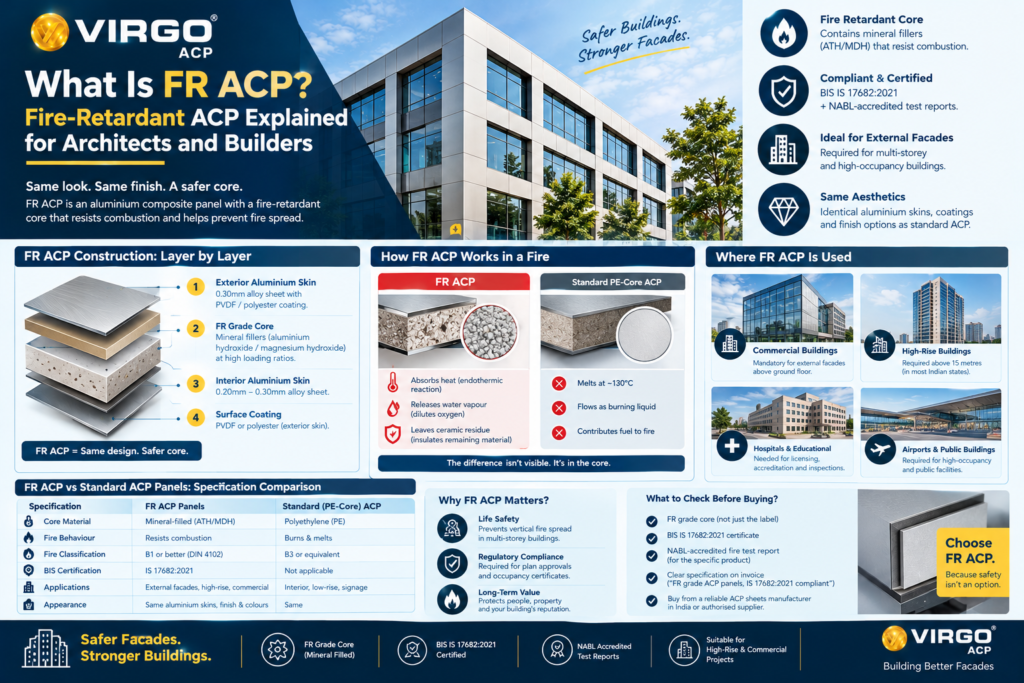
The building authority inspector stood on the sixth floor of a completed commercial tower in Noida and asked a question that nobody on the project team had prepared for: ‘Can you show me the fire test documentation for the ACP facade panels?’ The project’s fire safety consultant had specified FR ACP. The contractor had purchased from an ACP sheet dealer who said the product was FR grade. The delivery invoices said ‘FR ACP sheets.’ What nobody had asked for was an NABL-accredited fire test certificate that demonstrated what the FR in FR ACP actually meant for the specific product supplied. The project was delayed three weeks for retrospective documentation. What is FR ACP, really — beyond the label? And what should architects, builders, and procurement teams actually check? What Does FR ACP Mean? FR ACP stands for Fire-Retardant Aluminium Composite Panel. The ‘FR’ designation refers specifically to the core material — the compound between the two aluminium skins — which contains mineral fillers that resist combustion. FR ACP is not fireproof. What FR ACP does is resist sustaining and spreading flame. When correctly specified, manufactured, and installed, FR grade ACP panels behave very differently from PE-core Aluminium Composite Panels in fire conditions. FR ACP is distinguished from standard (PE-core) ACP panels by its core composition alone. The aluminium skins, the PVDF surface coating, the panel dimensions, and the external appearance of FR ACP are identical to standard ACP sheets. The difference is entirely internal — in the core — and cannot be identified visually. This is why documentation matters more than the FR ACP label. FR ACP Construction: Layer by Layer Layer 1 — Exterior aluminium skin 0.30mm aluminium alloy sheet for external ACP facade panels applications, coated with PVDF or polyester surface coating. The aluminium skin in FR ACP is identical to standard ACP sheets — aluminium itself is non-combustible. At facade fire temperatures, the aluminium skin deforms and may separate from the core; the core exposed is where fire behaviour diverges between FR ACP and standard ACP panels. Layer 2 — FR grade core In FR ACP, this layer contains mineral fillers — primarily aluminium hydroxide (ATH) or magnesium hydroxide (MDH) — at high loading ratios, sometimes exceeding 90% by weight of the core compound. These minerals are the fire-retardant mechanism that makes FR grade ACP panels behave differently from PE-core Aluminium Composite Panels in fire. Layer 3 — Interior aluminium skin Same as the exterior skin — 0.20mm to 0.30mm aluminium alloy. Provides structural closure to the ACP facade panels tray. Layer 4 — Surface coating PVDF or polyester coating on the exterior skin. The coating type governs UV performance, not fire performance. FR ACP with PVDF coating is the correct specification for external ACP facade panels. FR ACP with polyester coating is appropriate only for interior ACP sheets applications. How the FR Core Works in a Fire The fire-retardant mechanism in FR grade ACP panels is endothermic decomposition. When the mineral fillers in the FR ACP core are exposed to fire heat, they: absorb heat from the combustion zone (endothermic reaction) — reducing temperature available to sustain burning; release water vapour into the combustion zone — diluting oxygen concentration; and leave a ceramic residue that insulates remaining material from further heat. Standard PE-core ACP sheets, by contrast, contain polyethylene — a thermoplastic that melts at approximately 130°C, flows as burning liquid at higher temperatures, and contributes fuel to fire. The difference between FR ACP and PE-core ACP panels in fire conditions is categorically different fire behaviour, not a marginal performance difference. Where FR ACP Is Used Commercial buildings Any external ACP facade panels on a commercial building above ground floor should be FR ACP. Building authorities in most major Indian cities require FR grade ACP panels documentation for plan approvals and occupancy certificates on commercial projects. This is the primary application category for FR ACP. High-rise buildings FR ACP is mandatory — not discretionary — for external Aluminium Composite Panels and exterior wall cladding panels on buildings above 15 metres in most Indian states. Hospitals and educational buildings Healthcare and educational facilities require FR grade ACP panels for external ACP sheets. Fire test documentation for FR ACP must be available for building licensing, healthcare accreditation, and fire safety inspections. Airports and public buildings Public buildings with high occupancy require FR ACP for all external cladding. The fire behaviour of exterior wall cladding panels at these facilities is subject to specific regulatory standards. How FR ACP Affects Overall Facade Fire Performance FR ACP is necessary but not sufficient for a fire-safe exterior wall cladding panels system. Installation and joint detailing matter: FR grade ACP panels installed with combustible backing materials or without cavity fire breaks at floor levels can still contribute to fire spread despite compliant panel specification. The complete system — FR ACP specification plus correct installation including cavity barriers at floor levels — determines facade fire performance. FR ACP vs Standard ACP Panels: Specification Comparison Specification Factor FR ACP Standard PE-core ACP Sheets Core material Mineral-filled compound — FR grade ACP panels Polyethylene (PE) — standard ACP panels Fire behaviour Resists combustion; absorbs heat; releases water vapour Burns and melts; contributes fuel to fire Fire classification B1 or B2 (DIN 4102); FR classification IS 17682:2021 B3 (highly flammable) or unclassified External multi-storey application Required — IS 17682:2021 compliant Aluminium Composite Panels Not compliant for external exterior wall cladding panels Fire test documentation Available from NABL-accredited laboratory Not applicable Cut edge identification Visible granular mineral filler — FR grade ACP panels Uniform solid white/translucent plastic — ACP sheets Cost vs standard ACP panels 10–25% higher Lower initial cost Interior ACP sheets use FR ACP can be used — unnecessary cost PE-core ACP panels appropriate for interior Common Mistakes When Specifying FR ACP Buying on price without verifying core type — price difference between FR ACP and PE-core ACP sheets creates substitution incentive; verify by cutting a panel edge on delivery Accepting the word ‘FR’ without
How to Choose the Right ACP Sheets in India: 7 Factors to Consider
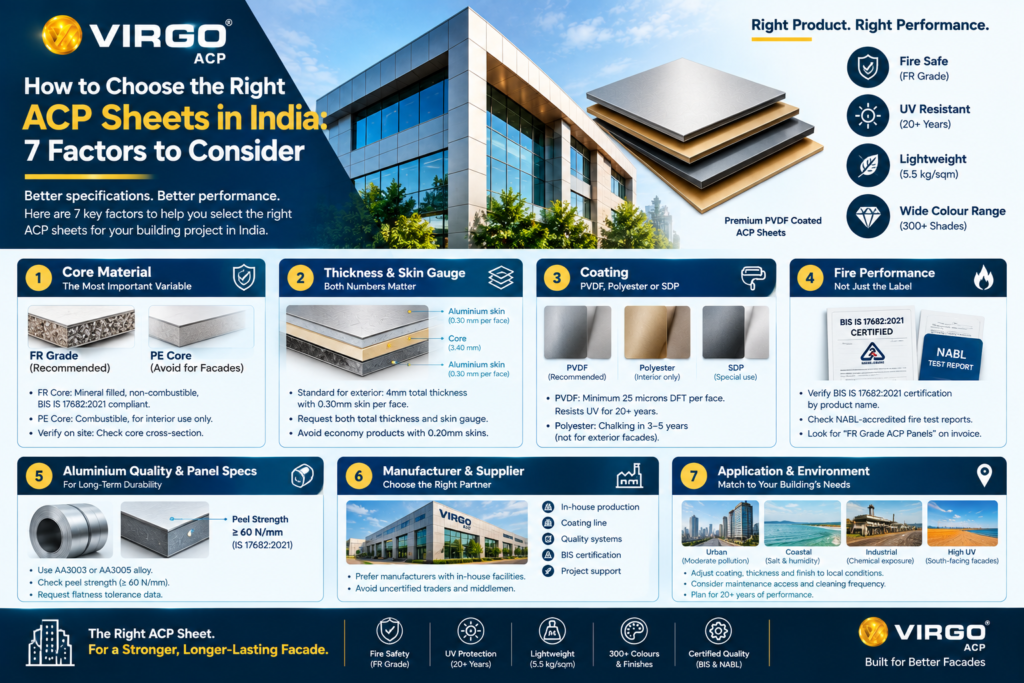
A fabricator in Surat called his long-time ACP sheet dealers contact three months after completing a large commercial project in Vadodara. The ACP sheets were blistering at the edges on the upper three floors. He’d bought them ₹40/sqft below market rate. The trade invoice said ‘4mm PVDF ACP sheets.’ What it didn’t say was the skin gauge, the core type, or the DFT. What the panels turned out to contain was PE core. What the coating turned out to be was polyester. The story is not unusual. The ACP sheets market in India includes credible ACP sheets manufacturer in India operations producing certified, high-performance product — and traders selling panels that look identical at delivery and perform very differently after eighteen months on an external facade. Before buying ACP sheets in India, these seven factors determine whether you get the product your project actually needs. Factor 1: Core Material — The Most Important Variable in Any ACP Sheets Purchase The core material in ACP sheets determines fire behaviour — non-negotiable for external building facades on multi-storey occupied structures. PE (polyethylene) core ACP sheets Combustible. Lightweight. Less expensive. Appropriate for interior applications and low-level non-occupied signage. Not appropriate for external facades on occupied multi-storey buildings. Still sold by ACP sheet dealers as a general product without application guidance. FR grade ACP panels Contains mineral fillers — aluminium hydroxide or magnesium hydroxide — that suppress combustion. FR grade ACP panels are required for any external facade above ground floor. Every credible ACP sheets manufacturer in India should clearly designate FR grade ACP panels in their product range. Verify on site: cut a panel edge. FR grade ACP panels show visible granular mineral filler in the core cross-section. PE-core ACP sheets show a uniform solid white plastic. Thirty seconds. Factor 2: ACP Sheets Thickness and Aluminium Skin Gauge — Both Numbers The ACP sheets market in India describes products by total panel thickness — 3mm, 4mm, 6mm. Total thickness tells half the story. Aluminium skin thickness per face tells the other half, and this is the number ACP sheet dealers most commonly omit from their documentation. For external ACP sheets: 4mm total thickness is the standard, and 0.30mm aluminium skin per face is the minimum correct specification under IS 17682:2021. An ACP sheets manufacturer in India producing economy products may supply 4mm ACP sheets with 0.20mm skins — meeting total thickness while delivering reduced surface rigidity and dent resistance. A reputable ACP panel manufacturers operation will state both numbers. Request both explicitly. Factor 3: ACP Sheets Coating — PVDF, Polyester, or SDP The coating on ACP sheets governs UV resistance, colour retention, and weathering performance across the service life. PVDF coated ACP sheets The correct specification for external building facades. PVDF coating resists UV degradation for 20+ years under India’s extreme solar conditions. The minimum DFT for PVDF coated ACP sheets on external facades is 25 microns per face. Any credible ACP sheets manufacturer in India producing external products should provide DFT data in their technical documentation. PVDF coated ACP sheets from a quality ACP panels supplier in India at 25+ microns DFT is the non-negotiable external coating specification. Polyester coating on ACP sheets Appropriate for interior applications only. Polyester-coated ACP sheets begin chalking within three to five years on south-facing external facades in Indian conditions. Frequently sold by ACP sheet dealers at lower price points without clear guidance on exterior limitations. Factor 4: Fire Performance Documentation — Not Just the Label FR grade ACP panels require verifiable fire performance documentation — not just the word ‘FR’ on an ACP sheet dealers invoice. BIS IS 17682:2021 certification — verify at bis.gov.in by searching the ACP sheets manufacturer in India name under IS 17682:2021 NABL-accredited fire test reports for FR grade ACP panels — certificate should reference the specific product series from the ACP panel manufacturers, not a generic FR ACP category On the delivery invoice — ‘FR grade ACP panels, IS 17682:2021 compliant’ should appear explicitly; ACP sheet dealers who cannot provide this for FR grade ACP panels are selling product that cannot be documented for building authority submissions Factor 5: Aluminium Quality and Panel Specifications The aluminium skins in ACP sheets determine surface quality, coating adhesion, and long-term appearance. Quality PVDF coated ACP sheets from a reputable ACP sheets manufacturer in India use AA3003 or AA3005 aluminium alloy. Peel strength — the bond between aluminium skin and core — should meet the IS 17682:2021 minimum of 60 N/mm for external ACP sheets. Below this threshold, ACP sheets are vulnerable to delamination under Indian thermal cycling conditions. Request flatness tolerance data from any ACP panel manufacturers — critical for high-gloss and metallic PVDF coated ACP sheets. Factor 6: ACP Sheets Manufacturer and Supplier Quality Buying ACP sheets in India from the right source is as important as specifying the right product. ACP sheets manufacturer in India Companies with in-house production facilities, own coating lines, quality management systems, and BIS IS 17682:2021 certification. These ACP panel manufacturers can provide production traceability, batch documentation, and warranty backed by manufacturing capability. ACP panels supplier in India (trading) Companies that buy ACP sheets from ACP panel manufacturers and resell. Quality varies significantly — some ACP panels supplier in India operations offer excellent product with full documentation; others offer limited documentation and inconsistent quality. ACP sheet dealers Local dealers who stock multiple brands. Price-competitive but often limited in technical documentation for FR grade ACP panels and PVDF coated ACP sheets. For projects requiring BIS certification and NABL fire test reports, the ACP sheets manufacturer in India directly is the appropriate source. Factor 7: Total Cost of Ownership — Not Just Per-Sqft Price from ACP Sheet Dealers The per-sqft price of ACP sheets from ACP sheet dealers is the number everyone compares first. It is also the least useful number in isolation. Material cost: ACP sheets per sqft plus 10–15% wastage allowance = actual material cost per sqft installed Subframe and fixings: not included in the ACP sheets
ACP vs HPL vs Glass: Which Facade Material Is Right for Your Project?
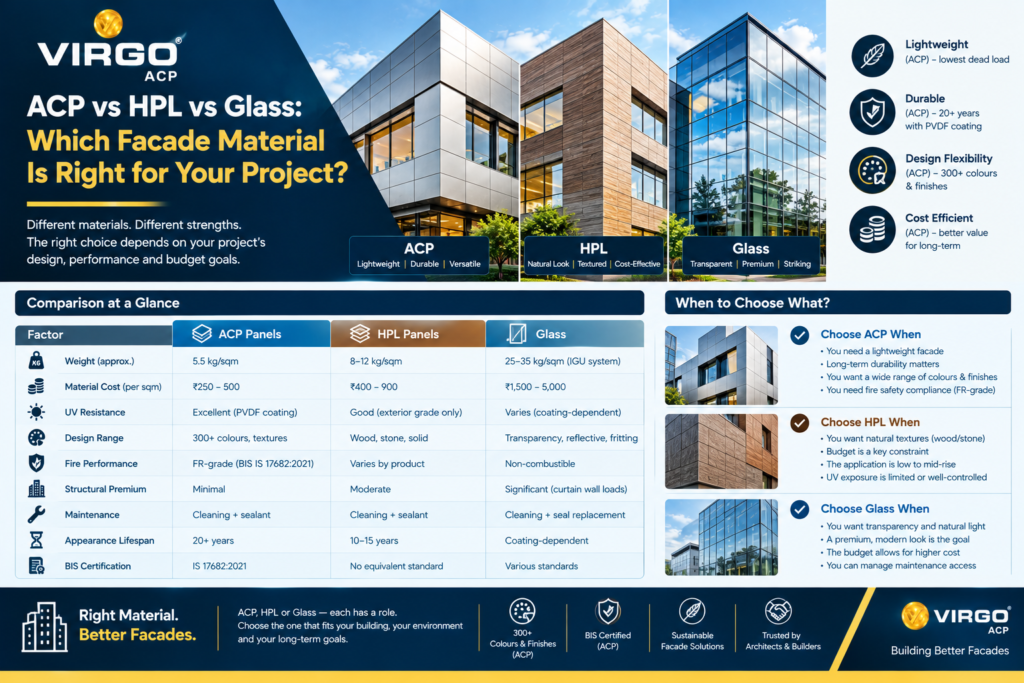
A project architect working on a mixed-use development in Bengaluru had three materials shortlisted: ACP panels on the office tower, HPL on the retail podium, and glass on the corner feature element. Each had a specific application where it genuinely outperformed the others. Then the client asked whether all three could be unified into one material. The architect’s answer was instructive: ACP vs HPL vs Glass is not a ranking of which is ‘best’ — it’s a selection tool for matching building facade materials to specific application requirements. No single material wins all categories for all projects. What changes is which performance criteria matter most for each specific part of the brief. This guide works through the ACP vs HPL vs Glass comparison systematically. Aluminium Composite Panels: Construction and Applications Aluminium Composite Panels are three-layer panels — two aluminium skins bonded to a core — installed on an aluminium subframe in a ventilated cavity ACP facade panels system. Every serious Aluminium composite panel manufacturer offers PVDF-coated ACP panels for external applications: UV-resistant for 20+ years, available in 300+ colours. Any reputable ACP panels supplier in India can provide FR-grade core and PVDF coating with BIS IS 17682:2021 certification. ACP panels are the most widely used external building facade materials in Indian commercial construction because they balance lightweight performance, design flexibility, installation speed, and cost across a wide range of exterior wall cladding panels applications. HPL (High-Pressure Laminate): Construction and Applications High-pressure laminate is a compressed sandwich of resin-impregnated paper layers — typically 6–12mm thick for facade applications. HPL facade panels are available in wood-grain and stone-effect surfaces that achieve naturalistic appearances at close viewing distance. HPL is heavier than ACP facade panels (approximately 8–12 kg/sqm versus 5.5 kg/sqm for ACP panels) but significantly lighter than natural stone. HPL has specific limitations in Indian external conditions: direct UV exposure causes chalking and surface degradation in standard HPL formulations. Exterior-grade compact HPL specifically formulated for UV resistance must be specified. For the ACP vs HPL vs Glass comparison in full-sun Indian conditions, PVDF-coated ACP facade panels from a quality Aluminium composite panel manufacturer demonstrate superior UV resistance to most HPL products. Architectural Glass: Types and Facade Applications Architectural glass in building facade materials includes clear and tinted float glass in curtain wall systems, reflective glass, laminated safety glass, and insulated glass units. Glass delivers transparency, reflectivity, and light interaction that no opaque exterior wall cladding panels material can replicate. It is also the most technically complex and expensive facade material in the ACP vs HPL vs Glass comparison — requiring specialist curtain wall engineering and significantly higher maintenance access cost. ACP vs HPL vs Glass: Full Comparison Table Factor ACP Panels / ACP Facade Panels HPL Glass Weight 5.5 kg/sqm — ACP panels supplier in India 8–12 kg/sqm 25–35 kg/sqm (IGU curtain wall system) Material cost ₹250–500/sqm — ACP facade panels PVDF FR ₹400–900/sqm — compact HPL exterior ₹1,500–5,000/sqm — curtain wall system UV resistance Excellent — PVDF ACP panels — Aluminium composite panel manufacturer Good — exterior-grade HPL only Varies — coating-dependent on glass Design range 300+ colours, textures — ACP panels supplier in India Wood, stone, solid finishes Transparency, reflectivity, fritting Fire performance FR-grade ACP facade panels — BIS IS 17682:2021 Fire performance varies by product Non-combustible glass Structural premium Minimal — ACP panels Moderate Significant — curtain wall loads Maintenance Cleaning + sealant — ACP facade panels Cleaning + sealant — HPL Cleaning (access-intensive) + seal replacement Appearance lifespan 20+ years — PVDF ACP panels from Aluminium composite panel manufacturer 10–15 years exterior HPL Coating-dependent BIS certification IS 17682:2021 — Aluminium composite panel manufacturer No equivalent standard Various glass standards Weight and Structural Requirements in ACP vs HPL vs Glass In the ACP vs HPL vs Glass comparison, ACP panels are the lightest opaque building facade materials. At 5.5 kg/sqm for a complete ACP facade panels system from any qualified Aluminium composite panel manufacturer or ACP panels supplier in India, the dead load is minimal. HPL facade panels weigh 8–12 kg/sqm — heavier than ACP panels but manageable. Glass curtain wall systems impose 25–35 kg/sqm — the structural premium for glass versus ACP facade panels is substantial. Weather Resistance and Indian Climate Performance UV exposure in ACP vs HPL vs Glass PVDF-coated ACP panels from a reputable Aluminium composite panel manufacturer maintain colour and gloss for 20+ years under India’s UV index 10+ conditions. Exterior-grade HPL typically shows surface degradation after 10–15 years on south-facing facades in western India. ACP facade panels consistently outperform HPL in UV resistance in the ACP vs HPL vs Glass comparison for Indian external facade applications. Rain and moisture ACP facade panels are waterproof — the aluminium skins are impermeable. HPL is relatively moisture-resistant but joint detailing is critical in high-monsoon Indian climates. Glass is impermeable; water management is entirely a joint and seal design issue. For exterior wall cladding panels, ACP panels and glass both handle monsoon rainfall without panel degradation; HPL requires careful edge and joint sealing. Design and Appearance in ACP vs HPL vs Glass ACP panels from a quality Aluminium composite panel manufacturer or ACP panels supplier in India are available in 300+ colours — solid, metallic, wood-effect, stone-effect, mirror, and specialty finishes — with consistent batch colour across large installations. HPL offers wood-grain and stone-effect surfaces that read convincingly at close viewing distance — an advantage over ACP facade panels for ground-level elements. Glass offers transparency — the one design quality that neither ACP panels nor HPL can replicate as building facade materials. Maintenance and Long-Term Care ACP panels maintenance Cleaning twice per year for standard urban exterior wall cladding panels; three to four times in high-pollution environments. Individual ACP facade panels are replaceable without affecting adjacent panels. A quality ACP panels supplier in India can match panels from shade code for future replacement. Glass maintenance Cleaning is the primary maintenance requirement — but access for high-rise glass facades is expensive. High-rise glass requires specialist cleaning equipment, rope