
How Weather and UV Exposure Affect ACP Facades
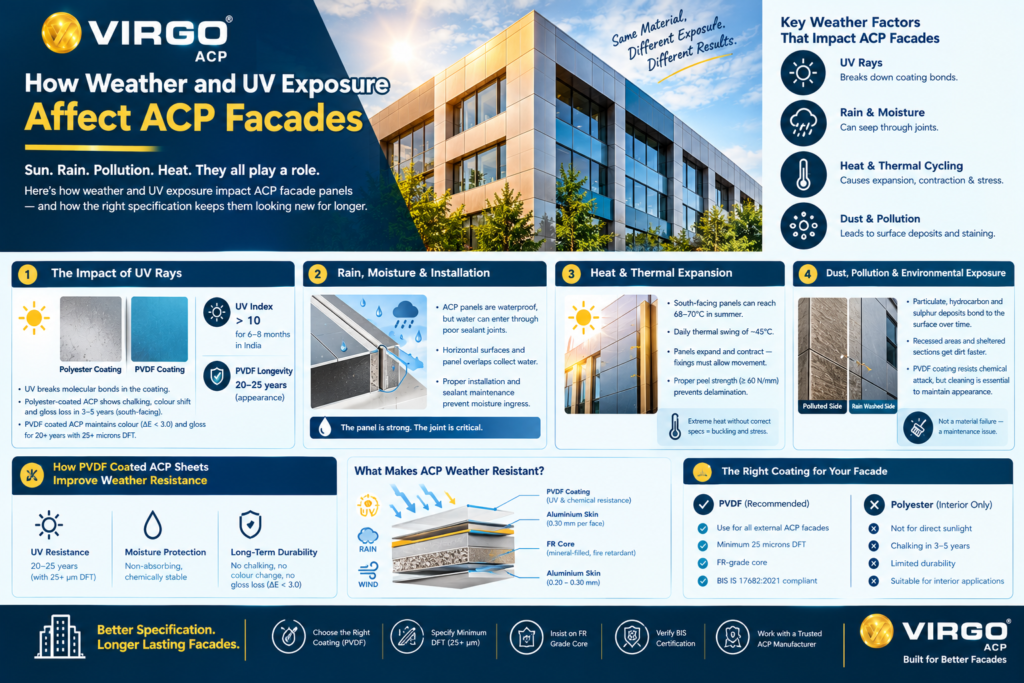
Three years after a commercial tower opened in Bengaluru’s outer ring road corridor, the project architect visited the site for a maintenance review. The ACP facade panels on the south and west elevations had chalked — not dramatically, but visibly. A pale whitish haze on what had been a sharp champagne gold. The north elevation looked exactly as it had at handover. The building had used the same specification on all four elevations: 4mm ACP cladding sheets, ‘PVDF coating,’ FR-grade core. The difference between the north and south ACP facade panels three years on was not the material — it was the UV load each face had endured. The south and west PVDF coated ACP sheets had been applied at 17 microns DFT. At below-minimum DFT, the PVDF resin couldn’t withstand nine months of UV index 10+ without beginning to break down. This is what weather and UV exposure actually do to ACP facade panels — gradual, specific degradation that is entirely predictable and entirely preventable with the correct specification. How Different Weather Conditions Affect ACP Facade Panels Impact of UV Rays on ACP Sheets UV radiation is the dominant weathering mechanism for ACP facade panels in India. The UV index across most of the country exceeds 10 for six to eight months per year. What UV does to ACP sheets is photochemical: high-energy UV photons break molecular bonds in the surface coating binder. For polyester-coated Aluminium Composite Panels, this produces chalking, colour shift, and gloss reduction — typically visible within three to five years on south-facing ACP facade panels. PVDF coated ACP sheets resist this because the fluorine-carbon bond in polyvinylidene fluoride is among the most UV-stable molecular structures in industrial chemistry. Correctly applied at minimum 25 microns DFT, PVDF coated ACP sheets maintain colour (ΔE < 3.0) and gloss for 20+ years on Indian external ACP facade panels. The difference between polyester and PVDF coated ACP sheets on a south-facing Indian facade is not gradual — at year five to seven, polyester-coated building facade materials show visible decline while PVDF coated ACP sheets look essentially unchanged. Effect of Heavy Rain and Moisture on Exterior Wall Cladding Panels Correctly specified ACP cladding sheets are waterproof — the aluminium skins in Aluminium Composite Panels don’t absorb moisture, don’t corrode, and don’t swell. The moisture risk for ACP facade panels is not in the panels — it’s in the installation details around them. Failed or absent sealant at ACP sheets panel joints allows water ingress behind the exterior wall cladding panels. Horizontal surfaces on ACP cladding sheets — ledges, parapet caps, panel overlaps — concentrate monsoon water against building facade materials joint lines, driving moisture into the wall assembly through minor sealant gaps. High Temperatures and Thermal Expansion of ACP Facade Panels A south-facing ACP cladding sheets panel in Nagpur can reach 68–70°C at midday in summer and cool to 25°C overnight — a 45°C daily thermal swing repeating every summer day for twenty years. Aluminium Composite Panels expand and contract predictably with this temperature cycling. When these movement allowances are inadequate — when fixings prevent thermal expansion — the stress transfers into the ACP cladding sheets panel tray itself, producing visible buckling on south-facing exterior wall cladding panels in extreme heat zones. The skin-to-core bond in ACP facade panels is also tested by thermal cycling. Panels with adequate peel strength (60 N/mm minimum per IS 17682:2021) handle this without delamination. Under-specified building facade materials develop edge blistering as the skin-to-core bond progressively weakens. Dust, Pollution and Environmental Exposure of ACP Sheets India’s urban pollution deposits particulate, hydrocarbon residue, and sulphur compounds on ACP facade panels continuously. Surface contamination on exterior wall cladding panels is a maintenance issue rather than a material degradation issue for correctly specified PVDF coated ACP sheets — PVDF doesn’t react with standard industrial pollutants, but contamination deposits bond progressively if not removed. Differential soiling patterns develop on ACP cladding sheets in polluted environments: rain-washed exposed Aluminium Composite Panels faces stay relatively clean; recessed details and sheltered sections accumulate contamination faster. How PVDF Coated ACP Sheets Improve Weather Resistance UV Resistance and Colour Retention PVDF coated ACP sheets at 25+ microns DFT maintain colour (ΔE < 3.0) and gloss for 20–25 years on south-facing Indian ACP facade panels — documented in weatherometer testing at 3000+ hours accelerated exposure. Standard polyester-coated ACP sheets and ACP cladding sheets begin showing UV-driven chalking within three to five years on Indian south-facing ACP facade panels. The visual difference between PVDF coated ACP sheets and polyester ACP facade panels at year seven is not subtle on Indian building facade materials. Protection Against Moisture and Weathering PVDF coated ACP sheets don’t absorb moisture and their coating doesn’t react with the weak acids present in Indian pollution and acid rain. Aluminium Composite Panels with PVDF coating maintain their surface integrity across monsoon-dry season cycles without swelling, lifting, or developing the surface porosity that accelerates staining on other exterior wall cladding panels. Selecting the Right Coating for Exterior ACP Facade Panels For any external ACP sheets application in India, PVDF coating is the correct specification. The additional specification that matters is minimum DFT — 25 microns per face. ‘PVDF coated ACP facade panels’ on a product description is insufficient without DFT confirmation. Two ACP cladding sheets products both described as ‘PVDF coated’ can have 15-micron and 27-micron coatings — with significantly different UV resistance over their service life as building facade materials. Factors That Influence the Lifespan of ACP Facade Panels Panel and Coating Quality PVDF coated ACP sheets from a BIS IS 17682:2021 certified manufacturer with current NABL-accredited test documentation represent the quality baseline for external ACP facade panels. The combination of FR-grade core, 0.30mm aluminium skin per face, and PVDF coating at 25+ microns DFT is the specification for ACP cladding sheets that perform across India’s full climate range. Aluminium Skin Thickness and Core Specification ACP cladding sheets with 0.30mm aluminium skin per face on external ACP facade panels provide surface rigidity,