
ACP vs HPL vs Glass: Which Facade Material Is Right for Your Project?
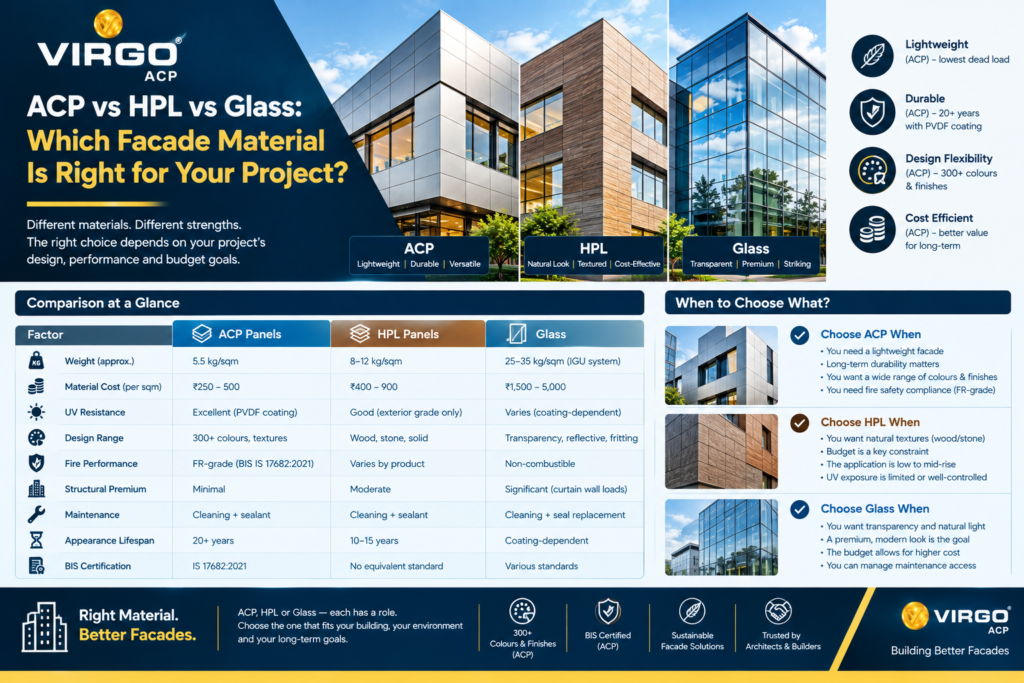
A project architect working on a mixed-use development in Bengaluru had three materials shortlisted: ACP panels on the office tower, HPL on the retail podium, and glass on the corner feature element. Each had a specific application where it genuinely outperformed the others. Then the client asked whether all three could be unified into one material. The architect’s answer was instructive: ACP vs HPL vs Glass is not a ranking of which is ‘best’ — it’s a selection tool for matching building facade materials to specific application requirements. No single material wins all categories for all projects. What changes is which performance criteria matter most for each specific part of the brief. This guide works through the ACP vs HPL vs Glass comparison systematically. Aluminium Composite Panels: Construction and Applications Aluminium Composite Panels are three-layer panels — two aluminium skins bonded to a core — installed on an aluminium subframe in a ventilated cavity ACP facade panels system. Every serious Aluminium composite panel manufacturer offers PVDF-coated ACP panels for external applications: UV-resistant for 20+ years, available in 300+ colours. Any reputable ACP panels supplier in India can provide FR-grade core and PVDF coating with BIS IS 17682:2021 certification. ACP panels are the most widely used external building facade materials in Indian commercial construction because they balance lightweight performance, design flexibility, installation speed, and cost across a wide range of exterior wall cladding panels applications. HPL (High-Pressure Laminate): Construction and Applications High-pressure laminate is a compressed sandwich of resin-impregnated paper layers — typically 6–12mm thick for facade applications. HPL facade panels are available in wood-grain and stone-effect surfaces that achieve naturalistic appearances at close viewing distance. HPL is heavier than ACP facade panels (approximately 8–12 kg/sqm versus 5.5 kg/sqm for ACP panels) but significantly lighter than natural stone. HPL has specific limitations in Indian external conditions: direct UV exposure causes chalking and surface degradation in standard HPL formulations. Exterior-grade compact HPL specifically formulated for UV resistance must be specified. For the ACP vs HPL vs Glass comparison in full-sun Indian conditions, PVDF-coated ACP facade panels from a quality Aluminium composite panel manufacturer demonstrate superior UV resistance to most HPL products. Architectural Glass: Types and Facade Applications Architectural glass in building facade materials includes clear and tinted float glass in curtain wall systems, reflective glass, laminated safety glass, and insulated glass units. Glass delivers transparency, reflectivity, and light interaction that no opaque exterior wall cladding panels material can replicate. It is also the most technically complex and expensive facade material in the ACP vs HPL vs Glass comparison — requiring specialist curtain wall engineering and significantly higher maintenance access cost. ACP vs HPL vs Glass: Full Comparison Table Factor ACP Panels / ACP Facade Panels HPL Glass Weight 5.5 kg/sqm — ACP panels supplier in India 8–12 kg/sqm 25–35 kg/sqm (IGU curtain wall system) Material cost ₹250–500/sqm — ACP facade panels PVDF FR ₹400–900/sqm — compact HPL exterior ₹1,500–5,000/sqm — curtain wall system UV resistance Excellent — PVDF ACP panels — Aluminium composite panel manufacturer Good — exterior-grade HPL only Varies — coating-dependent on glass Design range 300+ colours, textures — ACP panels supplier in India Wood, stone, solid finishes Transparency, reflectivity, fritting Fire performance FR-grade ACP facade panels — BIS IS 17682:2021 Fire performance varies by product Non-combustible glass Structural premium Minimal — ACP panels Moderate Significant — curtain wall loads Maintenance Cleaning + sealant — ACP facade panels Cleaning + sealant — HPL Cleaning (access-intensive) + seal replacement Appearance lifespan 20+ years — PVDF ACP panels from Aluminium composite panel manufacturer 10–15 years exterior HPL Coating-dependent BIS certification IS 17682:2021 — Aluminium composite panel manufacturer No equivalent standard Various glass standards Weight and Structural Requirements in ACP vs HPL vs Glass In the ACP vs HPL vs Glass comparison, ACP panels are the lightest opaque building facade materials. At 5.5 kg/sqm for a complete ACP facade panels system from any qualified Aluminium composite panel manufacturer or ACP panels supplier in India, the dead load is minimal. HPL facade panels weigh 8–12 kg/sqm — heavier than ACP panels but manageable. Glass curtain wall systems impose 25–35 kg/sqm — the structural premium for glass versus ACP facade panels is substantial. Weather Resistance and Indian Climate Performance UV exposure in ACP vs HPL vs Glass PVDF-coated ACP panels from a reputable Aluminium composite panel manufacturer maintain colour and gloss for 20+ years under India’s UV index 10+ conditions. Exterior-grade HPL typically shows surface degradation after 10–15 years on south-facing facades in western India. ACP facade panels consistently outperform HPL in UV resistance in the ACP vs HPL vs Glass comparison for Indian external facade applications. Rain and moisture ACP facade panels are waterproof — the aluminium skins are impermeable. HPL is relatively moisture-resistant but joint detailing is critical in high-monsoon Indian climates. Glass is impermeable; water management is entirely a joint and seal design issue. For exterior wall cladding panels, ACP panels and glass both handle monsoon rainfall without panel degradation; HPL requires careful edge and joint sealing. Design and Appearance in ACP vs HPL vs Glass ACP panels from a quality Aluminium composite panel manufacturer or ACP panels supplier in India are available in 300+ colours — solid, metallic, wood-effect, stone-effect, mirror, and specialty finishes — with consistent batch colour across large installations. HPL offers wood-grain and stone-effect surfaces that read convincingly at close viewing distance — an advantage over ACP facade panels for ground-level elements. Glass offers transparency — the one design quality that neither ACP panels nor HPL can replicate as building facade materials. Maintenance and Long-Term Care ACP panels maintenance Cleaning twice per year for standard urban exterior wall cladding panels; three to four times in high-pollution environments. Individual ACP facade panels are replaceable without affecting adjacent panels. A quality ACP panels supplier in India can match panels from shade code for future replacement. Glass maintenance Cleaning is the primary maintenance requirement — but access for high-rise glass facades is expensive. High-rise glass requires specialist cleaning equipment, rope