
What to Check in an Aluminium Composite Panels Technical Datasheet
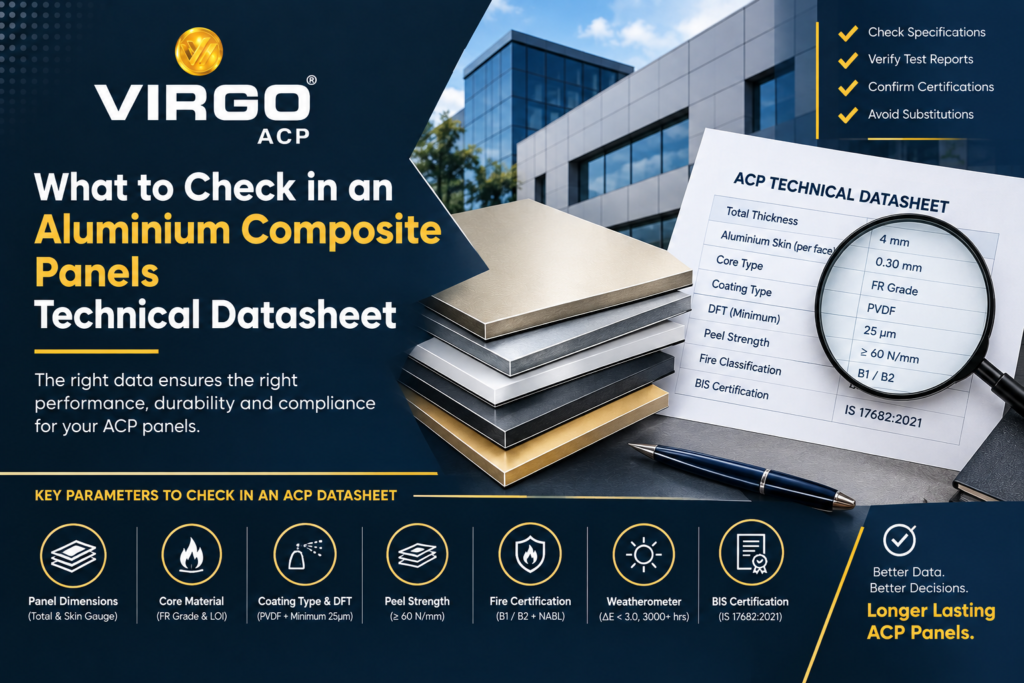
The approved sample was a perfectly acceptable champagne gold Aluminium Composite Panels finish. The delivered ACP panels were a lighter, cooler variation — not dramatically different, but invisible when comparing two adjacent ACP panels and obvious when comparing the first three floors to the top two installed months later. The datasheet for these aluminium composite panels said: ‘champagne gold, PVDF coated ACP sheets, 4mm.’ No minimum DFT, no peel strength, no shade code. It was signed off because it contained all the words that sounded correct. What an Aluminium Composite Panels technical datasheet doesn’t say is as important as what it says. Knowing which values should be present — and what their absence signals — is the reading skill for ACP panels specification. Panel Dimensions in Aluminium Composite Panels Datasheets Total thickness is the first number on any Aluminium Composite Panels datasheet — and the least informative on its own. A 4mm ACP panels entry can represent 0.18mm to 0.50mm aluminium skins per face. The difference between 0.20mm and 0.30mm skins in 4mm ACP panels is surface rigidity, dent resistance, fabrication depth, and coating substrate quality. If the Aluminium Composite Panels datasheet states only ‘4mm ACP panels’ without skin gauge per face, ask explicitly before accepting the specification. An ACP panels supplier who can’t provide this number has a reason for that choice. Core Material Data in ACP Panels Datasheets The Aluminium Composite Panels datasheet should provide fire performance evidence alongside the FR grade ACP panels designation — not just a label: Fire classification for FR grade ACP panels: B1 or B2 under DIN 4102, or equivalent IS 17682:2021 FR classification. These are different fire performance levels — the Aluminium Composite Panels datasheet must specify which for FR grade ACP panels. Limiting oxygen index (LOI) for FR grade ACP panels: FR grade ACP panels typically show LOI above 26%. Products at exactly 26% have minimal margin above ambient air. Core density in ACP panels: FR grade ACP panels are denser than PE-core ACP panels due to mineral filler — density data confirms fire-resistance loading is present. Coating Data: The Most Critical Section of Any Aluminium Composite Panels Datasheet Coating type named explicitly for ACP panels ‘PVDF,’ ‘FEVE,’ or ‘polyester’ — not ‘premium exterior coating.’ The resin system determines UV resistance of the ACP panels over the facade’s service life. DFT stated as minimum for PVDF coated ACP sheets Nominal DFT of 25μm for ACP panels means the average is 25μm — some areas of PVDF coated ACP sheets may be below. Minimum DFT of 25μm means no compliant area of the Aluminium Composite Panels falls below this. For UV performance of ACP panels, the minimum matters. Weatherometer performance data for PVDF coated ACP sheets Quality PVDF coated ACP sheets show 3000+ hours of accelerated weatherometer exposure with ΔE below 3.0, gloss retention above 50% of initial, and no chalking on Aluminium Composite Panels. ΔE below 3.0 for PVDF coated ACP sheets means colour change after weathering is not visible to the naked eye. Peel Strength: Bond Quality Indicator in ACP Panels Peel strength — force to separate the aluminium skin from the core in ACP panels per unit width, in N/mm — governs resistance of Aluminium Composite Panels to delamination under thermal cycling. IS 17682:2021 minimum: 60 N/mm for external ACP panels. An Aluminium Composite Panels datasheet omitting peel strength is omitting a fundamental ACP panels quality indicator. Aluminium Composite Panels Datasheet Verification Table Datasheet Parameter What Complete Aluminium Composite Panels Datasheet Shows What to Question for ACP Panels Total thickness + skin gauge Both stated separately for ACP panels Only total Aluminium Composite Panels thickness Core type FR grade ACP panels with classification and test data ‘FR grade ACP panels’ label only — no classification PVDF coated ACP sheets coating Resin system named explicitly ‘Premium coating’ without resin system for ACP panels DFT for PVDF coated ACP sheets Minimum DFT stated per face Nominal or average DFT only in ACP panels datasheet Weatherometer performance Hours, ΔE, gloss retention for Aluminium Composite Panels ‘Weather resistant’ without quantified data for ACP panels Peel strength of ACP panels N/mm value, minimum, test method Absent from Aluminium Composite Panels datasheet FR grade ACP panels fire cert NABL lab, product-specific, current Non-accredited lab or generic scope for ACP panels BIS certification of ACP panels Verifiable licence number Certificate without verifiable number Frequently Asked Questions Q. What are the most critical values in an Aluminium Composite Panels datasheet for external facades? Ans. Minimum coating DFT for PVDF coated ACP sheets and peel strength for ACP panels. PVDF coated ACP sheets at minimum 25 microns DFT governs UV resistance. ACP panels peel strength at 60+ N/mm governs delamination resistance under thermal cycling. Both should be minimum values — not averages — in the Aluminium Composite Panels datasheet. Q. What is ΔE in Aluminium Composite Panels coating specification? Ans. Delta-E measures colour difference between original ACP panels colour and colour after accelerated weathering. ΔE below 3.0 for PVDF coated ACP sheets means colour change is not visible to the naked eye. Aluminium Composite Panels with ΔE above 3.0 will show visible colour shift on installed ACP panels facades over time. Q. What does FR grade ACP panels fire classification B1 vs B2 mean? Ans. B1 (non-flammable) and B2 (normally flammable) are different fire performance classifications under DIN 4102 for FR grade ACP panels. B1 aluminium composite panels provide higher fire resistance than B2 ACP panels. The specific FR grade ACP panels classification required should be confirmed against the building’s occupancy classification. Q. Why does skin thickness matter when Aluminium Composite Panels total thickness is specified? Ans. Two ACP panels with identical total thickness can have very different skin gauges. A 4mm ACP panels product with 0.20mm skins is interior specification. A 4mm Aluminium Composite Panels product with 0.30mm skins is the correct external specification for ACP facade panels. Q. What weatherometer performance should quality PVDF coated ACP sheets show? Ans. 3000+ hours of accelerated weathering
How to Select ACP Panels for Commercial, Residential and Industrial Projects
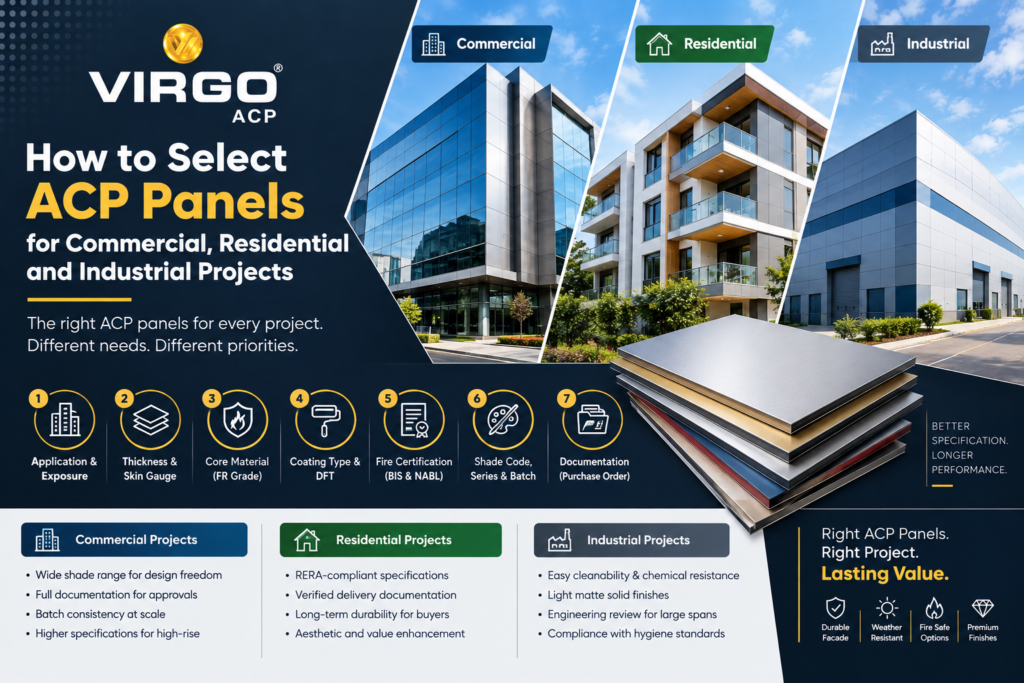
Three clients, three conversations, the same product category. An architect on a Hyderabad corporate headquarters asks whether champagne gold metallic ACP panels will hold their reflective quality on a west-facing elevation for twenty years. A residential developer in Thane under RERA asks whether the ACP sheets specification in their project documents will survive a buyer’s material verification at possession. A pharmaceutical facility procurement manager in Baddi asks which aluminium composite panels surface is easiest to clean with the specified disinfectant. Same category — ACP panels. Entirely different conversations. Selecting aluminium composite panels isn’t about which product is ‘better’ — it’s about which ACP panels variables matter for each specific project type. Commercial Projects: ACP Panels Where Design Meets Documentation ACP panels shade range determines design freedom A 60-shade aluminium composite panels catalogue forces design compromises on ACP sheets specifications. A 300-shade catalogue across 16 ACP panels series allows architects to specify the aluminium composite panels the design requires. For corporate identity on ACP facade panels, this is a commercial requirement. Aluminium Composite Panels documentation for building authority submissions Commercial ACP panels projects require BIS IS 17682:2021 certification, NABL-accredited test reports for FR-grade aluminium composite panels, and invoices tracing delivered ACP sheets back to the certified manufacturer. These are submission requirements — not optional ACP panels administrative documents. ACP panels batch consistency at commercial scale A significant commercial building installs aluminium composite panels over weeks to months. Without production capacity to hold a full ACP panels project batch, shade variation between ACP sheets deliveries reads as a visible division line across the completed ACP facade panels facade. High-rise ACP panels specification Above 30 metres, a structural engineer’s wind load assessment should precede ACP panels thickness selection. Standard 4mm aluminium composite panels may be under-specified for upper floor ACP facade panels in high-wind zones. Residential Projects: Aluminium Composite Panels Specification Under RERA RERA has changed what ACP panels specification means for residential developers. Material specifications in RERA-registered project documents are legal commitments for aluminium composite panels. ACP sheets specifications must be verifiable under RERA ‘ACP panels‘ is not verifiable in a RERA context. ‘4mm FR-grade PVDF aluminium composite panels, shade [code], manufacturer [name]’ is verifiable. This difference in ACP sheets documentation is the difference between a RERA filing that protects the developer and one that creates exposure. Aluminium Composite Panels delivery documentation must be retained BIS certificate, NABL test reports, and ACP panels delivery invoices must be in the project file through the statutory defect liability period. ACP panels longevity matters to buyers The developer completes the residential project and moves on. The buyer observes the ACP facade panels for fifteen to twenty years. Polyester-coated ACP sheets that begin chalking at year six affect buyer experience and developer reputation long after possession. Industrial Projects: ACP Panels Specification for Performance and Cleanability Cleanability is the primary ACP panels criterion for industrial facades Pharmaceutical, food processing, and healthcare facilities must specify ACP sheets compatible with their cleaning protocols. PVDF coatings on aluminium composite panels are chemically resistant to most industrial cleaning agents — confirm specific formulations against ACP panels chemical resistance data. Light matte solid ACP panels are standard for industrial Industrial hygiene environments require ACP sheets that show contamination clearly. Light-coloured matte solid PVDF ACP panels meet this requirement. Dark or textured aluminium composite panels are inappropriate for environments where contamination visibility is a compliance requirement for ACP facade panels. Large spans require ACP panels engineering review Industrial buildings have bay widths that may require 6mm ACP panels or closer subframe spacing rather than standard 4mm aluminium composite panels. ACP Panels Selection by Project Type Factor Commercial ACP Panels Residential Aluminium Composite Panels Industrial ACP Facade Panels Shade range priority High — ACP panels design intent Moderate — RERA ACP sheets spec Low — functional ACP panels colour Core type FR-grade ACP panels required FR-grade aluminium composite panels required FR-grade ACP panels; verify occupancy Coating on ACP sheets PVDF 25μm+ PVDF 25μm+ PVDF 25μm+ + chemical review for ACP panels Finish priority Design-led ACP panels range ACP facade panels durability + aesthetics Light matte solid ACP sheets — cleanability ACP panels documentation BIS, NABL, building authority BIS, NABL, RERA compliance BIS, NABL, fire classification for ACP panels Batch consistency Critical for ACP panels at scale Critical for multi-building aluminium composite panels Moderate for smaller ACP panels installations Frequently Asked Questions Q. What ACP panels specification is standard for commercial building facades in India? Ans. 4mm total thickness, 0.30mm aluminium skin per face, FR-grade core, PVDF coating at minimum 25 microns DFT, BIS IS 17682:2021 certified aluminium composite panels. For high-rise ACP facade panels above 30 metres, review whether 6mm ACP sheets are appropriate based on wind load assessment. Q. How does RERA affect aluminium composite panels specification for residential projects? Ans. RERA-filed residential projects legally require installed ACP panels match registered specifications. Aluminium composite panels specs need shade code, series, manufacturer, coating type, and core grade. ACP sheets delivery documentation must be retained through the defect liability period. Q What makes industrial ACP facade panels specification different from commercial? Ans. Cleanability requirements, chemical exposure profile, and structural spans that may require 6mm ACP panels or closer subframe spacing. Industrial aluminium composite panels also require light-coloured matte solid finishes for hygiene visibility, and cleaning chemicals must be confirmed compatible with ACP sheets coating. Q. What ACP panels shade range should I look for when specifying commercial aluminium composite panels? Ans. A manufacturer offering 300+ shades across 16 ACP panels series provides the range to meet specific design briefs without compromise. Aluminium composite panels suppliers with 60-shade catalogues consistently force design concessions in ACP facade panels specifications. Full Virgo ACP panels range at virgoacp.com/products/ · ACP sheets specification support at virgoacp.com/contact/