
How an Aluminium Composite Panel Manufacturer Makes ACP Sheets
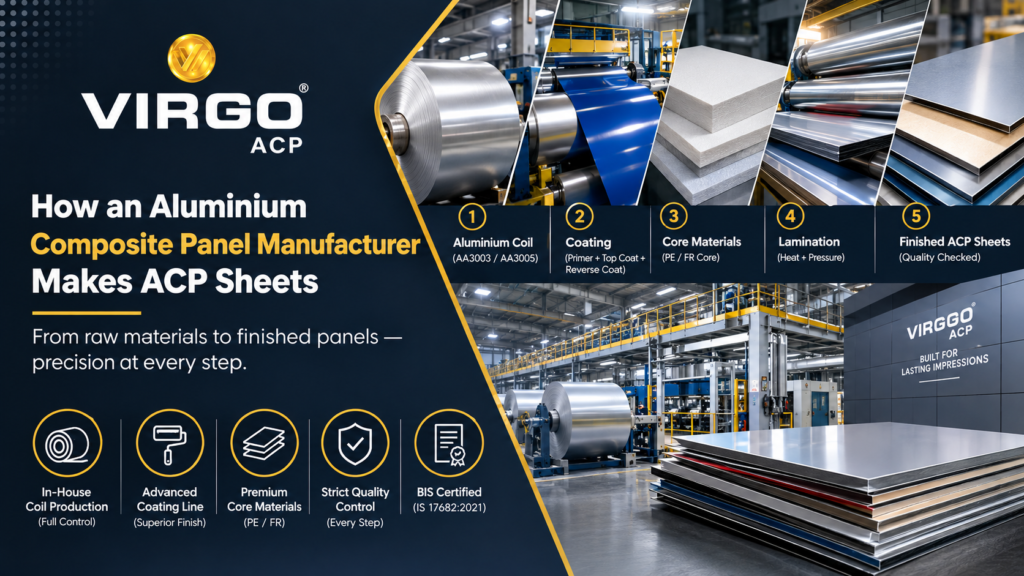
A quality audit comparing two operations reveals something most buyers never ask. Two facilities both describe themselves as an aluminium composite panel manufacturer producing ‘4mm PVDF-coated ACP panels.’ The first controls everything — raw coil, coating line, lamination press. The second buys pre-coated coil from aluminium composite panel suppliers and runs it through a laminator. The first aluminium composite panel manufacturer provides cure temperature data, DFT variance, and batch peel strength distribution. The second ACP sheets manufacturer in India tells you what the coil supplier said. Both hold BIS IS 17682:2021 certification. In three years on a south-facing Indian facade, the two sets of ACP panels will show the difference. Stage 1: Aluminium Coil — Where Every Aluminium Composite Panel Manufacturer Begins ACP panels start as aluminium alloy coil — typically AA3003 or AA3005, rolled to between 0.20mm and 0.50mm gauge. This gauge directly determines skin thickness in the finished ACP panels. An aluminium composite panel manufacturer who controls their own coil production controls this specification. Aluminium composite panel suppliers buying pre-coated coil inherit whatever the coil supplier applied. Before coating, every serious ACP sheets manufacturer in India runs two-stage pre-treatment on coil: alkaline cleaning followed by a conversion coating creating adhesion-active bonding sites. Pre-treatment failure is the invisible defect in ACP panels — undetectable at delivery but visible as coating lifting on installed ACP panels under UV and thermal cycling. An aluminium composite panel manufacturer who controls pre-treatment prevents this upstream. Stage 2: Coating — Where an ACP Sheets Manufacturer in India Adds Surface Performance On the continuous coating line, three layers are applied to ACP panels coil: Primer (5–8 microns DFT) on ACP panels Bonds to the pre-treated aluminium. Chemistry is matched to the top coat — a PVDF ACP panels top coat requires primer formulated to bond to PVDF resin. Every quality aluminium composite panel manufacturer specifies primer chemistry to match their ACP panels top coat system. Top coat (20–25+ microns DFT) on ACP panels The exterior-visible surface. For PVDF ACP panels: fluoropolymer paint at minimum 25 microns DFT. The DFT is the specification governing UV performance of the finished ACP panels — any ACP sheets manufacturer in India should provide this data on their technical datasheet. Reverse coat (8–12 microns) on ACP panels Applied to the interior face — corrosion protection and bondable substrate for the lamination adhesive in ACP panels. Each coating layer is oven-cured immediately, with cure cycle determining the ACP panels coating’s crosslink density. Stage 3: Core Materials in ACP Panels PE-core ACP panels Thermoplastic, lightweight, and combustible. Appropriate for interior ACP panels applications only. Any reputable aluminium composite panel manufacturer clearly marks PE-core ACP panels as interior use only in their product documentation. FR-core ACP panels Mineral fillers — aluminium hydroxide or magnesium hydroxide — that suppress combustion through an endothermic reaction when exposed to fire heat. FR-core ACP panels are required for external facades on multi-storey buildings. Every credible ACP sheets manufacturer in India provides fire test certificates from NABL-accredited laboratories for FR-core ACP panels. Aluminium composite panel suppliers offering FR ACP panels without independent test data are suppliers to question. Stage 4: Lamination — The Bond Quality in ACP Panels In continuous lamination, two coated coil feeds and core material enter the press simultaneously, bonded under controlled temperature and pressure to produce ACP panels. The quality metric is peel strength: force to separate the aluminium skin from the core in ACP panels per unit width, in N/mm. IS 17682:2021 minimum: 60 N/mm for external ACP panels. The most reliable assessment of an aluminium composite panel manufacturer’s lamination quality is peel strength data across multiple production batches. Any serious ACP sheets manufacturer in India tests peel strength on every production run — not just on request from aluminium composite panel suppliers. Stage 5: Quality Control at Every ACP Panels Production Step Incoming coil — alloy, gauge, and surface quality checked before ACP panels coating line Coating application on ACP panels — wet film thickness monitored in real time; cured DFT spot-checked after each oven pass Lamination of ACP panels — peel strength tested from every production run; flatness verified Final ACP panels inspection — visual check for coating defects, dimensional accuracy BIS IS 17682:2021 certification — requires NABL-accredited laboratory testing; licence for ACP panels verifiable at bis.gov.in Frequently Asked Questions Q. What is the difference between an aluminium composite panel manufacturer and aluminium composite panel suppliers? Ans. An aluminium composite panel manufacturer controls ACP panels production from raw material through finished panel — coil, coating, and lamination. Aluminium composite panel suppliers typically purchase finished or semi-finished ACP panels from manufacturers and resell them without production control. Q.What does BIS IS 17682:2021 mean for ACP panels from an ACP sheets manufacturer in India? Ans.The Bureau of Indian Standards specification for ACP panels, covering minimum requirements for peel strength, coating adhesion, dimensional tolerances, weatherometer performance, and fire classification. Any credible ACP sheets manufacturer in India should hold a current BIS licence verifiable at bis.gov.in. Q.What is the difference between PE and FR core in ACP panels? Ans. PE-core ACP panels are combustible — interior use only. FR-core ACP panels use mineral fillers suppressing combustion — required for external facades on multi-storey buildings. Every aluminium composite panel manufacturer should clearly designate which core type appears in each product in their ACP panels range. Why does in-house coil production matter when choosing an aluminium composite panel manufacturer? Ans. An ACP sheets manufacturer in India producing their own coils controls alloy selection, pre-treatment quality, and coating specification upstream for their ACP panels. This enables consistent batch-to-batch quality that aluminium composite panel suppliers assembling from bought-in materials cannot guarantee. Virgo ACP — aluminium composite panel manufacturer with in-house coil production. ACP panels specifications at virgoacp.com/