
What is ACP Sheet? Types, Benefits, Applications & Price Factors Explained
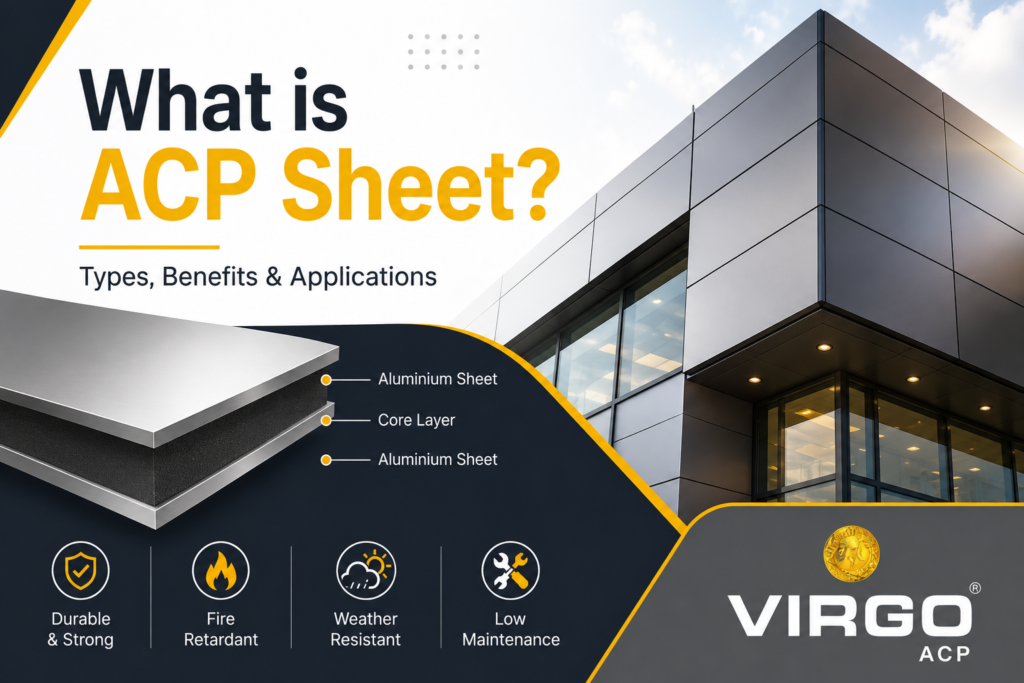
Walk past almost any modern showroom, hospital, or office tower today and there is a fair chance you are looking at an ACP sheet without realising it. Aluminium Composite Panels, or ACP sheets, have quietly become the material of choice for architects and builders across India who want a facade that looks sharp, survives the weather, and does not demand constant upkeep. At Virgo ACP, we get asked almost every week what an ACP sheet actually is, so this guide breaks it down in plain language, what it is made of, the types available, the benefits it brings, where it is used, and what actually drives its price. What is an ACP Sheet? An ACP Sheet is a flat panel made of two thin aluminium sheets bonded to a non-aluminium core in between, usually a low-density polyethylene or a fire-retardant mineral compound. Think of it as a sandwich aluminium on the outside for strength and finish, a lightweight core in the middle for rigidity and weight reduction. This construction gives the panel a rare combination: it is light enough to install quickly on a building’s exterior, yet strong enough to hold its shape for decades against sun, rain, and pollution. Structure of an ACP Sheet Understanding what goes into a panel helps explain why quality varies so much between brands. A genuine ACP sheet has four distinct layers working together. Top Aluminium Layer This is the visible face of the panel, coated and finished in the colour or texture the customer chooses. Its thickness and alloy grade determine how well the panel resists dents and scratches on site. Core Material Sitting between the two aluminium sheets, the core decides the panel’s fire behaviour. A polyethylene core keeps costs low but burns readily, while a mineral-filled FR (fire-retardant) core is designed to resist flame spread a difference that matters enormously on tall buildings. Bottom Aluminium Layer The second aluminium sheet mirrors the top layer and completes the rigid sandwich structure, giving the panel its flatness and load-bearing capability. Coating Layer The coating sits above the top aluminium layer and is what actually faces the sun, rain, and pollution every single day. PVC and Standard Coatings Entry-level panels typically carry a basic polyester coating. It looks fine on day one, but under direct sun exposure it tends to chalk and fade within a couple of years, especially in India’s harsher climate zones. PVDF Coating PVDF coated ACP sheets use a fluoropolymer-based coating that is far more resistant to UV degradation. This is the coating Virgo ACP relies on for its premium range, because it is built to hold colour and gloss for much longer under real outdoor conditions. Why PVDF Matters for Indian Buildings India’s climate swings between intense summer heat, monsoon humidity, and heavy urban pollution a combination that is unusually tough on exterior coatings. This is exactly the environment PVDF coated ACP sheets are engineered to handle. Weather Resistance PVDF resists moisture ingress and does not soften or crack the way lower-grade coatings can after repeated monsoon cycles. Colour Retention Because the fluoropolymer bond is chemically stable, PVDF-coated panels resist chalking and colour shift far longer than standard coatings, keeping a facade looking new for years. Types of ACP Sheets Not every ACP panel is built for the same job. Panels are broadly classified by their core, and choosing the right one is as important as choosing the right colour. FR Grade (Fire Retardant) FR grade panels use a mineral-filled core designed to slow the spread of fire. This is now the standard specification for most commercial and high-rise projects in India, and it is what Virgo ACP recommends for any building above a few storeys. Non-FR Grade These use a plain polyethylene core. They cost less but offer minimal fire resistance, which limits where they can responsibly be used typically low-rise or budget interior work only. A2 Fire Rated At the top end sits the A2 fire-rated panel, built with a near-non-combustible mineral core for projects where fire safety codes are strictest, such as hospitals, airports, and high-occupancy towers. Benefits of Using ACP Sheets The reason ACP has replaced older cladding materials on so many projects comes down to a handful of practical advantages. Applications of ACP Sheets ACP panels have moved well beyond office buildings and now show up across almost every type of construction. Commercial Buildings Corporate offices, malls, and hotels use ACP extensively for facades because it delivers a premium, uniform look at a fraction of the cost and weight of stone. Residential Facades Homeowners increasingly choose ACP for balconies, boundary walls, and elevation upgrades, since it transforms a building’s appearance without heavy structural work. Interior Applications Reception walls, false ceilings, and partition panels frequently use ACP for its clean finish and ease of fabrication into custom shapes. Signage and Branding Because the surface takes print and cutting well, ACP is a favourite base material for shop signage, hoardings, and branded storefronts. Price Factors of ACP Sheets Customers comparing quotes are often surprised by how much prices vary between suppliers for what looks like the same panel. A handful of factors explain the gap. Thickness Panels typically range from 3mm to 6mm. Thicker panels cost more but offer better rigidity for larger facade spans. Coating Type A PVDF coated ACP sheet costs more upfront than a standard-coated panel, but the extended lifespan and colour retention usually make it the better long-term investment. Core Quality FR and A2 grade cores cost more to manufacture than plain polyethylene cores, and this is reflected directly in the price per square metre. Manufacturer and Supplier Pricing also depends heavily on who you buy from. Working with an established Aluminium Composite Panel Manufacturer rather than an unbranded trader usually means better raw material consistency, proper certification, and a warranty that actually holds up. When comparing ACP panels supplier in India options, it is worth asking for test certificates rather than choosing on price alone, since two panels that look identical