
FR Grade ACP Panels: Why Fire-Rated Cladding is Mandatory for Commercial Buildings
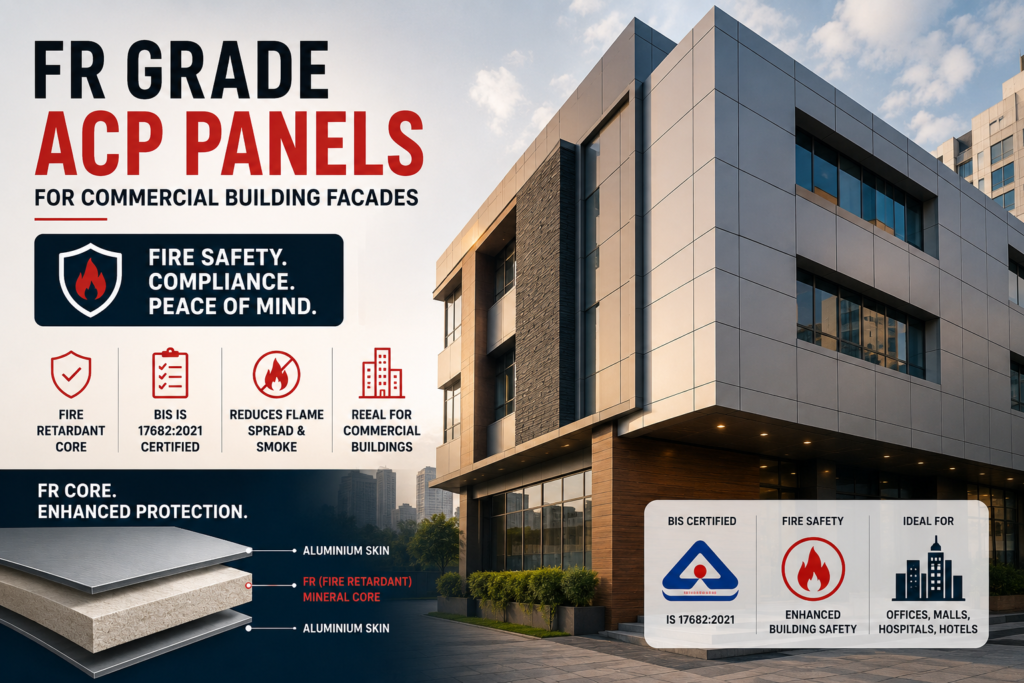
Here is something that rarely gets said in a specification meeting: a significant share of commercial buildings going up in Indian cities right now are being clad with panels that have no business being on an exterior facade. On 14 June 2017, the Grenfell Tower fire in London killed 72 people. Post-incident investigation identified one material as the primary accelerant of flame spread across the building’s exterior PE core cladding panels that ignited, melted, and carried fire up 20 floors in under 30 minutes. Closer home, the 2017 Kamala Mills fire in Mumbai while interior in origin reshaped how Indian regulators, insurers, and fire authorities think about occupancy, materials, and accountability in commercial spaces. These incidents changed the regulatory conversation in India. What they haven’t changed, unfortunately, is what you’ll sometimes find on construction sites PE core ACP panels being installed on commercial exteriors where they plainly don’t belong. The reason isn’t ignorance. It’s margin. A PE core panel is typically 20–30% cheaper than an equivalent FR grade ACP panel. On a 10,000 sq. metre facade, that price gap looks appealing in a budget review. What it doesn’t show is the regulatory liability, the insurance exposure, and in the worst scenario what happens when that building catches fire. This article is for every architect, project developer, and procurement manager who specifies exterior wall cladding panels for commercial construction. Here’s what you need to know all of it, including the parts most suppliers skip. So What Actually Makes a Panel “FR Grade”? ACP Aluminium Composite Panel is three layers: two thin aluminium skins bonded to a core in the middle. The aluminium itself doesn’t burn. The core very much can. Standard ACP panels use a Polyethylene (PE) core. Polyethylene belongs to the same material family as plastic bags and plastic film packaging. It melts at around 120°C, ignites readily, and when it burns, it drips carrying flaming droplets down and outward across a facade surface. This is the exact mechanism behind the Grenfell Tower fire’s rapid external spread. FR grade ACP panels swap the PE core for a mineral-filled fire-retardant compound typically aluminium hydroxide or magnesium hydroxide. Both materials release water vapour when thermally stressed, which actively cools the core and suppresses combustion. When an FR core reaches its thermal limit, it chars and holds position. It doesn’t melt. It doesn’t drip. That distinction is the difference between a contained fire and one that climbs your building. Above FR, there’s A2 the highest classification. A2 core panels are non-combustible by European EN 13501-1 standards and don’t sustain burning at all. For tall buildings, hospitals, and complex-evacuation structures, A2 is increasingly the specification floor. One thing worth saying clearly: FR grade is not fireproof. No external cladding system is. What it does is buy time and in a building fire, time is what enables evacuation. Core Type Grade Fire Behaviour Smoke Output Typical Use PE Core Standard Burns, melts and drips fast Dense, toxic Interior / low-rise residential only FR Core Fire-Retardant Chars and holds limited spread Significantly less Commercial facades, mid-to-high-rise A2 Core Non-Combustible Does not sustain burning Minimal High-rise 30m+, hospitals, airports The Regulatory Picture in India And Why It’s Getting Stricter Let’s deal with the compliance question directly, because this is where most specification conversations get muddled. India’s National Building Code 2016, Part 4 (Fire and Life Safety), requires fire-resistant construction materials for buildings based on their occupancy classification and height. The affected occupancy groups are not obscure edge cases they are the bulk of what gets built commercially: Group B (business/offices), Group C (institutional, including hospitals), Group D (assembly, including malls and auditoriums), and Group E (industrial). For all of these, exterior wall cladding panels fall within the scope of fire resistance requirements. Specifying uncertified PE core panels on any of these buildings is a code violation the kind that can invalidate an occupancy certificate and void your professional indemnity cover. BIS IS 17682:2021 – The Certification That Actually Matters The product standard for aluminium composite panels in India is BIS IS 17682:2021. It covers fire reaction, dimensional tolerances, peel strength, bond strength, and coating durability. A manufacturer holding active BIS certification under this standard has put their panels through independent third-party testing and passed. This certificate verifiable on the BIS India portal at bis.gov.in is your baseline compliance document. Not a brochure, not a price list, not a verbal assurance from a sales representative. State-Level Directives Have Tightened Things Further Following international facade fire incidents, Maharashtra, Delhi, Gujarat, and Telangana have each issued directives requiring submission of fire test documentation during building permit review. In several jurisdictions, fire NOC issuance is now conditional on the facade material meeting minimum FR standards and fire authorities are actively checking. If you’re working on a commercial project in any of these states and you haven’t confirmed the specific cladding requirement with the local fire NOC authority before finalising specification, that conversation needs to happen before the facade goes to tender. The Insurance Angle (Which Most Specifications Ignore) Commercial property insurers have started asking about facade cladding material during policy underwriting. A building with PE core ACP panels on the exterior can face premium loading, fire-related exclusion clauses, or outright rejection. In the event of a fire claim where non-FR cladding is identified as a contributing factor, the building owner’s liability exposure goes significantly beyond the insurance payout. This is not a theoretical risk it’s a conversation that building owners are having with their insurers after projects are complete, and it feeds back to the architect’s specification decision. The Honest Conversation About Why PE Core Still Gets Specified This section won’t appear in most manufacturer brochures, but it should be said. PE core ACP is cheaper typically 20–30% per square metre. On a large commercial facade, that is a real number. Procurement teams see it. Developers feel it during value engineering. Some suppliers exploit this. There are documented cases, and the BIS enforcement wing has acted on several of them,